Best Night Vision Goggles for Hunting a Buyer’s Guide
If you're looking for the short answer, here it is: for most hunters, the best night vision goggles for hunting are a Gen 3 monocular like the PVS-14. It's the perfect sweet spot of performance, versatility, and value. But if you have the budget and need top-tier depth perception for tracking fast-moving targets, nothing beats a set of dual-tube binoculars.
This guide will walk you through the critical choices you'll need to make to truly own the night.
Choosing the Right Night Vision Goggles for Hunting
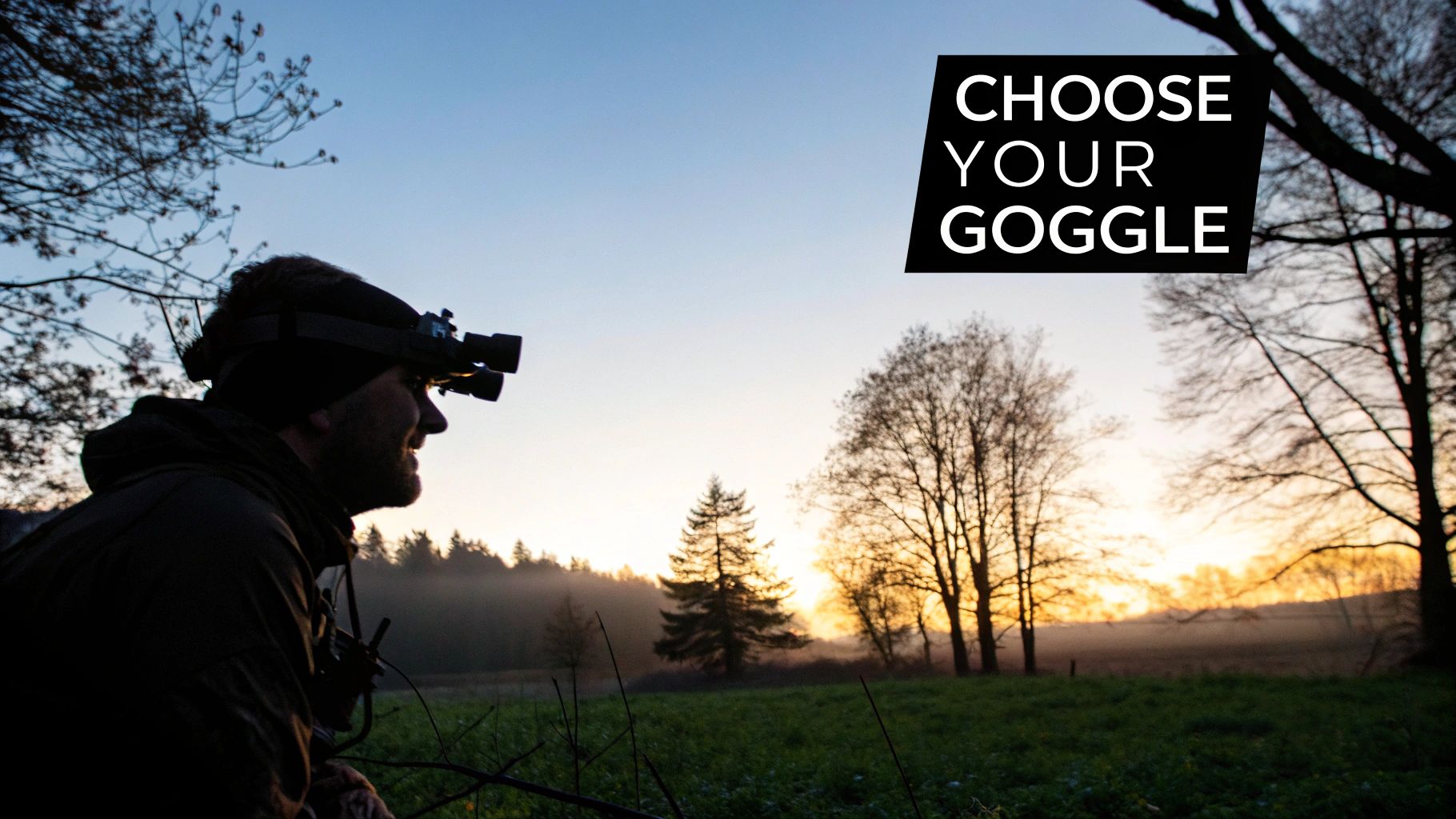
Stepping into the field after sunset completely changes the game. It requires gear that can cut through the darkness and give you a clear, decisive edge. The first fork in the road is choosing between two completely different technologies: traditional image intensification (I²) and thermal imaging. Each has a specific, vital role for a hunter.
Image intensification is what powers classic "green" night vision. It works by taking what little ambient light is available—from the moon, the stars—and amplifying it thousands of times to create a detailed image. This makes it perfect for positive target identification, letting you see crucial details like the rack on a buck or telling a coyote apart from the neighbor's dog.
On the other hand, thermal imaging detects heat signatures. This makes it the undisputed king of detection.
Thermal Detection vs. Night Vision Identification
Getting this fundamental difference straight is the first, most important step. A thermal unit can pick up the heat from an animal's body through fog, rain, or thick brush from incredible distances. What it won't do is show you the fine details that a true night vision device can.
That’s why so many seasoned night hunters use both. They'll scan with a handheld thermal monocular to find a heat signature, then flip down their helmet-mounted night vision goggles or shoulder their rifle to identify and engage the target. This guide is focused on image intensification devices, which give you the visual clarity you need to take a safe, ethical shot.
| Technology | Primary Function | Ideal Scenario | Key Limitation |
|---|---|---|---|
| Night Vision (I²) | Identification | Seeing specific details (antlers, species) in low light. | Needs some ambient light to amplify. |
| Thermal Imaging | Detection | Spotting heat through visual obstructions like fog, brush, or camo. | Can't render fine details, making positive ID tough. |
Why This Choice Matters
Night hunting isn't a niche hobby anymore, and the technology has exploded in recent years. The night vision market is on a trajectory to grow from USD 10.28 billion to USD 19.16 billion by 2032. For hunters like us, that means better gear is becoming more accessible, capable of cutting down search times by over 50% in the dark. You can see more on these trends at Stellar MR.
The rule of thumb out in the field is simple: use thermal to find it, use night vision to ID it. This two-part approach is the foundation of responsible and effective night hunting.
To pick the right gear, you first need to understand the different device formats, the "generations" of night vision, and the key performance specs that actually matter. We’ll break it all down so you can make a purchase with confidence.
For a deeper look, check out our complete guide on https://superiortac.com/how-to-choose-the-right-night-vision-device-for-your-needs/. At Superior Tactical, we only stock field-tested gear, because we know preparation is everything.
Night Vision vs. Thermal Imaging: Which One Is Right for Your Hunt?
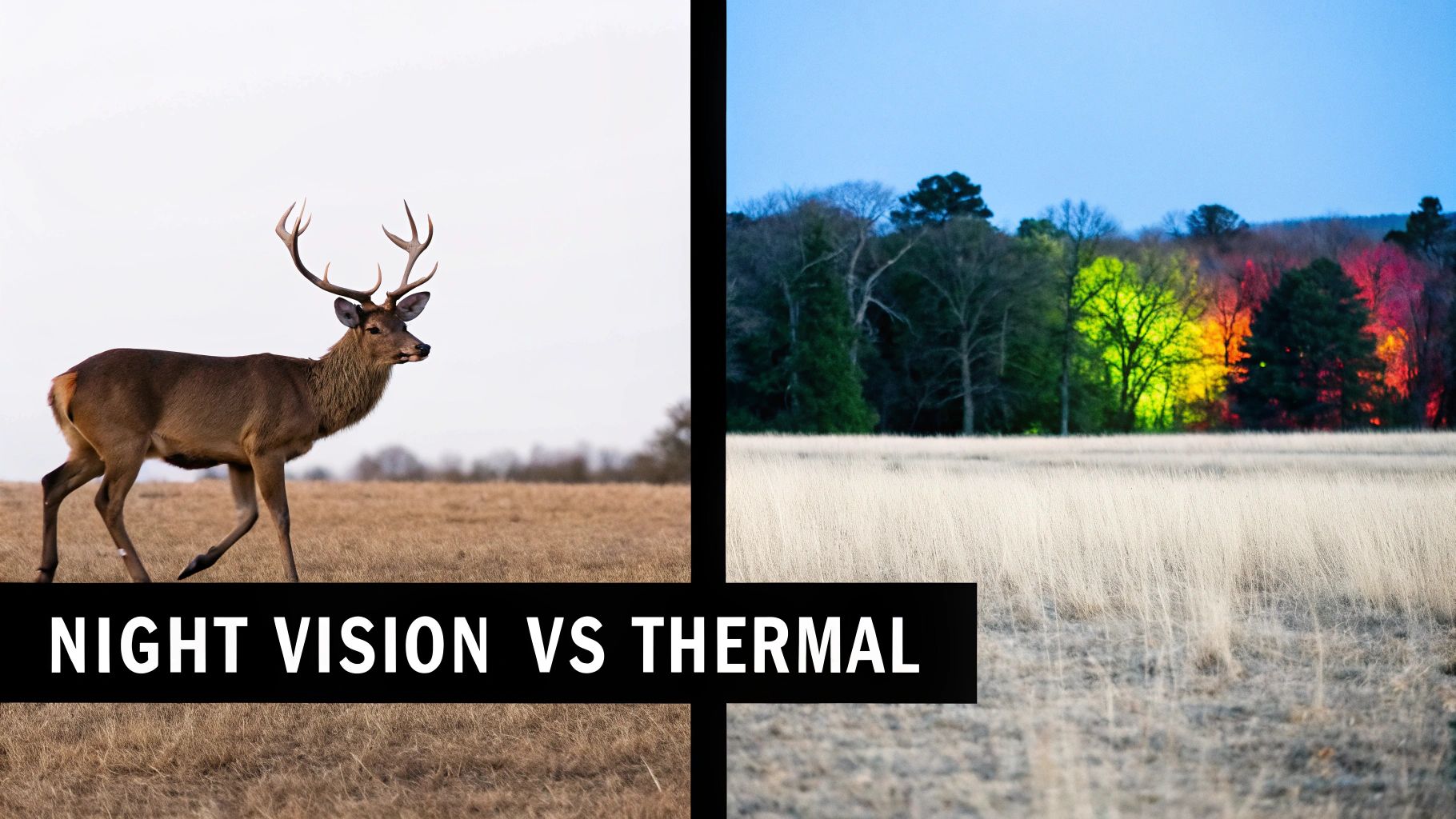
When you start looking for the best night vision goggles for hunting, you’ll immediately hit a fork in the road: traditional image intensification (I²) or thermal imaging? This isn't just a minor choice of features; these are two completely different technologies, and they absolutely are not interchangeable. Getting this decision right is the single most important step you'll take.
Think of it this way: traditional night vision works by amplifying tiny amounts of existing light from the moon and stars. It takes what's already there and makes it bright enough for you to see a clear, detailed picture. On the other hand, thermal imaging doesn't see light at all—it sees heat. It creates a picture based on the temperature differences between objects.
Understanding Night Vision Generations
Not all night vision is created equal. The tech is broken down into "generations," and each one represents a huge leap in performance. While you might see older stuff out there, for any serious hunter, the real conversation starts with Gen 2 and is perfected in Gen 3.
- Gen 1: This is your entry point. It needs a good bit of moonlight to work well and often gives you a noisy, distorted image. It’s cheap, but honestly, it’s not up to the demands of hunting.
- Gen 2: A massive improvement over Gen 1. You get much better clarity, less distortion, and it works in far darker conditions. It’s a viable option but still doesn't have the crispness or reach of modern units.
- Gen 3: This is the gold standard for a reason. It's what professional hunters and military operators rely on. Gen 3 tubes provide incredible light amplification—often 20,000x or more—with fantastic resolution and a much longer lifespan.
For a hunter in the field, the gap between Gen 2 and Gen 3 is night and day. When it’s almost pitch black, a Gen 3 device will give you a clear, usable image while a Gen 2 unit will be struggling. That clarity is what allows you to reliably identify game at a distance. It's exactly why we at Superior Tactical focus our inventory on high-performance Gen 3 systems.
Thermal for Detection, Night Vision for Identification
Here’s the simplest way to break it down. Thermal’s greatest strength is its phenomenal ability to detect. Because it sees heat, it cuts right through camouflage, fog, and foliage. A thermal monocular will light up a warm body hiding in thick brush hundreds of yards away, something I² night vision could never do.
But thermal's weakness is detail. You'll see a bright heat signature, but good luck telling a trophy buck from a doe, or even telling a coyote from a stray dog. That’s where image intensification is absolutely essential.
Night vision goggles give you the critical detail you need for positive identification. You can count antler points, judge an animal’s size, and make sure your backdrop is safe before you even think about pulling the trigger. That kind of clarity is non-negotiable for ethical and legal hunting.
The most effective night hunters I know use a "fusion" approach. They'll scan the field with a handheld thermal to find a heat signature, then flip down their helmet-mounted Gen 3 night vision goggles to positively identify and engage the target.
A Real-World Comparison
Let's see how this plays out in a few common hunting scenarios:
| Hunting Scenario | Thermal Advantage | Night Vision (I²) Advantage |
|---|---|---|
| Scanning a Wooded Ridge | Instantly picks up a coyote's heat signature through thick brush where it would be completely invisible to I² or the naked eye. | Gives you a clean, detailed view of the entire landscape, letting you see the terrain, trees, and other landmarks. |
| Identifying a Feral Hog | Easily tracks the bright heat blob of a hog moving across a field, even in misty conditions that would challenge I². | Lets you clearly see the hog's size, tusks, and build, confirming it's the animal you're after. |
| Predator Calling at Night | You'll detect an incoming predator by its body heat long before you could see it otherwise, giving you precious time to get ready. | You can aim precisely using an IR laser, which is totally invisible to the animal but shines like a beacon through your goggles. |
At the end of the day, thermal finds the heat, and night vision gives you the visual proof. While both have their place, for the crucial act of positive identification that every responsible hunter must make, a quality set of night vision goggles is the one tool you can't go without.
Picking the right technology can feel overwhelming, but it gets a lot clearer when you focus on what each system does best. For an even deeper dive into this, you can check out our comprehensive guide explaining the nuances of night vision technology and how it compares to thermal imaging. Arming yourself with that knowledge ensures you invest in gear that will actually work for you in the field.
Understanding Key Night Vision Goggle Specifications
Once you get past the basics of generations and tech, the real work begins when you start digging into the spec sheet. These numbers aren't just technical jargon; they directly determine how effective and safe you'll be in the field. Getting a handle on them is what separates a smart investment from a very expensive mistake when choosing the best night vision goggles for hunting.
The heart and soul of any Gen 3 device is its image intensifier tube. Its performance is what you're really paying for. A few key metrics tell you almost everything you need to know about the tube's quality and how it will perform when it counts.
Figure of Merit (FOM)
If there's one number to rule them all, it’s Figure of Merit (FOM). It’s a straightforward calculation—Resolution multiplied by the Signal-to-Noise Ratio—that gives you the single best snapshot of a tube’s overall performance. A higher FOM delivers a cleaner, crisper image, which is especially critical for spotting targets at a distance or in near-total darkness.
For any serious hunting, look for a minimum FOM of 1800. The high-end, top-tier tubes can easily push past 2400. This isn't just about bragging rights; a higher FOM directly translates to your ability to positively identify a target from further out, making the crucial distinction between a coyote and your neighbor's dog.
Resolution and Gain
Resolution, measured in line pairs per millimeter (lp/mm), is all about detail. It's the tube's ability to show you the fine lines in the image. A higher resolution lets you see smaller details with greater clarity, which is invaluable for things like counting antler points or spotting an animal partially hidden in thick brush. Any quality Gen 3 tube should start at 64 lp/mm or better.
Gain is simply the brightness. It’s the degree to which the device amplifies the available ambient light. While having a high maximum gain is useful, what's far more important is having adjustable gain. This lets you dial the brightness down on a full-moon night to reduce that grainy "snow" in the image and prevent eye fatigue. On a moonless, overcast night, you can crank it up to pierce through the darkest shadows.
A simple way to think about it: Resolution is the sharpness of the picture, and Gain is its brightness. A great FOM score means the tube strikes an excellent balance between the two, giving you a detailed and bright image that works well in all kinds of light.
IR Illuminators and Field of View
An IR Illuminator is your ace in the hole when there’s absolutely zero ambient light. It’s basically an infrared flashlight—totally invisible to the naked eye and to animals—that acts like a powerful spotlight for your NVD. If you’re hunting in dense timber or on a cloudy, new-moon night, a built-in or weapon-mounted IR illuminator is a must-have.
Field of View (FOV) is simply how wide of an area you can see, usually measured in degrees. The industry standard is right around 40 degrees, which gives you a great balance between situational awareness and a natural-feeling perspective. It helps avoid the "tunnel vision" effect that can be incredibly disorienting when you’re on the move.
Device Formats: Monocular, Biocular, and Binocular
Beyond the internal specs, the physical format of the device—how you actually wear and use it—is a huge part of the equation. Each design comes with its own set of trade-offs in weight, depth perception, and how you see the world around you.
-
Monoculars: These are the classic single-tube, single-eyepiece units like the PVS-14. You could argue it’s the most versatile setup out there. It’s light, can be used in your hand or mounted on a helmet, and leaves one eye free to preserve its natural night-adapted vision. It’s an awesome choice for hunters who need to stay mobile and flexible. For a deeper dive, check out our guide on the top features to look for in a quality night vision monocular.
-
Bioculars: This format uses a single image tube but splits the image to both of your eyes. It can be more comfortable for long-term observation than a monocular, but you get zero depth perception because both eyes are seeing the exact same picture. They’ve become less common for modern hunting.
-
Binoculars: Also called "dual tubes," this is the absolute peak of night vision performance. By using two separate image intensifier tubes—one for each eye—they give you true stereoscopic vision. The result is incredible depth perception, which is a massive advantage for navigating tricky terrain or judging distance to a moving animal. The trade-offs are significant, though: they are heavier, bulkier, and much more expensive.
Choosing the right format really comes down to how you hunt and what you're willing to spend.
Comparing Night Vision Formats for Different Hunting Scenarios
The best way to visualize the trade-offs between monoculars, bioculars, and binoculars is to see how they stack up in real-world hunting situations.
| Device Format | Best Use Case | Depth Perception | Situational Awareness | Weight and Fatigue | Relative Cost |
|---|---|---|---|---|---|
| Monocular | Versatile use, spot-and-stalk, keeping one eye free | None | Good (one eye unaided) | Very Low | $$ |
| Biocular | Long, stationary observation (e.g., in a stand) | None | Moderate | Medium | $$$ |
| Binocular | Navigating terrain, tracking movers, max performance | Excellent (True Stereo) | Excellent | High | $$$$ |
Ultimately, a monocular offers unmatched versatility for the price, while binoculars provide the most immersive and capable experience if you can handle the weight and cost. The choice depends entirely on your specific needs in the field.
How to Match Night Vision Goggles to Your Hunt
The best night vision for hunting isn't a one-size-fits-all deal. What works for a guy sitting in a blind is completely different from what you need when you're on the move. The secret is matching the tech to your tactics, so your gear becomes an extension of you, not a burden.
It really comes down to thinking about how you hunt. How you move, how you scan for game, and how you engage. Let's break down the most common hunting styles to figure out which features will give you the sharpest edge out in the dark.
Recommendations for Stand Hunting
When you're posted up in a deer stand or a hog blind, mobility goes out the window, and pure observation becomes king. Weight isn't much of an issue, but image clarity and the ability to scan a wide field for hours on end are absolutely critical. You need gear that won’t tire you out and lets you spot and ID game from a distance.
For this kind of stationary hunting, a quality monocular like a PVS-14 mounted on a tripod is a fantastic setup. It gives you a rock-steady image for long glassing sessions without your arm getting tired. But this is also where bioculars or binoculars really come into their own. Because you're not moving, the extra weight is a non-issue, and the comfort of using both eyes for long sits is a game-changer. It seriously cuts down on eye strain and helps you stay sharp.
A key insight for stand hunters: Since you're not on the move, you can afford the weight of a dual-tube system. The comfort and reduced eye fatigue you get from true binocular vision over a long sit is a massive advantage that far outweighs the typical mobility penalty.
This flowchart can help you visualize which format makes the most sense for your style.
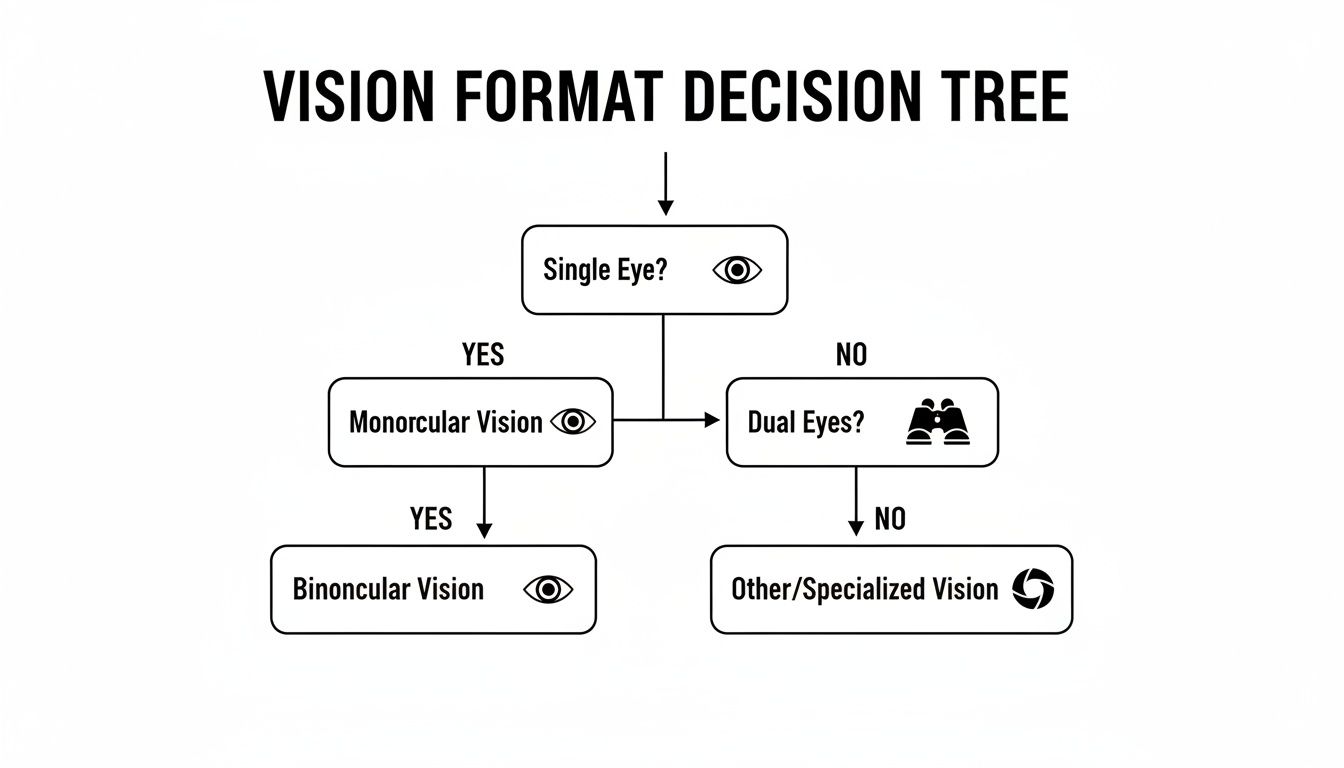
As you can see, the decision often boils down to how much you're moving and whether you need true depth perception. This directs you toward either a jack-of-all-trades monocular or a high-performance binocular setup.
Gearing Up for Spot-and-Stalk Hunting
Spot-and-stalk at night is the ultimate test of your awareness and agility. Every ounce feels like a pound when you're covering ground, and having a clear sense of your surroundings is the only way to move silently and safely. This is where lightweight, helmet-mounted systems are in a league of their own.
A top-tier Gen 3 monocular is hard to beat here. Running a PVS-14 over one eye lets you keep your other eye free, naturally adapted to the ambient darkness. This "unaided eye" is a huge asset for maintaining your peripheral vision and natural night adaptation, helping you avoid tripping on a root or snapping a twig.
For hunters who absolutely need the best depth perception to navigate rocky or treacherous terrain, a lightweight set of dual-tube binoculars is the pinnacle. They are heavier, no doubt, but the true stereoscopic vision they provide makes judging distances and moving through a cluttered environment feel much more natural and instinctive.
Optimizing for Predator Calling
Predator calling is a game of speed. When a coyote or bobcat comes charging in, your ability to get on target and make the shot right now is all that matters. This is a scenario that screams for a completely hands-free setup that allows for instant engagement.
The gold standard for calling is a helmet-mounted goggle system—either a monocular or binoculars—teamed up with a weapon-mounted infrared (IR) laser.
- Hands-Free Operation: A helmet mount keeps the NVG locked in place, leaving both your hands free to work the call and handle your rifle.
- Rapid Target Acquisition: An IR laser is invisible to the predator's naked eye but paints a bright aiming dot that you see through your goggles. You just look at the target, put the dot on it, and press the trigger. No need to break your sight picture to shoulder the rifle and find a traditional scope.
This combination is brutally fast and effective. It’s why goggles hold a dominant 31.7% global share—they are the go-to for hunters who need to be hands-on. With a viewing range typically between 100 to 400 feet, they are perfectly matched for the close-to-mid-range shots common in predator hunting. You can find more data on these market trends from Strategic Market Research. Gearing up this way flips the script; you’re no longer just reacting, you’re the one in control.
Why Trust Superior Tactical for Your Night Vision Gear
Choosing the right night vision device is a serious investment in your hunt, and picking the right partner to buy it from is just as crucial. Here at Superior Tactical, we get it. You're not just buying a piece of equipment; you're buying the confidence that it will perform flawlessly when that trophy animal finally steps out at last light.
We're hunters and tactical professionals ourselves. That firsthand experience in the field is the bedrock of our business, influencing everything from the gear we choose to stock to how we support our customers. We don't just ship boxes—we deliver complete solutions to make sure you're ready for any low-light situation you might face.
A Curated Selection of Elite Gear
You’ll notice our catalog is focused. That's by design. We only carry brands that have proven themselves time and again in the toughest conditions, which is why you'll see elite names like EOTech and Sightmark on our shelves. We know they deliver the kind of rugged performance serious hunters demand. This isn't about giving you endless options; it's about giving you the right options.
This is especially true for our Gen 3 night vision systems. The market for low-light hunting scopes is exploding, projected to hit USD 2.5 billion by 2034. With over 11.5 million deer hunters in the U.S. alone, top-tier gear can cut down on missed opportunities by as much as 60% in those make-or-break twilight hours. We're here to make sure you're positioned for success. You can learn more about the growth in the low-light hunting sector right here.
Unmatched Support and Service
What really sets Superior Tactical apart is what happens after you buy. We stand behind our high-performance Gen 3 systems with an industry-leading 10-year warranty. Think of it as a decade of peace of mind, knowing your investment is completely protected.
We believe that downtime is unacceptable. Whether you're prepping for a hunt of a lifetime or a critical mission, your gear has to be ready to go when you are. Our entire support system is built around that principle.
Our commitment to keeping you up and running includes a few things you won't find just anywhere:
- In-House Repairs: We handle diagnostics and repairs right here. That means much faster turnaround times and service from expert technicians who know this equipment inside and out.
- Free Diagnostics: Not sure what's wrong with your device? We’ll figure it out for free, giving you a clear picture of the problem without any upfront cost.
- Same-Day Shipping: When you place an order, it's out the door. We run a tight ship to minimize your wait time and get your gear into the field where it belongs.
Your Partner in Preparedness
We see ourselves as more than just a retailer; we're a dedicated partner in the night vision community. For the hands-on folks who enjoy building their own systems, we offer DIY build kits and all the components you need to assemble a custom device, with our full support along the way.
From providing the best night vision goggles for hunting to offering the parts and know-how to keep them running, Superior Tactical is your trusted source. We deliver reliable equipment and dependable support so you can focus on what matters—a successful and safe hunt.
Your Top Questions About Hunting with Night Vision
Even after you've done your homework, a few questions are bound to pop up. The world of night vision is full of technical jargon, and you want to be sure about your investment before you pull the trigger. Let's walk through some of the most common questions we get from hunters ready to take on the night.
We'll get into the nitty-gritty of aiming your rifle, navigating the legal landscape, and keeping your gear in top shape. The idea is to give you clear, straight-up answers so you can head out with total confidence.
Can You Actually Aim a Rifle While Wearing Night Vision Goggles?
You absolutely can, but probably not the way you're thinking. Forget trying to get a cheek weld and look through your magnified scope—it’s a clunky, frustrating exercise that just doesn't work. The real solution, and the one professionals use, is a weapon-mounted infrared (IR) laser.
An IR laser mounts to your rifle's rail and shoots a beam that's completely invisible to the naked eye and, more importantly, to game animals. But when you look through your night vision, that beam becomes a crisp, bright aiming dot painted right on your target.
This setup is a game-changer for a few reasons:
- It's Fast: You don't need a perfect sight picture. Just put the dot on the target and squeeze the trigger. It’s an incredibly intuitive way to shoot, especially when you're tracking a moving coyote.
- You See Everything: Your head is up and you’re scanning the entire scene through your goggles, not locked into the narrow view of a scope. This gives you unbeatable situational awareness.
- Other Options Exist: Many modern red dot and holographic sights are built to be "night vision compatible." They have special low-brightness settings that show up clearly through your goggles without creating a blinding flare, giving you another great aiming option.
Is It Legal to Hunt with Night Vision?
This is the big one, and the answer is a hard it depends entirely on where you are. The laws around using night vision and thermal optics for hunting vary wildly from one state to another. What's perfectly fine in Texas could land you in serious trouble in Pennsylvania.
Regulations often hinge on:
- What you're hunting: Many states give the green light for non-game animals like feral hogs and coyotes but draw the line at big game like deer.
- The time of year: Some rules might only apply during specific hunting seasons.
- Public vs. Private Land: The regulations can change depending on whose land you're on.
Before you even think about packing your night vision for a hunt, you have to check your state's wildlife regulations. It's 100% your responsibility to know and follow the law. A quick search for your state's Department of Fish and Wildlife website is the best place to start.
How Do I Take Care of My Night Vision Goggles?
Good maintenance is what protects your investment and keeps your unit running reliably for years. These are sophisticated pieces of equipment, but looking after them is pretty simple if you stick to a few ground rules.
First, keep those lenses spotless. Use a soft, lint-free cloth (microfiber is perfect) and a good lens cleaning solution. Never, ever use Windex, a t-shirt, or anything abrasive that could scratch the delicate coatings on the glass.
Second, be smart about batteries. If you’re putting the device away for a while, always take the batteries out. This stops any chance of leakage, which can corrode the contacts and wreck the electronics inside. It's a simple step that can save you a massive headache.
Finally, store it properly. When you're not using it, keep your night vision unit in its protective case in a cool, dry spot. Don't leave it on the dashboard of your truck or anywhere it'll bake in direct sunlight, as extreme heat can slowly degrade the image intensifier tube. Follow these steps, and your gear will be ready to perform when you are.
For a curated selection of the best night vision goggles for hunting, backed by an industry-leading 10-year warranty and in-house expert support, trust Superior Tactical. We provide the reliable gear and dependable service you need to be prepared for any low-light scenario. Explore our full range of night vision and thermal optics at https://superiortac.com.
