A Complete Guide to Night Vision Generation 2
When you need serious night vision performance without the eye-watering price tag of the absolute top tier, Generation 2 is where you land. It’s the battle-tested workhorse for professionals and dedicated enthusiasts, representing a massive jump in capability from older tech. For many, Gen 2 is simply the smart, proven choice for owning the dark.
The Sweet Spot of Night Vision Performance
If you think of night vision like car engines, Gen 1 is a basic four-cylinder—it gets the job done, but that’s about it. Gen 3 is a finely tuned V12, packing incredible power but at a price to match. Night vision generation 2 is the high-performance V6 of the group; it delivers strong, reliable power that blows the entry-level stuff away, but without the extreme cost of the absolute best.
What makes this possible? It all comes down to a game-changing piece of tech: the Micro-Channel Plate (MCP). The MCP is the heart of every Gen 2 device and the single biggest reason it outperforms its predecessors. Think of it as a massive electron amplifier, taking what little ambient light is available and multiplying it exponentially to produce a bright, crisp image.
Why Gen 2 Remains a Top Choice
Gen 2 isn't just a stepping stone to Gen 3; for many operators, it's the final destination. It provides professional-grade capability for real-world scenarios where you can't afford equipment failure, all without requiring a blank check.
Here’s why it’s so trusted:
- Drastically Improved Clarity: The MCP cleans up the image significantly, getting rid of the distortion and "fish-bowl" effect you often see in Gen 1. The result is a clean picture from one edge of your view to the other.
- Excellent Low-Light Capability: A good Gen 2 unit works incredibly well under starlight or in deep shadows. You'll only need an IR illuminator when you're in near-total darkness.
- Proven Reliability: Gen 2 tubes are built to last, with typical lifespans running into thousands of hours. You're making an investment that will hold up for years of hard use.
The introduction of the Micro-Channel Plate was the defining moment for Gen 2. It's what turned night vision from a niche novelty into a critical tactical tool for a much wider range of users.
Who Relies on Gen 2 Technology
From police officers clearing a dark building to hunters tracking prey after sunset, Gen 2 delivers the visual data needed to work safely and effectively. Security teams also rely on its clear imaging to monitor perimeters. It has cemented its reputation as a dependable platform that offers incredible value.
You can get a more detailed breakdown in our guide on the different night vision generations. The long and successful track record of Gen 2 makes it a solid choice for anyone who is serious about operating in the dark.
How Gen 2 Technology Turns Night Into Day
To really get a handle on what makes night vision generation 2 such a leap forward, you have to follow the journey of light itself as it travels through the device. This whole process happens in a flash, turning a scene you can't see with your own eyes into a sharp, green-hued image.
It all starts when the faintest bit of ambient light—from the moon, stars, or even distant city glow—enters the objective lens. The lens gathers this weak light and focuses it squarely onto a component called the photocathode. You can think of the photocathode as a special screen that converts light particles (photons) into electrical particles (electrons). For every single photon that hits it, an electron is kicked loose.
The Micro-Channel Plate: Gen 2's Secret Sauce
This is where the real magic of Gen 2 kicks in. The few electrons released by the photocathode are then accelerated toward the defining component of this technology: the Micro-Channel Plate (MCP). An MCP is a wafer-thin slice of glass, barely a millimeter thick, that's absolutely riddled with millions of microscopic channels.
Picture a honeycomb, but shrunk down to an incredible degree. Each of those tiny, angled glass tubes is an electron multiplier. When one electron from the photocathode zips into a channel, it smacks against the wall, knocking loose several more electrons. This new cluster of electrons continues down the tube, striking the walls again and again, creating a massive chain reaction.
What started as a single electron entering a channel exits the other side as a cloud of thousands. This incredible amplification is the single biggest advantage Gen 2 has over older tech, allowing it to paint a bright picture even in near-total darkness.
Turning Electrons Back Into a Picture
Now you have a dense cloud of electrons that perfectly mirrors the original scene, just massively amplified. An electrical field then flings this electron cloud across a tiny gap until it slams into the final piece of the puzzle: the phosphor screen.
The phosphor screen operates a lot like an old-school CRT television screen. When the high-energy electrons hit the phosphors, they instantly glow, converting that electrical energy back into visible light. This is what creates that classic green image you see when you look through the eyepiece. The intensity of the electron cloud dictates the brightness of the phosphors, forming a complete, detailed picture of what's out there in the dark.
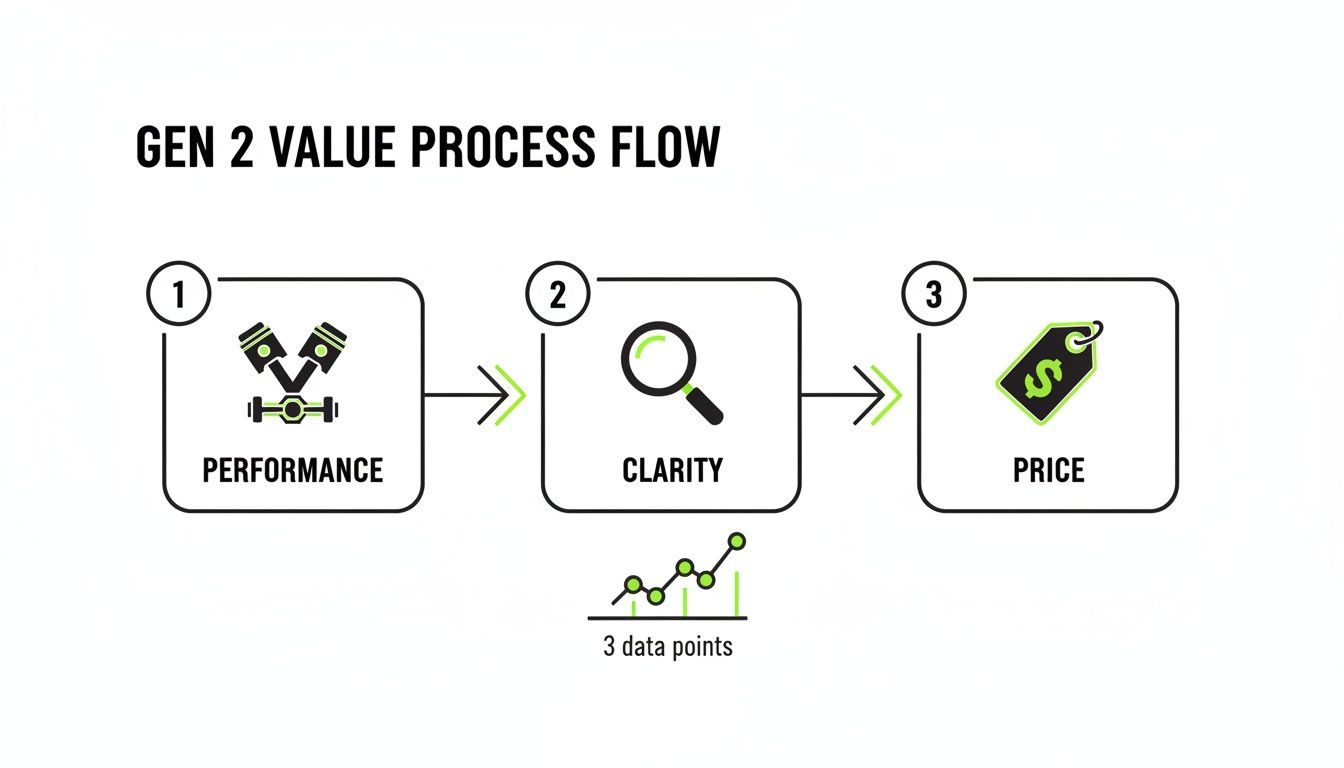
The diagram below really simplifies the value of Gen 2, breaking it down into three core pillars: Performance, Clarity, and Price.
This entire sequence, from light hitting the lens to an image appearing in your eye, happens so fast it feels instantaneous. You're seeing the world in real-time.
Generation 2, first appearing in the 1970s, was a massive step up. The introduction of the MCP allowed for light amplification of around 20,000 times, which was unheard of at the time. Suddenly, operations on moonless, overcast nights were possible.
While the fundamental process is similar in more advanced systems, the materials and specific construction—especially of the photocathode—are what set the generations apart. If you want to dive deeper into the technical nuances, you can learn more by reading our article comparing thin-filmed and unfilmed image intensifier tubes in night vision.
Getting this basic science down is crucial because it helps you understand why specs like Signal-to-Noise Ratio and Resolution are so critical when you're evaluating a night vision device, which we'll get into next.
Getting a Handle on Gen 2 Performance Specs
When you start digging into night vision generation 2, you have to look past the sales pitch and get comfortable with the numbers. These specs aren't just technical mumbo-jumbo; they're the direct measure of how well a device will actually perform when the lights go out. Getting a grip on three key metrics will give you the power to judge a unit's real-world capability and make a solid investment.
Think of these numbers as the vital signs for an image intensifier tube. They tell you its power, its clarity, and its overall health. For anyone who relies on their gear in low-light situations, understanding these specs is a must.
Signal-to-Noise Ratio (SNR)
If you're going to focus on one number, make it the Signal-to-Noise Ratio (SNR). It’s arguably the most critical metric for image quality. Here’s a simple way to think about it: imagine you're trying to hear someone whisper from across a room while a loud air conditioner is running. The whisper is your "signal," and the AC's hum is the "noise." A high SNR means you can hear that whisper clearly, despite the background racket.
In night vision, the "signal" is the good, usable light that creates the image you see. The "noise" is that fuzzy, sparkling static, sometimes called "scintillation," that gets worse as the environment gets darker.
A higher SNR is the single best indicator of how well a tube can cut through the darkness to produce a clean, defined image. It's what lets you spot a target or make out crucial details when ambient light is almost nonexistent.
A device with a low SNR might look perfectly fine on a night with a half-moon. But take that same unit into deep woods or under a thick cloud cover, and the image will quickly turn into a grainy mess that’s hard to make any sense of. For Gen 2, a high SNR is a premium feature that really separates the basic tubes from the high-performance ones.
Resolution in Lines Per Millimeter
While SNR tells you how clean the image is, resolution tells you how sharp it is. This is measured in line pairs per millimeter (lp/mm), and it's basically the night vision equivalent of a camera's megapixel count. It's a direct measurement of the tube's ability to show you two tiny objects that are very close together as two distinct things, rather than a single blurry blob.
A higher lp/mm number means you can see finer details. A unit with a resolution of 54 lp/mm is going to give you a much more defined picture than one rated at 45 lp/mm. That difference can be what lets you identify a threat from a friend at a distance or read the numbers on a sign in the dark.
- Standard Gen 2: You'll typically see resolutions in the 45-54 lp/mm range. This is plenty for general use like walking a trail or basic observation.
- Enhanced Gen 2+: These beefed-up tubes can push resolution into the 57-64 lp/mm range, which starts to get pretty close to what you'd see from some Gen 3 devices.
To get a better sense of how all the key specs work together, take a look at our guide on the top features to look for in a quality night vision monocular, where we break down resolution and more.
The Role of the Micro-Channel Plate
We've talked about how the Micro-Channel Plate (MCP) is the real engine inside a Gen 2 tube. The quality of that MCP has a huge impact on both performance and how long the device will last. The MCP handles the gain, which is simply the level of light amplification. A better MCP delivers more powerful and more consistent gain across your entire field of view.
The materials and construction of the MCP also determine the tube's lifespan. A well-made MCP can take the constant bombardment of electrons for thousands of hours before it starts to lose its punch. That's why you see Gen 2 tube life estimates ranging anywhere from 2,500 to over 5,000 hours.
The table below gives you a quick snapshot of what to expect from standard Gen 2 versus the higher-spec Gen 2+ tubes.
Gen 2 vs Gen 2+ Typical Performance Specs
| Performance Metric | Standard Gen 2 | Gen 2+ (Enhanced) |
|---|---|---|
| Resolution (lp/mm) | 45 – 54 | 57 – 64+ |
| SNR | 16 – 21 | 21 – 28+ |
| Tube Lifespan (Hours) | 2,500 – 5,000 | 5,000 – 7,500+ |
In the end, it's not about any single number. These three specs—SNR, resolution, and MCP quality—all have to work together. A tube with fantastic resolution but a poor SNR will give you a sharp but snowy image. On the flip side, a tube with a great SNR but low resolution will be clean but blurry. The best night vision generation 2 units strike a balance, giving you an image that’s bright, sharp, and clean enough to count on when you need it most.
Where Gen 2 Shines in the Real World
It's one thing to read about the specs of a night vision generation 2 device, but it's another thing entirely to see how that tech actually performs when the lights go out. All those numbers and metrics only mean something if they give you a clear, decisive edge in the field. From tense law enforcement situations to a quiet night hunt, Gen 2 has proven itself time and again as a reliable and effective tool.
You don't need to be in a Tier 1 unit to benefit, either. These devices fill a critical need for a wide range of professionals and serious enthusiasts who have to own the night. The sweet spot Gen 2 hits between solid performance and reasonable cost makes it a go-to choice for a ton of real-world scenarios.
Law Enforcement and Tactical Operations
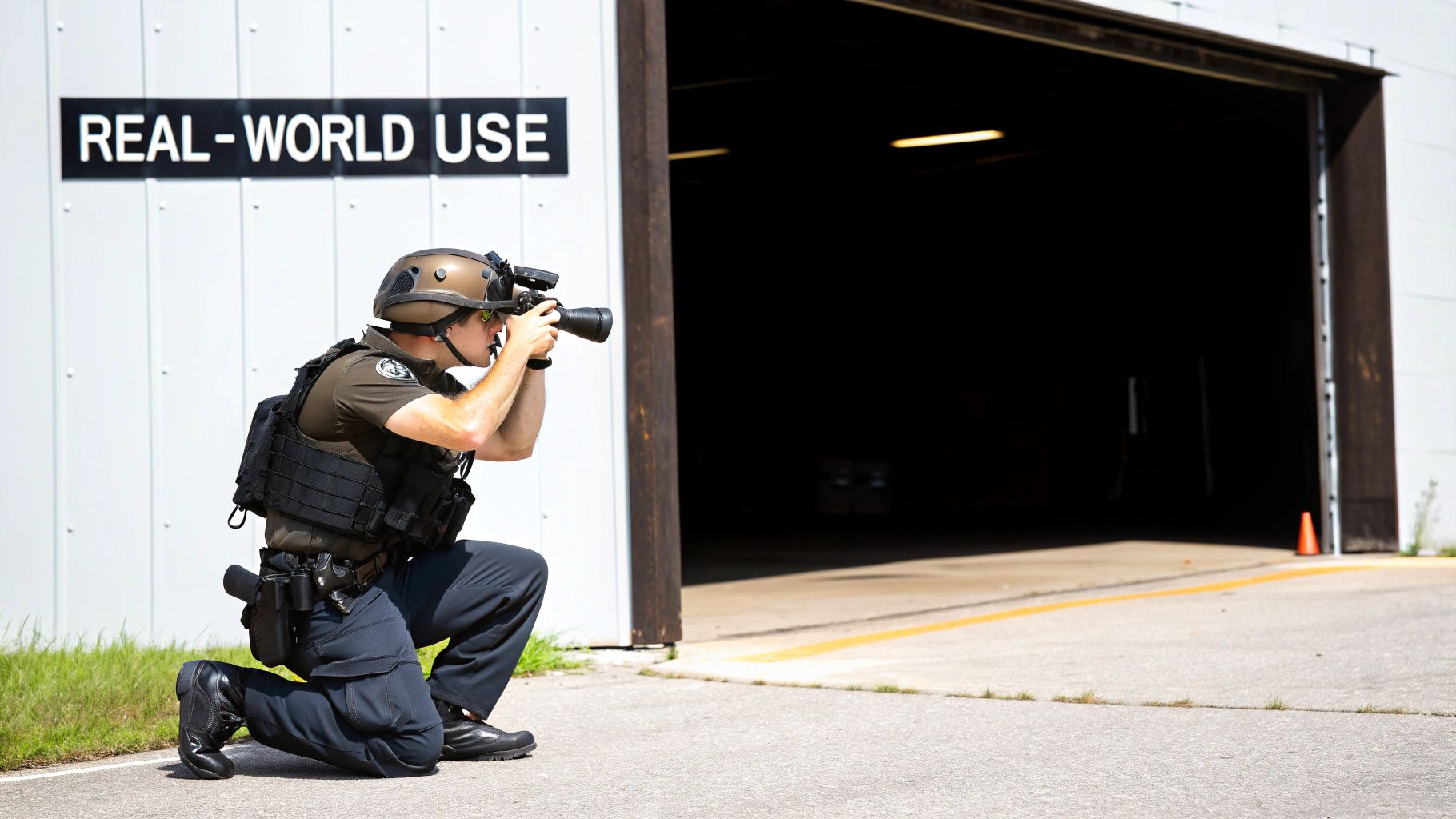
Picture a patrol officer responding to a call at a dark, sprawling warehouse. That's a high-risk scenario. But with a Gen 2 PVS-14 monocular, that officer can scan the entire unlit interior from a safe point of cover. The clean, edge-to-edge image from the Micro-Channel Plate lets them pick out threats hiding in deep shadows or behind machinery—all without giving away their position with a flashlight.
This isn't just a small improvement; it's a complete game-changer for officer safety and effectiveness. Being able to see without being seen provides a massive tactical advantage, whether you're clearing a building, running surveillance, or tracking a suspect through a poorly lit alley. You need gear you can trust, and Gen 2's reliability means it works when it matters most.
Gen 2’s serious light amplification—up to 20,000x thanks to the MCP—is what made it a favorite for law enforcement and military units back in the 1970s. It provided uniform clarity where Gen 1 was a fuzzy, distorted mess, completely changing the game on even quarter-moon nights. For a deeper dive, you can read about the evolution of night vision technology.
The jump in resolution and signal-to-noise ratio meant operators could finally trust what they were seeing, allowing for more confident, critical decisions. That legacy of dependable performance is still going strong today.
Nocturnal Hunting and Pest Control
If you're a hunter pursuing nocturnal animals like coyotes or feral hogs, you're up against the challenge of near-total darkness. A quality Gen 2 rifle scope turns that challenge into a serious advantage. As the last bit of light fades, the tube's amplification transforms a murky landscape into a clear field of engagement, letting you spot and track targets from hundreds of yards out.
Imagine scanning a field under nothing but starlight and being able to clearly pick out the silhouette of a coyote against the brush. The crisp image allows for positive target ID and a precise, ethical shot that would be completely impossible with the naked eye. This makes Gen 2 an indispensable tool for both sport hunting and property management.
Key advantages for hunters include:
- Target Identification: The clarity from a good Gen 2 tube helps you avoid misidentifying animals, which is crucial for a safe and ethical hunt.
- Situational Awareness: Wearing a monocular lets you navigate rough terrain safely in the dark, avoiding hazards and moving with stealth.
- Extended Hours: You're no longer limited to just dawn and dusk. The whole night opens up, creating more opportunities for a successful outing.
Security and Surveillance Professionals
Think about a security professional responsible for a large corporate campus or industrial site. Perimeter security is everything. Gen 2 goggles or monoculars allow guards to run effective patrols without having to blast the area with bright floodlights, which only create more deep, concealing shadows. They can spot suspicious activity from a distance, staying completely undetected while gathering intel.
This ability to observe covertly is essential for protecting assets. A guard can spot an intruder trying to breach a fence line from a hidden observation post, giving the team an early warning to coordinate a response. The dependable performance of night vision generation 2 makes it a cost-effective force multiplier for any security team. It delivers professional-grade capability without the five-figure price tag of top-tier systems, making it a smart, practical investment for any security-conscious organization.
Comparing Gen 2 vs Gen 1 and Gen 3
To really get a feel for night vision generation 2, you have to see where it fits in the bigger picture. It's not just about what a Gen 2 tube can do on its own, but how it stacks up against the technology that came before and the tech that came after. This context is what really shows why Gen 2 has earned its reputation as the sweet spot for so many people.
You’ve got to look in both directions. On one side, you have the almost primitive technology of Gen 1. On the other, the top-tier, high-cost performance of Gen 3. Gen 2 sits right in the middle, offering a massive leap in capability over Gen 1 without the brutal hit to your wallet that comes with Gen 3.
The Monumental Leap Past Gen 1
Let's be clear: the difference between Gen 1 and Gen 2 isn't a small step. It's a gigantic, game-changing jump. The secret sauce is the Micro-Channel Plate (MCP). Gen 1 devices simply don't have one, and that creates some major problems that Gen 2 completely eliminates.
- No More Image Distortion: Gen 1 units are infamous for a "fish-eye" effect that leaves the edges of your view blurry and warped. Thanks to the MCP, Gen 2 gives you a clean, flat, and totally consistent image from one edge to the other.
- A Huge Boost in Light Gain: A Gen 1 device barely amplifies light, which is why it almost always needs a built-in IR illuminator to be useful. Gen 2, on the other hand, can amplify ambient light by around 20,000 times. That’s enough to work passively with nothing but starlight.
- Longer Tube Life: Gen 2 tubes are just built tougher. They have a much longer operational lifespan, often running for thousands of hours, while a typical Gen 1 tube starts to fizzle out after about 1,000 hours.
Upgrading from Gen 1 to Gen 2 is like ditching your old tube TV for a modern flat screen. The improvement in clarity, brightness, and overall usability is immediate and impossible to ignore.
Balancing Performance and Price Against Gen 3
The conversation with Gen 3 is less about a total technological overhaul and more about smart trade-offs. There's no denying that Gen 3 is the king in extremely dark conditions. That performance comes from its gallium arsenide photocathode, which is far more sensitive to light than the S-25 photocathode found in Gen 2.
The core trade-off is simple: Gen 3 offers peak performance in the darkest environments at a premium price, while Gen 2 delivers professional-grade performance for most scenarios at a much more accessible cost.
For an elite military unit operating on a moonless desert night, that extra bit of sensitivity from a Gen 3 tube is non-negotiable. It gives them a cleaner image with less noise, letting them identify targets at greater distances.
But for a lot of law enforcement, hunting, or security work, that marginal performance gain just doesn't justify the huge price jump—often double or triple what a comparable Gen 2 device costs. This is exactly why night vision generation 2 is so often the intelligent choice for budget-conscious agencies and serious enthusiasts. You get 80-90% of the capability for a fraction of the cost, putting professional-grade night vision within reach.
To make things even clearer, let's break down how these technologies compare side-by-side.
Night Vision Generations At a Glance
The following table provides a high-level look at the key differences in technology, performance, and cost across the three main generations of night vision.
| Feature | Generation 1 | Generation 2 | Generation 3 |
|---|---|---|---|
| Core Technology | No MCP | Micro-Channel Plate (MCP) | MCP with Gallium Arsenide |
| Image Quality | Distorted edges | Clear, edge-to-edge | Exceptionally clear and sharp |
| Typical Lifespan | ~1,000 hours | 2,500 – 7,500 hours | 10,000+ hours |
| Low-Light Performance | Poor; needs IR | Good to excellent | Unmatched; superior sensitivity |
| Typical Cost | Low ($200-$500) | Moderate ($1,500-$4,000) | High ($4,000-$10,000+) |
As you can see, each generation represents a distinct tier of performance and investment. While Gen 1 is an entry point and Gen 3 is the pinnacle, Gen 2 firmly holds its ground as the workhorse, offering an incredible balance of capability and value.
Maintaining Your Gen 2 Night Vision Gear
Dropping a good chunk of change on night vision generation 2 gear is one thing; keeping it running for the long haul is another. If you want that investment to pay off, you’ve got to treat the gear with respect. We’re talking about protecting the delicate image intensifier tube at its heart, and thankfully, it’s not that complicated.
Think of your NVG like a high-end camera lens or a rifle scope. The objective and ocular lenses have special coatings to pull in as much light as possible and cut down on glare. Don't just wipe them on your t-shirt. Grab a dedicated lens cloth or a lens pen and use a gentle, circular motion. Using harsh chemicals or abrasive fabrics is a fast way to permanently strip those coatings and ruin your image quality.

Essential Care and Storage Practices
Beyond cleaning the glass, battery management is probably the most overlooked part of NVG care. If you’re putting the unit away for more than a couple of weeks, always take the batteries out. A leaky AA can create a corrosive mess that will eat through the internal electronics, turning your expensive device into a paperweight.
When it's time to put your gear away, a few simple rules go a long way:
- Keep it Dry: Store it in a cool, dry spot. Tossing in a desiccant pack is a great idea to fight off humidity.
- Keep it Dark: The objective lens cap needs to be on and secure. Period. You don't want any stray light hitting that tube when it's off.
- Keep it Safe: Use the padded case it came in. It's designed to protect the unit from bumps, drops, and shocks.
Following these steps is the best way to get the most out of your tube's lifespan, which is typically somewhere between 2,500 to 7,500 hours of runtime.
Understanding Blemishes and Upgrade Paths
So you've looked through your tube and seen a few tiny, permanent black specks. Don't panic. These are called blemishes, and they're a completely normal byproduct of making an image intensifier tube. They only become a real problem if you have a massive one right in the center of your view or a whole cluster of them.
Think of blemishes like cosmetic imperfections, not functional defects. Just about every tube has a few, and they're just part of the deal with this technology.
The great thing about Gen 2 systems is that they're not static. You don't have to buy a whole new setup to get better performance. An easy first step is adding a quality external IR illuminator or laser, which will let you see in situations with absolutely zero ambient light.
You can also look into upgrading the housing to something more modern and lightweight, or getting a better helmet mounting system. These kinds of upgrades can make a huge difference in ergonomics and how comfortable the unit is to use for extended periods, keeping your night vision generation 2 kit effective and relevant for years to come.
Answering Your Top Gen 2 Questions
Even after you've got the basics down, a few practical questions always pop up when it's time to actually pull the trigger on a night vision generation 2 unit. Getting straight answers is key to making a choice you’ll be happy with down the road. Let's tackle the questions we hear most often from buyers about performance, value, and real-world use.
Is Generation 2 Still a Solid Choice Today?
Absolutely. While newer tech gets all the hype, Gen 2 holds its own by offering a sweet spot of professional-grade performance and proven reliability at a price that won't break the bank. The image clarity you get is a world away from what you see in Gen 1.
For most law enforcement, hunting, or security scenarios—where you aren't operating in pitch-black, no-moon-no-stars conditions all the time—Gen 2 gives you everything you need. It’s still a smart, capable choice for anyone who needs serious night vision without paying the premium for Gen 3.
What's the Real Difference Between Gen 2 and Gen 2+?
The short answer is performance, specifically within the image intensifier tube itself. A Gen 2+ device, sometimes called "enhanced Gen 2," uses a hand-picked tube that simply performs better. We're talking higher Signal-to-Noise Ratios (SNR) and sharper resolution (lp/mm).
Think of it like this: Gen 2+ is the factory-tuned model. You get a cleaner, crisper image with less of that background static or "scintillation," which makes a real difference when the light gets low.
Can I Use a Gen 2 Device During the Day?
No. You should never power on a Gen 2 device in daylight or point the lens at a bright light source while it's running. The image tube is incredibly sensitive and you can permanently damage or "burn" it in a split second.
Always, always keep the daylight lens cap on unless you're in a low-light environment. Modern units usually have a bright-light cut-off feature to protect the tube, but don't rely on it. Following this one simple rule is the best thing you can do to make sure your investment lasts.
At Superior Tactical LLC, we're dedicated to sourcing vetted, high-performance night vision and tactical gear that keeps you ready for anything. Check out our curated selection of night vision devices and accessories to find the right setup for your operational needs.
