Finding the Best Budget Thermal Monocular in 2025
Imagine being able to track a coyote slinking through a field after sundown or spot what’s making that noise at the far end of your property in pitch-black darkness. That’s exactly what a good thermal monocular can do for you. And the best part? You no longer need a military-sized budget. Top-tier entry-level models are now hitting the market for under $500, giving you solid detection ranges of 300-500 meters.
This guide is designed to help you cut through the noise and find a high-value unit that performs without emptying your wallet.
Your Guide to High-Value Thermal Vision
The ability to see heat signatures used to be the exclusive domain of law enforcement and military units with deep pockets. Not anymore. Thanks to major leaps in sensor technology and manufacturing efficiency, what was once out of reach is now a practical tool for hunters, homeowners, and anyone serious about preparedness.
We're going to break down what "budget" really means in the thermal world and show you that you don't have to give up core performance for a good price. This is about making a smart investment, not just a cheap one. You’ll learn how to prioritize the features that matter for your specific needs, whether that’s spotting feral hogs across a pasture or just getting a clear look at what’s lurking in your backyard at 2 AM.
What Makes Budget Thermal Possible
The market for handheld thermal monoculars has absolutely exploded. This boom is fueled by manufacturing breakthroughs that have dropped prices by as much as 30% since 2020, packing serious capability into affordable packages. The market was valued at USD 1.13 billion in 2025 and is expected to climb to USD 1.94 billion by 2034, growing at a steady clip of 6.2% annually. You can read more about this market expansion on Research and Markets.
What does this mean for you? It means today's budget-friendly thermals deliver performance that was considered high-end just a few years ago. Here’s what you get:
- Unbeatable Detection: Thermal imaging sees heat, not light. This makes it far better than traditional night vision for picking out an animal or person in total darkness, camouflaged in brush, or obscured by fog.
- True 24/7 Capability: Unlike night vision that needs some ambient light to work, thermal works just as well in broad daylight as it does in the dead of night. It's always ready to go.
- Enhanced Situational Awareness: A quick scan of your surroundings with a thermal monocular instantly reveals any heat sources. It gives you a massive advantage and a much better sense of what's out there.
A budget thermal monocular is one of the biggest force multipliers you can own. It completely changes the game in low-light situations, giving you the power to see targets that would otherwise be invisible.
By getting a handle on the key specs and the state of the market, you can confidently choose the best budget thermal monocular that truly fits your mission and gives you a powerful new way to see in the dark.
How to Decode Thermal Monocular Specifications
Jumping into the world of thermal optics for the first time can feel like you’re trying to read a foreign language. You're hit with a wall of acronyms and technical specs—NETD, refresh rate, detector resolution. It’s easy to get bogged down, but these aren't just numbers to make a product sound fancy. They're the DNA of the device.
Understanding these core specs is what separates a smart purchase from a frustrating one. This is how you see past the marketing hype and figure out what will actually perform when you need it most. Let's break down the big ones, one by one, and translate them into what they mean for you out in the field.
Detector Resolution: The Sharpness of Your Image
If there’s one spec to pay attention to, it’s this one. Detector resolution is the thermal equivalent of megapixels in a digital camera. It tells you how many individual heat-detecting pixels are on the sensor, which is called a microbolometer. More pixels mean a sharper, cleaner image. Simple as that.
- Higher Resolution: A 384×288 sensor gives you 110,592 pixels working to paint a picture. That extra detail is what helps you tell the difference between a coyote and a stray dog at a distance.
- Lower Resolution: A budget-friendly 256×192 sensor has 49,152 pixels. It’s still incredibly effective for spotting a heat signature out to several hundred yards, but you might need to get closer to make a positive ID.
Think of it this way: 256×192 is a standard-definition TV. You can see the action just fine. But 384×288 is like stepping up to HD—everything is crisper and more defined. If you want to dig even deeper into how this plays out, we cover it in our guide on choosing the best thermal imaging monocular.
NETD: The Ability to See Subtle Differences
Noise Equivalent Temperature Difference (NETD) is a fancy term for a simple concept: sensitivity. It measures how well the sensor can pick up on tiny variations in temperature. A lower NETD number is always better. It's like having better hearing—you can pick up on the quietest whispers.
This spec becomes critical in tough conditions. On a damp, foggy night or in high humidity, the temperature differences between an animal and its surroundings get washed out.
A monocular with a **<40mK** rating will cut through that muck and give you a surprisingly clear image. A unit with a >60mK rating in the same conditions? You'll likely see a grainy, indistinct blob.
Refresh Rate: For Smooth Motion Tracking
Refresh rate, measured in Hertz (Hz), is all about how smoothly you can track movement. It’s the number of times per second the image on your screen gets updated. For anything that moves—hogs on the run, a person walking a fence line—this is a huge deal.
A 50Hz refresh rate provides a fluid, real-time view, almost like looking through a regular optic. It’s easy to follow a target without any jumpiness. A lower 25Hz rate can create a laggy or choppy image, which can be disorienting when you’re trying to track something moving quickly. For hunting or security, a higher refresh rate is a massive advantage.
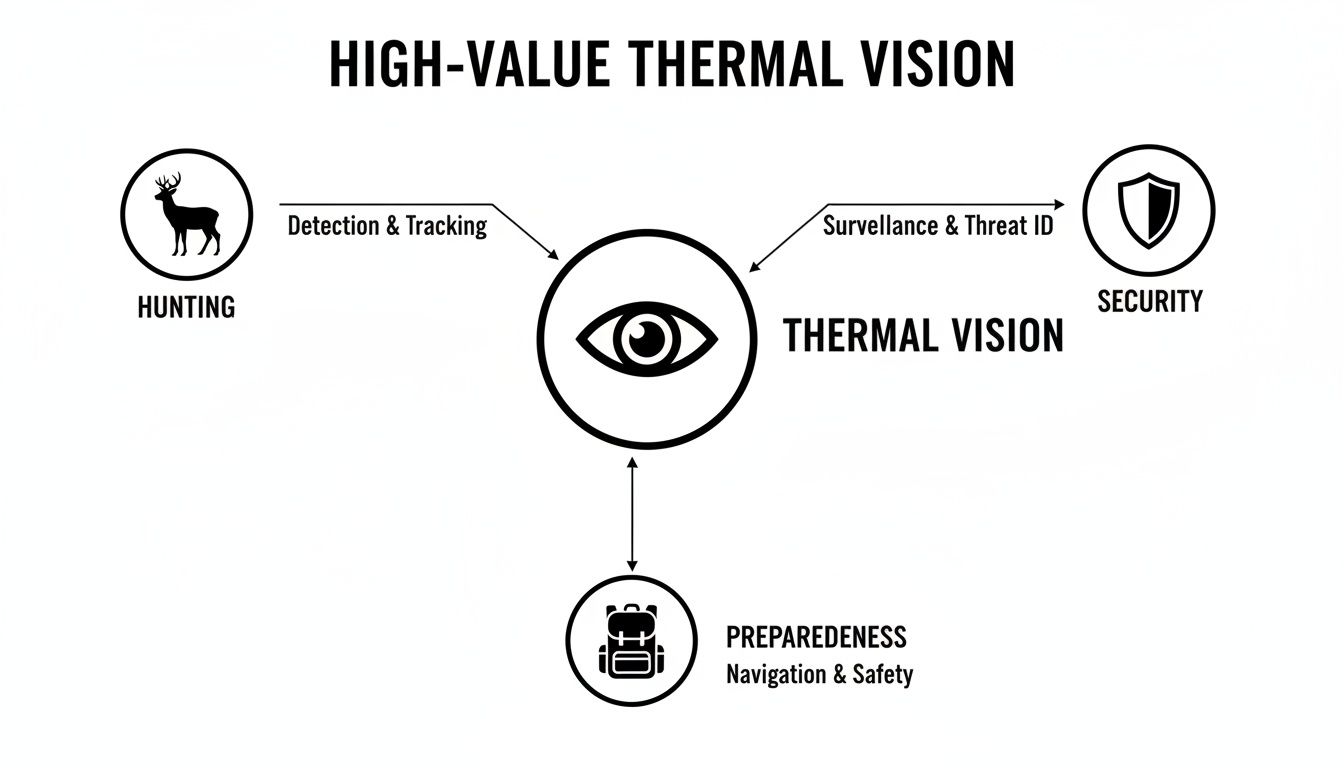
As you can see, whether you're hunting, securing your property, or staying prepared, the core performance of the device is what makes it a useful tool rather than just a gadget.
Lens Size: Field of View and Magnification
The size of the objective lens (the one at the front) dictates two things that work in opposition: your magnification and your Field of View (FOV). You can't have the best of both worlds; you have to pick what’s more important for your situation.
- Larger Lens (e.g., 35mm): A bigger lens gathers more light and gives you a higher starting magnification. This is your go-to for seeing things far away, letting you identify targets at a distance. The downside is a narrow field of view, like looking through a straw.
- Smaller Lens (e.g., 19mm): A smaller lens means less base magnification but a much wider FOV. This is perfect for scanning wide-open areas, like a field or a backyard, because you can see more of the landscape at once without having to pan around constantly.
The right choice comes down to your environment. If you're in thick woods where your shots are close, a wide FOV is your friend. If you’re watching a long pipeline or hunting over vast plains, you’ll want the reach that comes with more magnification. Nail these core specs, and you'll find a budget monocular that feels like it was made just for you.
What You're Giving Up (and Gaining) with an Affordable Thermal
Let's be clear: choosing a budget-friendly thermal monocular is all about making smart compromises, not just settling for second best. To get real value for your dollar, you need to understand where manufacturers cut costs and how that actually affects what you see in the field. Think of it as a game of give-and-take—and when you know the rules, you can absolutely come out on top.
An affordable thermal isn't some useless toy. Far from it. But you will see real, tangible differences in the specs when you put it side-by-side with a premium unit that costs thousands more. Being realistic about these trade-offs from the start is the key to buying a tool you'll be happy with for years.
Resolution Realities
The first and most obvious difference you'll notice is the detector resolution. A high-end model might rock a 640×480 sensor, giving you an incredibly crisp, detailed thermal image. A budget-friendly unit, on the other hand, will probably have a 256×192 or 384×288 sensor. This doesn't make it useless; it just changes the ranges at which it's most effective.
With lower resolution, positively identifying a target at long distances gets trickier—telling a raccoon from a possum at 300 yards, for instance, might be tough. But for pure detection? It’s more than enough. Spotting that heat signature and tracking its movement within a few hundred yards is exactly what these monoculars are built for.
Sacrificing the Bells and Whistles
Another place manufacturers save money is on the extra features. Premium thermals are often loaded with nice-to-have capabilities that aren't strictly necessary for the core job of seeing heat.
Here are a few common trade-offs you can expect on more affordable models:
- Onboard Recording: Many budget units skip internal video and photo capture to keep the price down. If you need to document your hunts or observations, you'll need to double-check that this feature is included.
- Battery Life: To keep the unit small, light, and cheap, a budget model might give you 4-6 hours of runtime. Higher-end devices can push 8-10+ hours. This is an easy problem to solve—just carry an external power bank for longer nights.
- Connectivity: Features like Wi-Fi streaming to a phone app or Bluetooth integration are typically reserved for the more expensive models.
The most important thing to remember is this: a sub-$1000 thermal monocular still gives you a massive advantage by letting you see heat signatures. The ability to spot a warm body in total darkness is a game-changer, putting you leagues ahead of what traditional optics can do.
To help visualize these differences, here’s a quick comparison of what you typically get at each price point.
Budget vs Premium Thermal Monocular Feature Comparison
This table breaks down the typical features you'll find in budget-friendly thermal monoculars versus their premium counterparts. It's a great way to see exactly what you're trading off for that lower price tag.
| Feature | Typical Budget Model (<$1000) | Typical Premium Model (>$2500) |
|---|---|---|
| Detector Resolution | 256×192 or 384×288 pixels | 640×480 pixels or higher |
| NETD | <40 mK to <50 mK | <25 mK to <35 mK |
| Display Resolution | 720×540 LCOS | 1024×768 OLED or AMOLED |
| Lens (Focal Length) | 10mm – 19mm | 25mm – 50mm+ |
| Detection Range | 400 – 1,000 yards (man-sized) | 1,500 – 2,500+ yards (man-sized) |
| Onboard Recording | Often excluded or basic quality | Standard; high-quality video/audio |
| Battery Runtime | 4-6 hours | 8-10+ hours |
| Advanced Features | Basic color palettes, digital zoom | Wi-Fi, app streaming, LRF, GPS |
As you can see, the core thermal detection capability is there on a budget model, but the premium units offer much greater detail, range, and a host of convenient features.
Putting It All in Perspective
It’s critical to frame these differences in terms of value. A budget thermal still accomplishes the most important mission: detecting heat that is completely invisible to your eyes. This is where it leaves even high-end night vision in the dust, since night vision needs some ambient light to work. You can dive deeper into how these technologies stack up in our detailed comparison of thermal scopes vs. night vision.
Ultimately, buying a budget thermal isn’t about getting every feature under the sun. It's about getting your hands on a powerful thermal sensor that fundamentally changes how you see the world after dark. By skipping a few luxury features, you gain access to one of the most effective tools available for hunting, security, and general awareness at an unbeatable price.
Matching Your Monocular to Your Mission
Let's be honest: the "best" budget thermal monocular doesn't actually exist. The right device is entirely dependent on what you're doing. A hog hunter sneaking through thick brush needs a totally different tool than a security guard scanning a wide-open property.
The single most important step you can take is to match the technology to your mission. It’s all about prioritizing the specs that give you a real-world edge. A massive detection range sounds impressive on paper, but it’s pretty useless if you really just need a wide field of view to scan your backyard.
So, let's break down what features really matter for different users and connect the technical jargon to what it actually means on the ground.
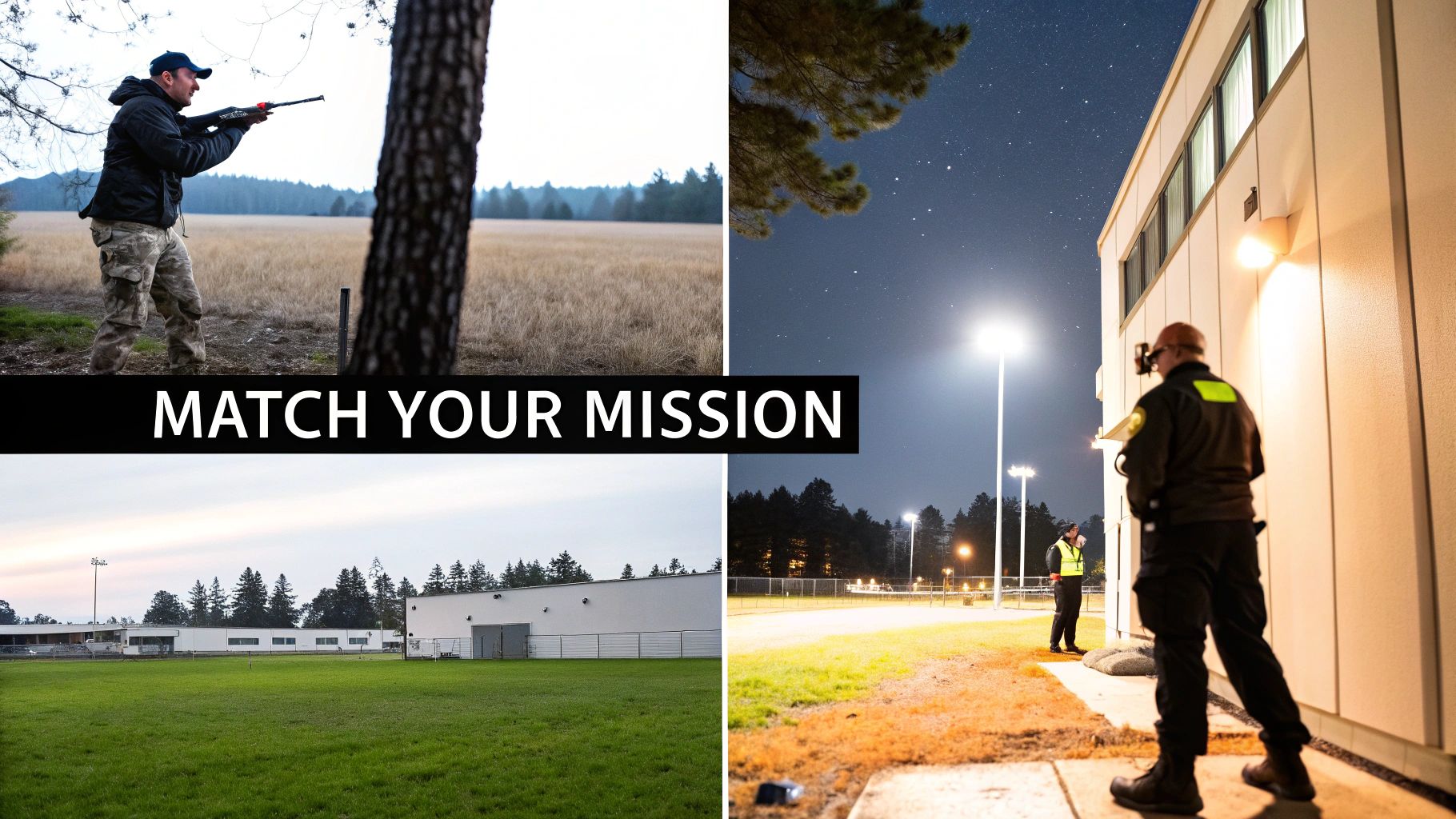
Thinking "mission first" keeps you from overspending on specs you'll never use. Even worse, it prevents you from cheaping out and ending up with a tool that fails you when it counts.
For the Dedicated Hunter
For any serious hunter, a thermal monocular isn't just a gadget—it's a game-changer for ethical and successful hunts. Your job is to spot and identify game, often when it's foggy, raining, or tucked away in dense foliage where an animal's natural camouflage works best.
Here’s what you should prioritize:
- High Thermal Sensitivity (Low NETD): This is non-negotiable. A sensor with a low NETD, something <40mK, can pick up on tiny temperature differences. This is what lets you see the heat of a deer against a cool treeline or cut right through morning mist.
- Adequate Detection and Recognition Range: You need enough reach to spot game well before it spots you. For most hunting scenarios, a budget unit that can detect a deer-sized animal at 800-1,200 yards is the perfect sweet spot.
- High Refresh Rate (50Hz): Animals don't stand still. Whether you're scanning for a walking buck or trying to track a coyote on the move, a smooth 50Hz refresh rate is critical. It eliminates that frustrating lag and image choppiness.
A hunter's ideal thermal isn't about identifying a target from a mile away. It's about reliably detecting heat signatures and getting a clear image in the exact environments where your quarry lives.
For Law Enforcement and Security Patrols
Professionals on patrol face a different set of challenges. Their work is about scanning large areas quickly, maintaining total situational awareness, and spotting potential threats in unpredictable environments. Here, a wide view, speed, and durability are king.
These are the key features for the job:
- Wide Field of View (FOV): When you're clearing a room or scanning a parking lot, seeing more at once is a massive tactical advantage. A monocular with a smaller lens (like a 19mm) gives you a much wider FOV, so you spend less time panning and more time observing.
- Fast Startup Time: Trouble doesn't wait for your gear to boot up. A device that powers on and gives you a clear image in under 5 seconds is essential for responding to a situation now.
- Long Battery Life and Durability: A patrol can last all night. You need a unit with 6+ hours of runtime, and the ability to connect an external power bank is a huge plus. It also has to be tough enough to handle being knocked around in a patrol car and used in bad weather. For a deeper dive, our guide on how thermal spotters can enhance your night vision covers these professional uses in more detail.
For the Preparedness-Minded Individual
If your focus is on preparedness, home defense, or just keeping an eye on your property, your priorities shift toward simplicity and rock-solid reliability. You need a tool that works every single time, without a steep learning curve.
Focus on these core characteristics:
- Simple User Interface: In a high-stress situation, the last thing you want is to be fumbling through confusing menus. Look for a monocular with big, intuitive buttons for the essentials: power, brightness, and changing color palettes.
- Reliability and Durability: This is the kind of tool that might live in a go-bag or on a shelf for months at a time. It has to be built tough and ready to perform the moment you need it. A solid build and a good IP rating (for dust and water resistance) are signs of quality.
- Sufficient Detection Range: You don’t need to see a mile down the road. A unit that can reliably detect a human-sized heat signature at 400-600 yards gives you more than enough of a heads-up to assess a potential threat on your property.
This focus on core functionality is what makes today’s budget thermals so effective. The market is exploding, valued at USD 1.2 billion in 2024 and projected to more than double to USD 2.5 billion by 2033. This growth is thanks to new tech that has slashed average unit costs in half since 2018, putting incredible capability within reach. By putting your mission first, you can tap into this value and get a tool that’s perfectly suited to your needs.
How to Protect Your Investment
Think of your thermal monocular as a precision instrument. Just like any other piece of high-end gear, it needs a little care to keep it running flawlessly for years. Taking a few simple steps will protect your investment and make sure it’s ready to perform when you need it most.
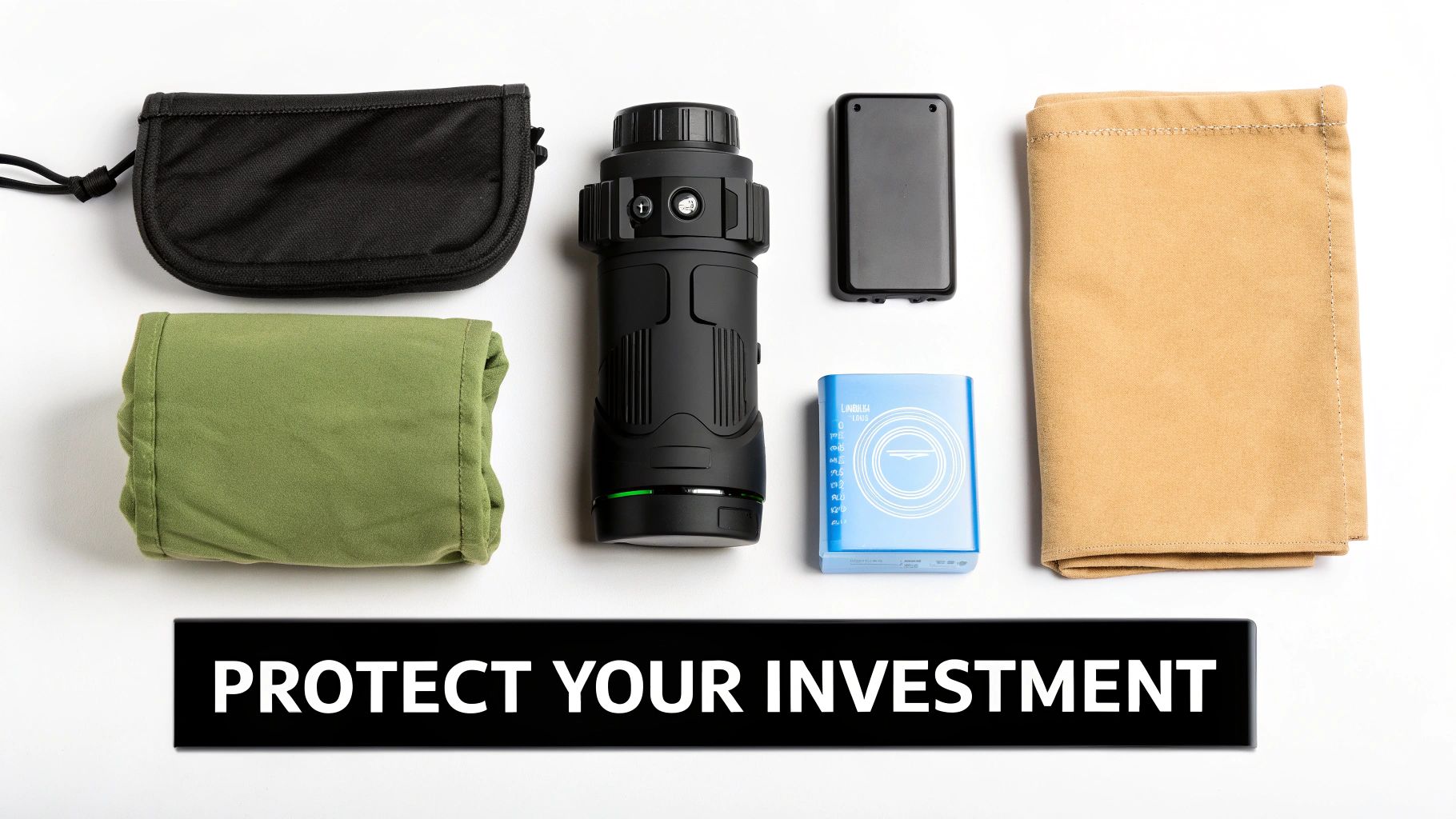
The single most important rule is to be gentle with the lens. That big, shiny objective lens is made of germanium, a material that’s fantastic at letting thermal energy pass through but is also notoriously soft and expensive. Wiping it with your t-shirt is a fast way to scratch the delicate anti-reflective coating, which will permanently degrade your image.
Essential Maintenance Practices
Beyond just cleaning the lens, a few good habits will keep the internal components happy. We're mainly talking about the battery and the software—the heart and brain of your unit.
- Battery Health: Most thermals run on lithium-ion batteries. To get the most out of them, try not to run the battery completely dead. If you're storing the unit for a while, leave it with a partial charge, somewhere around 50-70% is perfect.
- Firmware Updates: Manufacturers often release updates to improve performance, squash bugs, or even add new features. Checking for these updates every so often is a free and easy way to keep your monocular running at its best.
Protecting your investment goes beyond physical care. It also means choosing a brand that stands behind its products with a solid warranty and accessible customer support. This provides peace of mind that you have recourse if something goes wrong.
Warranty and Support You Can Trust
A good warranty is your safety net. You want clear terms and a company that’s easy to get ahold of when you need help. This is becoming even more critical as these affordable tools see wider professional use. The global thermal imaging market is expected to hit USD 7.59 billion by 2030, a huge leap from USD 4.27 billion in 2022.
This boom is driven by budget-friendly monoculars finally offering serious performance, leading to a 32% increase in adoption by U.S. police departments since 2023 alone. At Superior Tactical LLC, we back our gear with in-house repairs and free diagnostics to keep you mission-ready. Find more details on the thermal market's expansion.
Finally, don’t forget about protective accessories. A padded pouch or a hard case is non-negotiable for transport, and an external power bank is a smart move for long nights in the field. Always keep the lens cover on when you're not actively using the device. These small additions provide an extra layer of defense, making sure your best budget thermal monocular serves you well for the long haul.
Your Final Pre-Purchase Checklist
Alright, you've done the homework and you're close to making a choice. Before you commit, it's smart to run through one last mental checklist. This isn't about second-guessing yourself; it's about making sure the thermal you've picked is genuinely the right tool for your job.
Think of it like a pre-flight check. A few moments spent here can save you a world of headache and buyer's remorse down the road.
Confirm Your Mission and Budget
First things first, circle back to your primary use. What are you actually going to be doing with this thing 90% of the time? A monocular built for scanning a wide, open field is a different beast than one designed for positive ID on a coyote at 200 yards.
- Hunting: Did you stick with a low NETD (under 40mK) to see through fog and a fast 50Hz refresh rate to track that running hog without motion blur?
- Security/LE: Is the field of view wide enough for clearing a building, and does it power on fast enough for those moments when seconds count?
- Preparedness/Observation: Is the system simple enough that you could hand it to someone and they could use it? Is it built tough enough to be there when you truly need it?
With your mission locked in, double-check that you're staying within your budget tier. Don't get upsold on features you'll never use.
Review the Core Specifications
Now, let's give those key performance numbers one last look. These specs are what separate a clear, useful image from a fuzzy, frustrating one. Remember, they all work together.
The goal isn't to find the device that wins on paper. The best budget thermal is the one that excels in the specific areas that matter most for how you'll be using it.
Make sure these four specs are a solid match for what you need:
- Detector Resolution: Is that 256×192 or 384×288 resolution going to give you the detail you need at the distances you'll be working?
- NETD: Is the thermal sensitivity low enough to cut through the humidity, fog, or rain you typically encounter?
- Detection Range: Does the listed detection and recognition range give you a realistic buffer for your intended targets?
- Battery Life: Will the runtime last through a typical night out? If not, do you have a plan for an external battery pack?
Finally, who are you buying it from? A solid warranty and support from a trusted U.S.-based seller like Superior Tactical are non-negotiable. They ensure you have someone to call if things go wrong. Nail this final check, and you can be confident your new thermal is a perfect fit.
Got Questions? We've Got Answers
Even after digging into all the specs and features, you probably have a few questions rolling around in your head. It’s completely normal. This section tackles the most common things people ask us, so you can pull the trigger on your purchase with total confidence.
Let's cut through the noise and bust some common myths about what a budget thermal monocular can actually do.
Can I See Through Walls or Glass?
This is the number one question we get, and the answer is a hard no. Thermal imagers work by detecting heat, not by seeing through things like X-ray vision. A solid wall is simply too dense and insulated for the heat signature of a person on the other side to pass through. All you'll see is the surface temperature of the wall itself.
Glass is a bit different but gives you the same result. It basically acts like a mirror for thermal energy. Point your monocular at a window, and instead of seeing what's outside, you'll just get a faint, heat-based reflection of yourself.
What About Fog, Smoke, or Haze?
Now this is where thermal really earns its keep. Unlike your eyes, which need visible light, thermal imagers read infrared radiation. This energy cuts right through stuff that blocks light, like smoke, fog, dust, and heavy haze.
While a ridiculously dense fog bank might reduce your maximum range a little, a thermal monocular will still pick up heat signatures that are completely invisible to the naked eye or even a standard night vision device. It's a game-changer.
What's the Real-World Difference Between 25Hz and 50Hz?
This spec, the refresh rate, is all about how smooth the image looks, especially when things are moving. Think of it like the frames-per-second on your TV or a video game.
- 25Hz: The image refreshes 25 times per second. If you pan across a field quickly or try to track a running coyote, the image can look a bit choppy or laggy.
- 50Hz: The image refreshes 50 times per second. This gives you a smooth, fluid, real-time picture that makes it far easier to stay locked onto a moving target without getting that "stutter" effect.
For anything dynamic—hunting, law enforcement, security patrols—a 50Hz refresh rate is a massive practical advantage. We almost always recommend it if you can fit it in your budget.
How Is This Different From Digital Night Vision?
People often lump them together, but they are fundamentally different tools for seeing in the dark. Digital night vision works by gathering and amplifying tiny amounts of ambient light, like from the moon or stars, to build an image. Thermal, on the other hand, detects heat and couldn't care less if there's light or not.
Here's the bottom line: Night vision helps you see in the dark. Thermal lets you see what's hiding in the dark. A deer perfectly camouflaged in the brush might be nearly invisible with night vision, but its body heat will make it pop like a lightbulb on a thermal imager.
Picking the right budget thermal monocular comes down to knowing exactly what it can—and can't—do. Understanding these real-world capabilities ensures the gear you buy will actually work for you when it matters most.
At Superior Tactical LLC, our mission is to equip you with reliable gear and the no-nonsense advice you need to be ready for anything. Check out our hand-picked selection of thermal and night vision optics today. Find the right tool for the job at Superior Tactical's website.
