Night Vision Infrared Illuminator: night vision infrared illuminator essentials
Think of a night vision infrared illuminator as an invisible flashlight for your night vision device. Your NVD is great at amplifying tiny amounts of existing light, but what happens when there's no light at all? An IR illuminator solves that by actively throwing out a beam of infrared light—totally invisible to the naked eye—to light up the scene. It turns your passive NVD into an active system that lets you own the dark.
Seeing in Total Darkness with an IR Illuminator
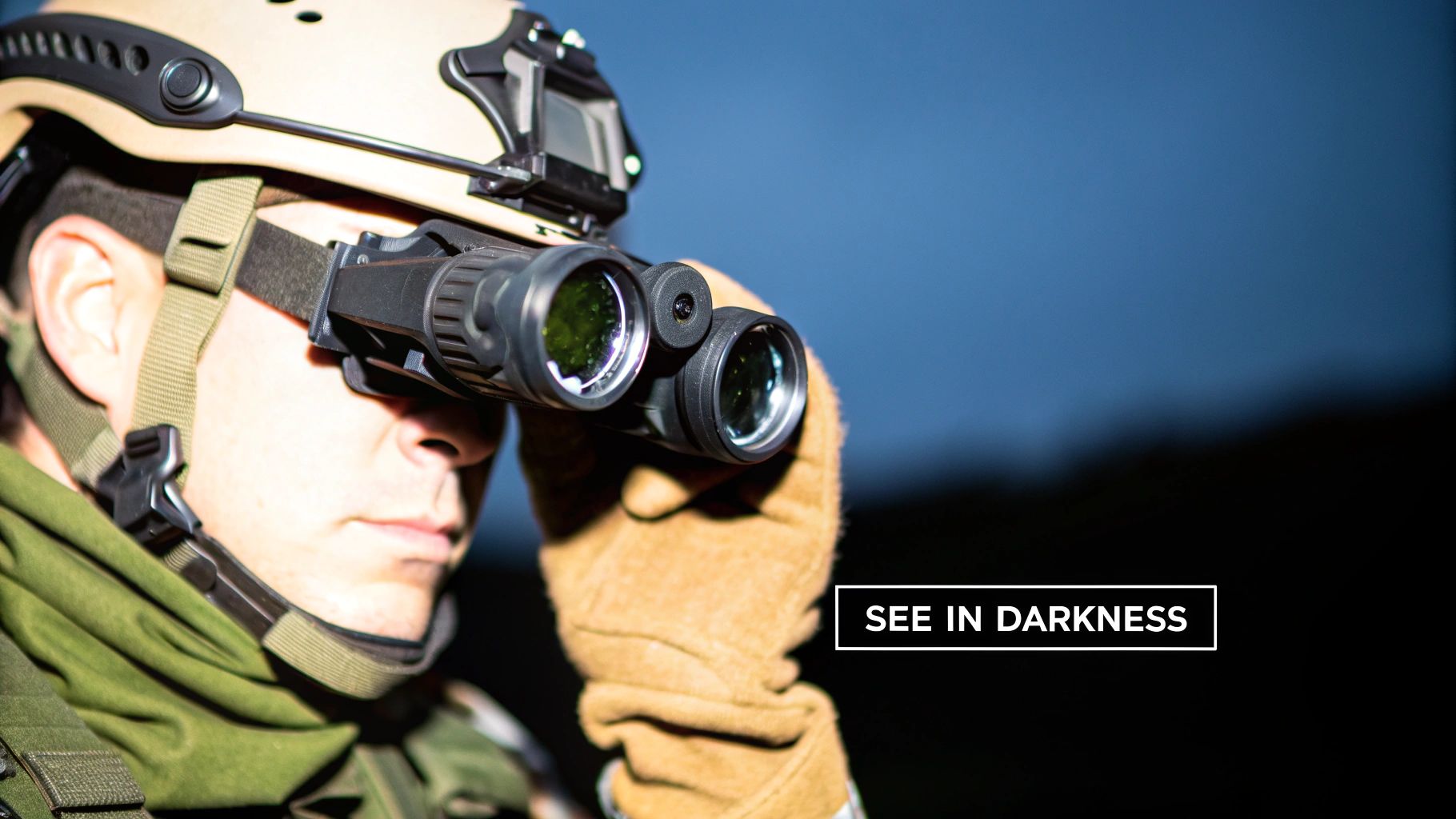
Picture yourself in a sealed room with absolutely zero light. A standard night vision device would be useless because there's no ambient light—no starlight, no moonlight—to amplify. This is where an IR illuminator becomes mission-critical. It's the difference between hoping there's enough light and making your own.
Here’s a good way to think about it: your night vision device (NVD) is like a super-sensitive microphone that can pick up the quietest whisper from across a field. But if you put that microphone in a soundproof room, it's silent. There’s nothing to amplify. An IR illuminator is like speaking into that microphone—it creates the "sound," or in this case, the light, for the NVD to "hear" and magnify.
From Passive to Active Vision
Without an illuminator, night vision is a purely passive system, completely dependent on the environment. The moment you switch on an IR illuminator, it becomes an active system. For professionals who can't afford to be at the mercy of the weather or their surroundings, this is a game-changer.
This active illumination gives you a few serious advantages:
- True Zero-Light Operation: You can see and operate in places with absolutely no ambient light, like deep caves, windowless basements, or on an overcast, moonless night in the middle of nowhere.
- Enhanced Detail and Range: The extra IR light dramatically boosts the clarity, contrast, and effective range of your NVD. This helps you identify threats and navigate difficult terrain with much more confidence.
- Improved Image Quality: It cleans up the image by reducing the "scintillation" or sparkling effect you often see in very low light. The illuminator provides a steady, consistent stream of light for the image intensifier tube to work with.
The integration of near-infrared (NIR) illuminators has completely changed the game for night vision, especially in security and surveillance. By flooding a scene with invisible IR light, these devices create clear visibility where none would otherwise exist.
This technology has more than proven its worth out in the field. Adding near-infrared (NIR) illuminators allows for clear identification in total darkness, pushing detection ranges out to 300-500 meters in urban settings. That's a 200% improvement over what you'd get from a passive system alone. You can dig into these night vision device market findings to see the full impact.
How Infrared Illuminators Actually Work
To really get a handle on how a night vision infrared illuminator pulls off its magic, you have to think about the invisible world of light all around us. Our eyes can only pick up a tiny slice of the electromagnetic spectrum—what we call visible light. Right next door, just past the red light we can see, is infrared (IR) light. We can't see it, but night vision devices sure can.
At its core, an IR illuminator is just a high-tech flashlight that pumps out this invisible infrared light. It uses powerful Light Emitting Diodes (LEDs) or laser diodes to throw a beam of IR energy out into the darkness. That energy hits whatever is out there, bounces back, and is collected by your night vision device, which turns the invisible light signature into a crisp, visible image.
This is the key difference between active and passive night vision. Instead of just struggling to amplify whatever faint starlight is available, you’re actively painting the scene with your own light source. It's how you can get a bright, clear picture even when there's literally zero ambient light.
The Critical Role Of Wavelength
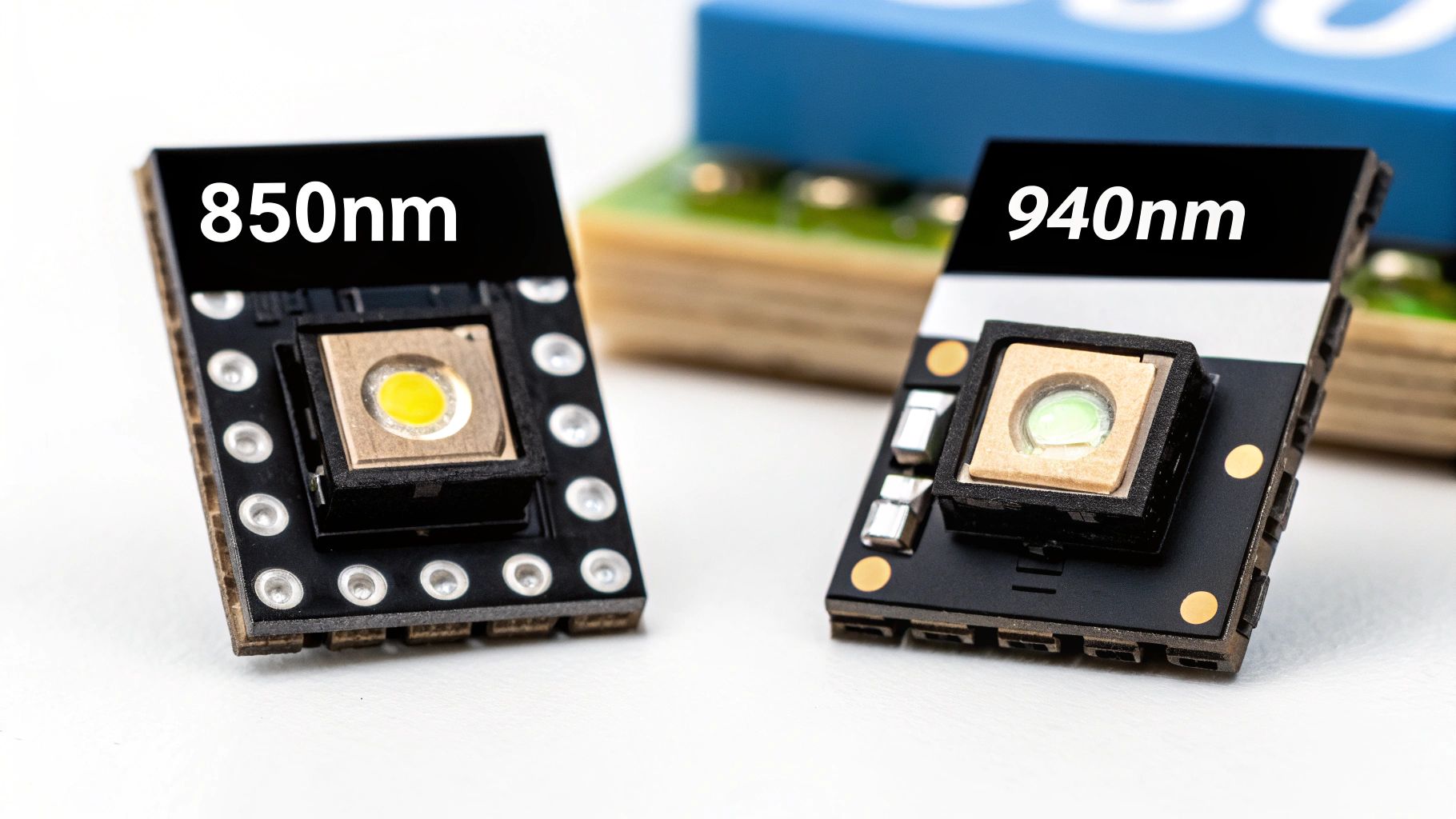
Not all infrared light is created equal. The specific wavelength an illuminator uses completely changes its performance on the ground. Wavelength is measured in nanometers (nm), and when it comes to IR illuminators, two numbers dominate the conversation: 850nm and 940nm. Knowing the difference is crucial for picking the right tool for the job.
- 850nm Illuminators: This is the workhorse wavelength. It produces a very powerful beam that gives you the best possible range and brightness with most NVDs. The only catch? The emitter itself gives off a faint, dull red glow that’s visible to the naked eye if you look right at it.
- 940nm Illuminators: This is the "stealth" option. The light it emits is almost totally invisible to the human eye, meaning no tell-tale red glow at the source. It’s the go-to choice when staying completely undetected is non-negotiable.
The price you pay for that stealth is a drop in performance. Night vision devices are less sensitive to the 940nm wavelength, which means the effective range is noticeably shorter—often by 30-40%—compared to an 850nm illuminator with the same power.
Think of it this way: an 850nm illuminator is like a loud whisper. It carries a long way, but someone looking for it might spot your position. A 940nm illuminator is a true secret whisper—it’s much harder to detect, but the target needs to be closer to get the message.
Comparing 850nm And 940nm IR Illuminator Wavelengths
To put it simply, the choice between these two wavelengths boils down to a classic trade-off: do you need maximum performance, or do you need maximum stealth? This table breaks it down.
| Feature | 850nm Wavelength | 940nm Wavelength |
|---|---|---|
| Visibility | Faint red glow visible at the source. | Completely invisible to the naked eye. |
| Stealth | Good (covert to anyone without NVDs). | Excellent (fully covert). |
| Effective Range | Maximum range and illumination power. | Reduced range (approx. 30-40% less). |
| Best Use Case | General purpose, long-range observation. | Close-quarters, tactical, and covert ops. |
When paired with a good night vision device, these illuminators can amplify image intensifiers and digital sensors by an incredible 10,000x in total darkness. Their importance is why the market for these tools is growing so fast, with projections expecting it to reach USD 1.95 billion globally by 2029. You can find more details about this expanding market on The Business Research Company.
Beam Pattern And Output Power
Wavelength is only part of the story. An illuminator's real-world effectiveness also hinges on its output power and beam pattern.
Output power, measured in milliwatts (mW), is the raw horsepower of the IR beam. Generally, a higher mW rating translates to more reach and a brighter picture.
The beam pattern is all about how that light is shaped. Most quality illuminators let you adjust the beam on the fly, switching between two essential modes:
- Flood Beam: This gives you a wide cone of light that illuminates a huge area. It's perfect for maintaining situational awareness, navigating terrain, or scanning your immediate surroundings.
- Spot Beam: This focuses all the illuminator's power into a tight, narrow beam. It’s what you use to punch through the darkness and positively identify a target at long range.
The ability to snap from a wide "flood" for scanning a field to a tight "spot" to check out a noise on the far tree line is a massive tactical advantage. It’s what makes a single night vision infrared illuminator an indispensable, multi-role tool. You can dive deeper into how this works with various systems by exploring our guide on different types of night vision technology.
Choosing the Right Illuminator for Your Night Vision Device
Pairing an IR illuminator with your night vision device (NVD) isn't as simple as just slapping it on and flipping a switch. The two pieces of gear have to work together, and a bad match will give you a grainy, washed-out image—or worse, nothing at all. Getting this right is about building a system where each part complements the other.
I like to use a microphone and speaker analogy. If you have a cheap, weak mic, you need a powerful speaker to be heard. But if you plug a high-end, sensitive studio mic into that same speaker and crank it to 11, you just get a wall of painful, distorted feedback. Night vision and IR light work the same way.
Matching Illuminator Power to Your NVD Generation
Every generation of night vision has a different level of sensitivity to light. That sensitivity is what determines how much of a helping hand it needs from an illuminator to see in the dark.
-
Generation 1: These are the most affordable units, but they're also the least sensitive. Gen 1 devices are incredibly "light hungry" and almost always need a powerful IR illuminator to give you a usable image in true darkness. For Gen 1, a strong illuminator isn't just a nice-to-have; it's a must-have.
-
Generation 2: Gen 2 was a huge leap forward in performance. These units are much more sensitive and can work in far lower light conditions. They still get a massive boost from an illuminator, but they don't need the fire-breathing power that a Gen 1 unit requires. A solid mid-range illuminator is usually the sweet spot here, giving a clean boost of light without overwhelming the tube.
-
Generation 3 & Above: This is where that sensitive microphone analogy really clicks. High-end Gen 3 tubes are incredibly good at amplifying whatever ambient light is available. If you blast a top-tier Gen 3 device with a high-powered illuminator, you'll instantly "white out" the image. This washout is a phenomenon called autogating kicking in to protect the tube, but the result is a bright, useless picture.
With a high-performance Gen 3 device, a lower-power, focusable illuminator is almost always the better choice. It lets you add a small, precise sliver of IR light to spot a distant target without nuking your entire field of view.
What About Digital Night Vision?
Digital night vision is a different animal. Instead of an analog tube, it uses a digital sensor to see, much like the camera in your phone. While digital NVDs are incredibly effective, their sensors are generally less sensitive than Gen 3 analog tubes, especially when it's pitch black.
Because of this, digital systems lean heavily on a good night vision infrared illuminator to perform at their best. They can handle a lot more IR light before washing out, which makes powerful illuminators a great way to seriously extend their range and image clarity.
Built-In vs. Standalone Illuminators
The type of illuminator you run is just as important as how powerful it is. Your choice usually comes down to three main styles, each with its own set of trade-offs.
| Illuminator Type | Best For | Key Considerations |
|---|---|---|
| Built-In | Convenience, close-range tasks, and users on a budget. | Typically low-power with a fixed, "floody" beam. They drain the NVD's battery. Perfect for reading a map but useless for long-range work. |
| Weapon-Mounted | Target identification, hunting, and tactical situations. | Adds weight to your firearm but puts the IR beam exactly where your optic is pointed. You illuminate what you aim at, period. |
| Standalone/Helmet-Mounted | Ultimate flexibility, situational awareness, and professional use. | Can be aimed separately from your NVD or weapon. This lets you "paint" a dark corner without flagging it with your rifle. It offers the most control. |
In the end, it's all about creating a balanced system. For a light-hungry Gen 1 or digital unit, a powerful weapon-mounted illuminator is a game-changer. For a sensitive Gen 3 monocular used for navigation, a tiny, low-output helmet-mounted "task light" is all you need to get the job done without destroying your dark adaptation. Matching the tool to the task—and the technology—is what separates a mediocre setup from a truly effective one.
Where the Rubber Meets the Road: IR Illuminators in Action
Theory is one thing, but seeing a night vision infrared illuminator perform in the field is where you understand its real power. This isn't just some fancy accessory. For professionals who operate after dark, it’s a critical piece of gear that can make or break a mission and keep them safe.
IR illuminators offer a massive advantage in high-stakes situations. Whether you're in a pitch-black forest or a shadowy city alley, an illuminator turns an unknown environment into a space you can see and control. Let's look at how these tools are actually used by the people who count on them most.
Law Enforcement and Tactical Operations
Picture a SWAT team about to clear a dark, abandoned warehouse. There’s zero ambient light, which means their night vision devices are basically blind. This is where a high-output, weapon-mounted illuminator becomes the most important tool they have.
As they move down a long corridor, an officer can crank the illuminator’s beam down to a tight "spot." This focused jet of invisible light punches through the darkness, letting them scan the entire length of the hallway and spot threats from a safe distance, all without tipping off anyone with the naked eye.
Then, when they get to a closed door, they can instantly open the beam up to a wide "flood." This paints the entire room with IR light the moment they enter, giving them total situational awareness and leaving no corner in shadow. That ability to manipulate invisible light gives them complete control.
In a tactical environment, controlling the light means controlling the situation. An IR illuminator lets an operator paint the darkness with invisible light, seeing everything without being seen.
This isn't just a niche tool anymore; the numbers prove it. The North American night vision market is booming, thanks in part to major defense contracts for helmet-mounted systems that come with built-in IR illuminators. Law enforcement adoption is also on the rise, jumping 22% between 2020 and 2024. In fact, IR-equipped body cams have been shown to cut officer response times by 35% during low-light urban patrols. You can see more data on the night vision device market on MarketsandMarkets.
Search and Rescue Operations
Now, imagine a search and rescue (SAR) team looking for a lost hiker in a remote, wooded area at night. The search grid is huge, covering miles of thick woods and rugged ground. Just wandering around with NVDs would be slow, dangerous, and likely pointless.
This is where a powerful, tripod-mounted IR illuminator can completely change the game. From a good vantage point, the team can sweep a massive flood of infrared light across entire valleys. This lets an observer with night vision spot a heat signature or the slightest movement that would otherwise be impossible to see.
This approach gives SAR teams a few massive advantages:
- More Ground Covered, Faster: A single powerful illuminator can light up hundreds of square meters at once, radically speeding up the search.
- Better Chance of a Sighting: The bright, consistent IR light makes it much easier to pick out subtle details, like a piece of clothing or a person lying on the ground.
- Keeps the Team Safe: Team members can use their own smaller, helmet-mounted illuminators to navigate the rough terrain, cutting down the risk of trips and falls.
Wildlife Observation and Photography
For a wildlife photographer, the goal is to capture an animal’s natural behavior without spooking it. Since so many interesting species are nocturnal, a regular flashlight would send them running in a heartbeat. This is where a stealthy 940nm illuminator is worth its weight in gold.
A photographer can set up near a game trail with a completely covert 940nm illuminator. This invisible light source lets their digital night vision camera record stunning, high-definition footage of animals behaving as if no one is there.
Because there's no faint red glow like you'd get from an 850nm illuminator, the risk of startling the animal is practically zero. This is a perfect example of why choosing the right wavelength is so critical—sometimes, total stealth is more important than raw power. If you're an outdoors enthusiast, understanding how these tools work is key; check out our guide on the best night vision flashlights for hiking and camping for more tips on that front.
How to Pick the Right IR Illuminator for Your Mission
Choosing the right night vision infrared illuminator isn’t about chasing the highest power or the longest range. It’s about matching the tool to the job. The best illuminator is the one that disappears into your workflow, seamlessly enhancing what your night vision can do in the real world. Think of it less like buying a flashlight and more like selecting a critical piece of operational gear.
This flowchart breaks down the decision-making process, guiding you from your primary mission to the specific features that will serve you best.
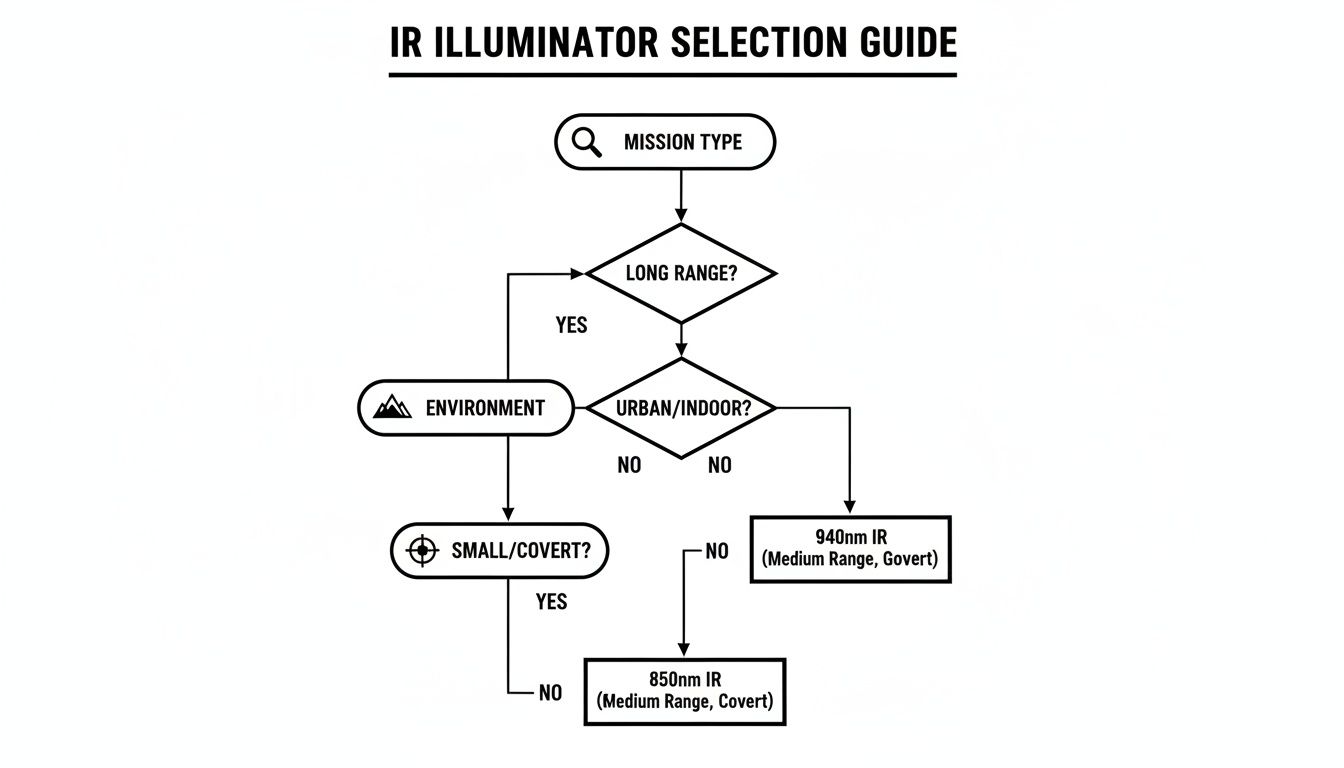
As you can see, everything starts with what you're trying to accomplish. Your mission—whether it's simple navigation, detailed surveillance, or positive target ID—sets the stage for every other choice you'll make.
Start With Your Mission and Environment
First things first: what are you actually doing in the dark? Are you trying to find your way through a dense forest, or are you trying to identify a threat across a wide-open field? The answer changes everything.
-
Navigation & Situational Awareness: For moving around and getting a sense of your immediate surroundings (inside 50 yards), you need a wide, "floody" beam. A low-to-medium power illuminator, usually mounted on your helmet, gives you plenty of spill without washing everything out or ruining your natural dark adaptation.
-
Mid-Range Observation: Need to get a better look at something between 50 and 150 yards? This is where a focusable beam becomes non-negotiable. You need the ability to go from a wide flood for scanning to a tighter spot beam to see exactly what you're looking at.
-
Long-Range Identification: Pushing past 150 yards for spotting game or conducting long-range surveillance? Now, raw power is your friend. You'll want a high-output unit with a tight, focusable "spot" beam that can really throw that IR energy downrange.
Power Source and Runtime: Don't Get Left in the Dark
An illuminator is just dead weight if the batteries die halfway through the night. Your power plan needs to fit your mission profile and logistical reality.
Do you prefer common disposables like CR123A or AA batteries? They're easy to find and swap out on the move. Or do you lean toward rechargeables, which save money over time but require access to a power source?
Whatever you choose, pay close attention to the manufacturer's listed runtime, and remember that running it on full blast will drain the battery much faster. Always, always carry at least one full set of spares.
A good rule of thumb for any professional is to pack enough power for twice your expected mission time. If you’re planning a four-hour operation, you better have enough batteries to run that illuminator for eight solid hours.
Mounting and Integrating With Your System
How you attach your night vision infrared illuminator is just as critical as its performance specs. The mount determines how you use it and how well it plays with the rest of your kit.
- Weapon-Mounted: This is the standard for hunters and tactical operators. It keeps your IR light perfectly aligned with your bore and your optic, ensuring the light is always where you're aiming.
- Helmet-Mounted: This setup gives you a hands-free light source that follows your head movement. It's perfect for navigation, driving, or handling gear in the dark.
- Standalone/Tripod: For static observation posts or search and rescue operations, mounting a powerful illuminator on a tripod lets you "paint" a massive area with IR light from a fixed position.
Durability and Weather Resistance
Let's be honest—your gear is going to get beat up. Make sure your illuminator can take the abuse.
Look for clear durability ratings. An IP rating (like IP67) tells you how well it resists dust and water. Shock-resistance ratings tell you if it can handle the repeated recoil from a firearm. A body machined from anodized aluminum is generally the go-to for a tough, lightweight build.
Below is a quick-reference table to help you align your primary use case with the most critical illuminator features.
Key Feature Decision Matrix For IR Illuminators
This table provides a starting point for matching your needs to the right specs.
| Primary Use Case | Recommended Wavelength | Ideal Beam Type | Power Considerations |
|---|---|---|---|
| Close-Quarters/Home Defense | 850nm (for max brightness) | Wide "Flood" Beam | Low-to-Medium |
| General Hunting/Pest Control | 850nm or 940nm | Adjustable (Flood-to-Spot) | Medium-to-High |
| Law Enforcement/Tactical Ops | 940nm (for better stealth) | Adjustable & Weapon-Integrated | High, with reliable power |
| Search and Rescue (SAR) | 850nm | High-Power, Wide Flood | Long Runtime is a Must |
| Covert Surveillance | 940nm (absolutely essential) | Tight, Long-Range "Spot" | High-Output, Often Tripod-Mounted |
This matrix isn't the final word, but it's a solid framework to build from as you narrow down your options.
Making the right call means weighing all these factors together. For a broader overview of the gear that completes your night vision setup, you can learn more about how to choose night vision accessories online with expert tips and make sure every piece of your kit works in harmony.
Here is the rewritten section, designed to sound completely human-written and natural.
Owning the Night
If there's one thing to take away from all this, it's that an IR illuminator isn't just another piece of gear you bolt onto your setup. It's a genuine force multiplier. It turns your night vision device from a passive tool that simply gathers existing light into an active system that lets you paint the darkness with invisible light, giving you total control.
Mastering your night vision setup really comes down to understanding that relationship. It's about matching the illuminator's capabilities—its wavelength, power, and beam pattern—to what you actually need to do. Get it wrong, and you could be facing a critical failure instead of a tactical advantage.
It All Comes Down to the Mission
There's no one-size-fits-all answer here. The core trade-offs are always in play: 850nm gives you that incredible reach, but 940nm keeps you hidden. A wide flood beam is perfect for scanning a field, but you need a tight spot beam to positively identify a target way out there.
Think of it like building a custom rifle. Every component has to work together.
- What NVD are you running? An older Gen 1 or digital unit is thirsty for light and needs a powerful illuminator just to be effective. A high-spec Gen 3 tube, on the other hand, is so sensitive that you need a much lighter touch to avoid blowing out the image.
- What's the job? A police officer clearing rooms has completely different needs than a hunter scanning for hogs or a photographer trying to capture nocturnal wildlife. The mission dictates the gear, period.
The real goal is to build a seamless system. You want an illuminator that provides the exact amount and type of invisible light you need to get the job done, turning a pitch-black environment into your personal advantage.
Looking at what's next, the future for IR tech is exciting. We're already seeing more efficient emitters that give you more performance without killing your batteries. Everything is getting smaller, lighter, and better integrated into weapon and helmet systems. These advancements are only going to make it easier to operate safely and effectively when the sun goes down.
With the right knowledge and the right gear, you're no longer just working in the dark—you're owning it.
Common Questions About IR Illuminators
Even after getting a good handle on how an infrared illuminator works, there are always a few specific questions that pop up. Let's tackle some of the most common ones to clear up any confusion and get you using your gear like a pro.
Can You See IR Light with the Naked Eye?
Nope. The human eye simply isn't built to see light on the infrared spectrum. It sits just beyond the visible light we see every day, which is exactly what makes it so useful for staying unseen. You can light up a whole field, and anyone without night vision will be completely oblivious.
That said, there's a small catch. An 850nm illuminator's emitter gives off a faint, dull red glow. If someone is looking right at the source, they can spot it. For true stealth, a 940nm illuminator is the way to go, as it's virtually invisible to the naked eye.
Does an IR Illuminator Work with a Thermal Scope?
This is a very common mix-up, but the answer is a hard no. IR illuminators and thermal optics are fundamentally different technologies and don't work together.
Here’s a simple way to think about it:
- Night Vision amplifies reflected light. It needs a light source—whether it's the moon, stars, or an IR illuminator—to function.
- Thermal Imaging detects heat. It creates an image by reading the tiny differences in temperature between objects and their surroundings. It needs zero light to work.
Think of it this way: an IR illuminator is a special flashlight for your night vision device. Trying to use it with a thermal scope is like shining a flashlight at your ears to help you hear better. They're built for two completely different senses.
What’s the Real-World Range of an IR Illuminator?
How far your IR illuminator can throw light depends on a handful of things: its power output (in milliwatts), how tightly you can focus the beam, the wavelength you're using (850nm tends to have a longer reach), and how sensitive your night vision device is. A basic, budget-friendly unit might only give you good illumination out to 50-75 yards.
On the other end of the spectrum, a high-end illuminator can light up targets hundreds of yards away. When you pair a powerful, focusable illuminator with a top-tier night vision device, you can push that range out past 500 yards. Just remember that bad weather like fog or heavy rain will cut that distance down significantly.
Will Using an IR Illuminator Kill My NVD's Battery?
If you're relying on the small, built-in illuminator that comes on many night vision units, then yes, it absolutely will. Those little guys pull power directly from the main battery, and you'll definitely notice a shorter run time.
This is exactly why most seasoned operators run an external illuminator. A dedicated, standalone unit runs on its own batteries (like CR123A or 18650 cells), so it doesn't touch your night vision's power supply. You get the full operational life out of your NVD and can use the extra IR light as much as you need without worrying about draining your primary optic.
At Superior Tactical LLC, we provide the high-quality gear you need to operate effectively in any light condition. Explore our curated selection of night vision, thermal optics, and tactical accessories to find the perfect tools for your mission. Find out more at https://superiortac.com.
