A Complete Guide to Gen 3 NVG Technology
If you’ve heard people talking about Gen 3 NVG, you've heard them talk about the gold standard. It’s the benchmark for high-performance night vision, known for giving users incredible clarity when it's nearly pitch black outside. This technology was a massive leap forward, delivering a bright, clean image where older gear would just fizzle out.
Unlocking the Night: What Is Gen 3 NVG Technology?
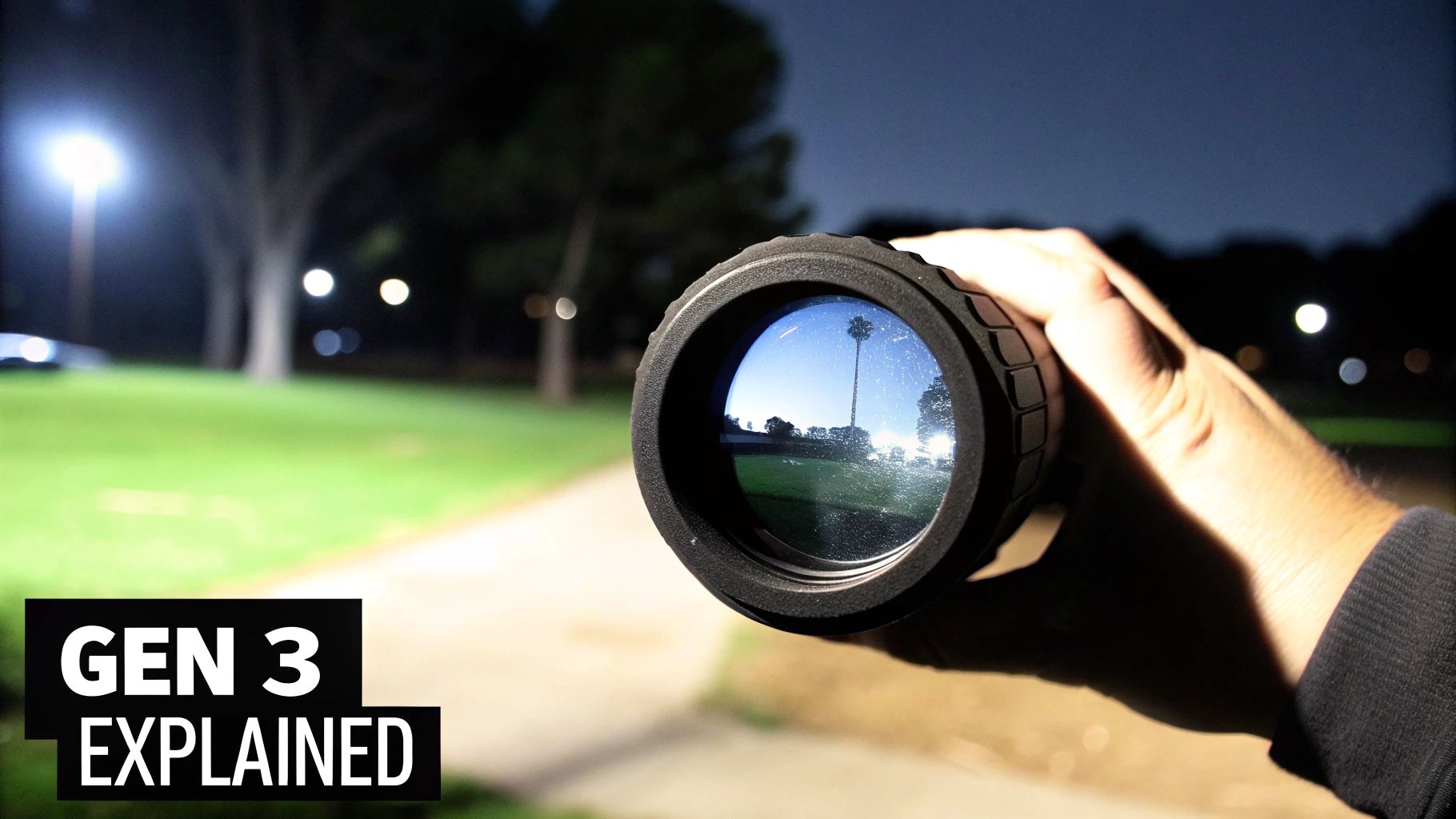
To really get what makes a Gen 3 device so special, you have to look inside at its heart and soul: the image intensifier tube. You can think of this tube as the engine that drives the whole system. While earlier generations did their best with the tech of the time, Gen 3 brought a true game-changer to the table.
The secret sauce is its Gallium Arsenide (GaAs) photocathode. The photocathode's job is to catch whatever tiny amount of light is available—starlight, moonlight, you name it. The Gallium Arsenide material is just vastly better at grabbing those faint photons and converting them into electrons compared to anything that came before it.
How the Magic Happens: A Simple Breakdown
Once the GaAs photocathode turns light into electrons, the real amplification kicks in. Those few electrons are multiplied thousands of times over inside the tube before hitting a phosphor screen, which lights up to create the image you see. This whole chain reaction happens in an instant, turning a scene you can't see with your naked eye into a clear, green-tinted (or white) landscape.
Here’s a good way to think about it. Imagine Gen 1 or Gen 2 night vision is like a basic microphone that can pick up a whisper in a quiet room but gets drowned out by any background noise. A Gen 3 NVG is more like a professional studio microphone that can isolate that same whisper from across a noisy stadium and play it back with perfect clarity. That’s the kind of light-gathering power we’re talking about.
The move to a Gallium Arsenide photocathode wasn't just a small step up. It completely redefined what was possible with night vision, setting a new performance floor for military, law enforcement, and serious civilian users.
The Real-World Payoff of Gen 3
This leap in technology isn't just about impressive numbers on a spec sheet; it translates directly to what you can see and do in the dark.
Here are the key advantages you get with true Gen 3 tech:
- Better Performance in the Dark: You can see clearly even on an overcast, moonless night when there’s almost no ambient light to work with.
- A Sharper, Cleaner Image: The picture is much crisper and more detailed. You'll see far less of the static, or "scintillation," that plagues older units.
- See Further, Identify Sooner: That improved sensitivity means you can spot and identify targets, animals, or people from much farther away.
- Built for the Long Haul: Gen 3 tubes are incredibly durable, often rated for 10,000+ hours of use. This isn't a disposable piece of gear; it's a long-term investment.
Getting a handle on the Gallium Arsenide photocathode is the first real step to understanding why Gen 3 has the reputation it does. It’s the foundational innovation that makes all the other performance specs we're about to dive into possible.
The Science Behind Gen 3's Crystal-Clear Images
So, what exactly makes a Gen 3 night vision device so much better? To really get it, you have to look under the hood at the core components that turn near-total darkness into a surprisingly bright, sharp image. We're not going to get lost in complex engineering diagrams, but understanding a few key parts shows you where the magic really comes from.
The Microchannel Plate: The Heart of the Image
At the very core of a Gen 3 tube is the Microchannel Plate (MCP). The easiest way to think of it is as a powerful amplifier for light. Instead of boosting sound like an amp for your guitar, it boosts electrons. Imagine a tiny glass disc, no thicker than a coin, that’s been honeycombed with millions of microscopic, hollow tubes.
When the few photons of light that enter your device are converted into electrons, they hit this plate. As each electron zips through a channel, it bounces off the specially coated walls, knocking loose more and more electrons in a massive chain reaction. A single electron going in can result in thousands coming out the other side. This incredible multiplication is what takes a faint, starlit scene and makes it bright enough for you to see clearly.
Figure of Merit: The Quick and Dirty Performance Score
As you start shopping around and comparing tubes, you'll see one spec pop up constantly: Figure of Merit, or FOM. It sounds intimidating, but it’s actually the single most useful number for quickly judging a tube's overall performance.
FOM is basically a final grade for the image intensifier. It’s calculated by multiplying the tube's resolution (in lp/mm, or line pairs per millimeter) by its Signal-to-Noise Ratio (SNR). A higher FOM means a cleaner, sharper, and less "sparkly" image, especially when the lights get really low.
It's a practical, real-world metric. A tube with a FOM of 2100 is going to give you a noticeably better picture than one rated at 1800. You’ll be able to spot details from further away and with less of that distracting electronic "snow" in the background. The MCP plays a huge role here, as its ability to amplify the signal is what drives up that all-important SNR.
To see how the MCP and other parts work together in the image intensification process, check out our guide on how night vision works.
Autogating: Your Shield Against Bright Lights
Picture this: you're moving through a dark alley and a car suddenly rounds the corner, hitting you with its high beams. With older, non-gated night vision, your view would instantly wash out in a blinding white flare, leaving you blind and potentially damaging the tube itself. This is the exact problem Autogating was designed to solve.
Think of autogating as a super-fast, automatic dimmer switch for the image tube. It's constantly flickering the power supply on and off thousands of times per second—so quickly that your brain just sees a smooth, continuous image.
The moment a bright light source enters your field of view, the system instantly dials back the power. This prevents the tube from being overloaded, drastically reduces the "blooming" or halo effect around the light, and protects the unit from permanent damage. It's a must-have feature that keeps you in the fight and protects your investment, especially in dynamic urban environments with car headlights and muzzle flashes.
How Gen 3 Compares to Other NVG Generations
To really get why a Gen 3 NVG is such a big deal, you have to look at where the technology came from. The history of night vision isn't just a story of small, incremental updates; it’s a series of massive leaps in what's possible in the dark. Seeing how Gen 3 stacks up against the older generations makes it crystal clear why it's the benchmark for anyone who's serious about night operations.
The journey started with Generation 1. As the first night vision available to the public, it was an amazing idea. But in practice, Gen 1 devices were hungry for light—they needed a good bit of moonlight to work and were almost completely dependent on infrared (IR) illuminators. The view you got was often grainy, with a classic "fish-eye" distortion around the edges, and the effective range was pretty limited.
Then came Generation 2, which was a huge step up. The game-changer here was the introduction of the Microchannel Plate (MCP), which allowed these devices to work in much darker conditions without constantly blasting an IR illuminator. The image was brighter, clearer, and had far less distortion than Gen 1. For a long time, Gen 2 was the professional standard, and it still offers decent performance for a lot of civilian uses today.
A Clear Leap in Performance
While Gen 2 was a major improvement, Gen 3 changed the game entirely. The key innovation was a Gallium Arsenide photocathode, which skyrocketed light sensitivity and pushed performance into a whole new league. A modern Gen 3 NVG can deliver a crisp, bright image in environments so dark that a Gen 2 device would barely show you a thing.
This diagram shows the science behind what makes Gen 3 tick.
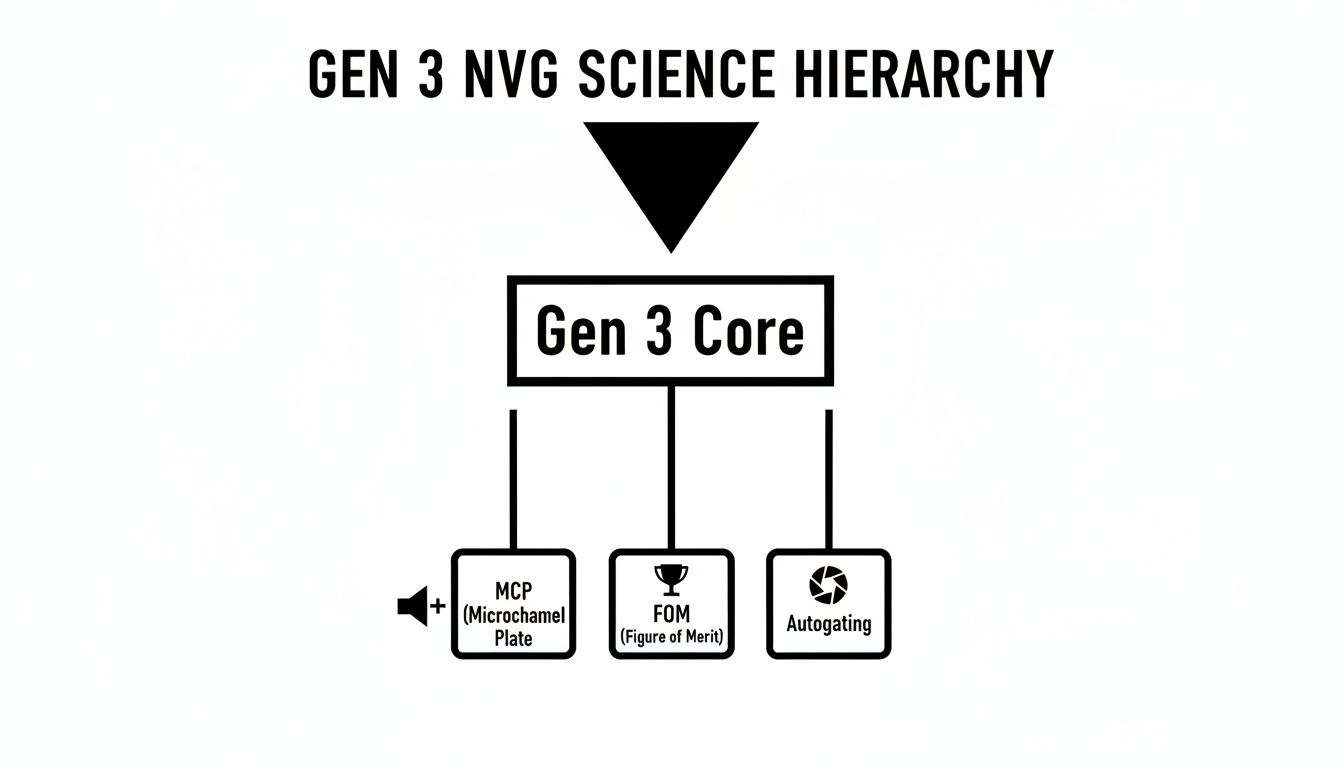
As you can see, it's the combination of the Microchannel Plate, a high Figure of Merit (FOM), and Autogating that all work together to produce the incredible images Gen 3 is famous for.
The performance gap really shows up in a few key areas:
- Low-Light Sensitivity: A Gen 3 unit can amplify available light by 30,000 to 50,000 times. Compare that to Gen 2, which tops out around 20,000 times. This is why Gen 3 absolutely excels in moonless, starlight-only conditions.
- Image Clarity: With resolution specs often hitting 64 line pairs per millimeter (lp/mm) or higher, Gen 3 gives you a much sharper, more detailed picture. Gen 2 typically sits in the 45-54 lp/mm range.
- Tube Longevity: An ion barrier film protects the Gen 3 photocathode, giving these tubes a massive operational life of 10,000+ hours. That easily doubles the 2,500-5,000 hour lifespan you’d expect from most Gen 2 units.
To give you a side-by-side look, here’s a quick breakdown of how the different generations stack up.
Night Vision Generations Performance Comparison
| Feature | Generation 1 | Generation 2 | Generation 3 |
|---|---|---|---|
| Light Amplification | ~1,000x | ~20,000x | 30,000x – 50,000x+ |
| Image Quality | Grainy, edge distortion | Clearer, less distortion | Sharp, high-resolution |
| Low-Light Need | High (needs moonlight/IR) | Moderate (works in starlight) | Very Low (excels in starlight) |
| Tube Lifespan | ~1,500 hours | ~2,500 – 5,000 hours | ~10,000+ hours |
| Common Use Cases | Hobbyist, casual use | Hunting, amateur astronomy | Military, law enforcement, serious use |
This table really highlights the jump in performance and durability that Gen 3 brings to the table, making it the clear choice for demanding applications.
For a more detailed look into the tech that defines each era, you can explore our full guide on the evolution of night vision generations right here on our site.
What About So-Called Gen 4?
You might hear people talk about "Gen 4" or "Filmless" tubes, but it's crucial to know this isn't an official U.S. military designation. What people are actually referring to is a specialized variant of Gen 3 technology that removes the ion barrier film from the MCP.
So what's the trade-off? Removing that protective film can squeeze out a bit more light sensitivity and reduce the "halo" effect you see around bright light sources. The major downside, however, is that it drastically cuts down the tube's operational lifespan. Because of this hit to durability, the military chose not to adopt it as the next official generation, classifying it instead as an advanced type of Gen 3.
At the end of the day, Gen 3 remains the gold standard. It offers an incredible, time-tested balance of raw low-light performance, image clarity, and the long-term durability needed for serious use—a combination that older generations just can't match.
Real-World Uses for Gen 3 Night Vision

Technical specs like FOM and autogating are great for comparing tubes, but they don't tell the whole story. The real proof of a Gen 3 NVG is what it lets you do in the field, where that top-tier performance changes outcomes in high-stakes situations and opens up a whole new world for outdoor enthusiasts.
After all, night vision gets used everywhere from pitch-black forests to shadowy city streets. That's where the advanced capabilities of Gen 3 stop being numbers on a spec sheet and become an indispensable tool.
Military and Law Enforcement Operations
For anyone in uniform, owning the night isn't just an advantage—it's a mission requirement. The incredible clarity and low-light sensitivity of a Gen 3 NVG are absolutely critical for maintaining situational awareness and spotting threats long before you're in danger. When things go sideways, being able to tell friend from foe in an instant is everything.
With a high-resolution Gen 3 tube, an officer can read a license plate from a hundred yards away, identify a suspect's face in a dark alley, or spot the glint of a hidden weapon. Older tech would just show a grainy blob. That level of detail fuels better, faster decisions under pressure, which is why this technology is the standard for professional night ops.
The market data backs this up. A huge slice of defense and agency spending is earmarked for Gen 3 and better systems, simply because they offer a proven tactical edge. You can see the scale of this demand in reports on the global night vision device market from Stratview Research.
Ethical Hunting and Wildlife Observation
Away from the front lines, Gen 3 NVG technology is a game-changer for serious hunters and wildlife enthusiasts. Its biggest advantage is the ability to positively identify an animal from a distance in near-total darkness, a cornerstone of ethical hunting. No hunter wants to make a mistake because of poor visibility, and Gen 3’s clarity takes that risk off the table.
For those heading outdoors, the benefits are clear:
- Positive Target ID: The crisp image lets you confirm the species, sex, and size of an animal before even thinking about taking a shot.
- Safer Navigation: Getting to your blind before dawn or tracking an animal after dusk becomes far less treacherous when you can see every root and rock.
- Natural Observation: Wildlife watchers can see animals behaving completely naturally, without spooking them with flashlights or IR illuminators.
Search and Rescue Missions
When someone is lost, the clock is always ticking, and most search and rescue (SAR) missions run straight through the night. Teams are often dealing with rough, unknown terrain where one bad step can lead to another emergency. In these scenarios, Gen 3 night vision is a lifesaver.
The ability to scan a huge, dark mountainside and pick out the faint shape of a lost hiker or a piece of their equipment can cut search times dramatically. The clarity a Gen 3 NVG provides can literally be the difference between life and death.
This tech allows SAR teams to move faster and with more confidence in the dark, covering more ground safely. Whether they're scanning from a helicopter or hiking through a dense forest, the performance of Gen 3 gives them a massive operational advantage when every second counts. It's truly essential gear for any serious SAR organization.
How to Choose and Buy a Gen 3 NVG Device
Investing in Gen 3 night vision is a big step, and understanding what you're actually buying is crucial. Unlike grabbing a new phone off the shelf, two NVG units that look identical can have wildly different performance and price tags. It all comes down to the image intensifier tube humming away inside.
Navigating the market isn't as intimidating as it first seems. You just need to know what to look for, who to trust, and what the rules are. Let’s walk through the essentials so you can get the right gear for your mission and budget.
Decoding the Spec Sheet
Any reputable Gen 3 device will come with a spec sheet. Think of it as the tube's birth certificate—it has all the performance data recorded right after it was made. It's loaded with numbers, but you really only need to focus on a few key values to know what you're getting.
Here are the most important specs to look for:
-
Figure of Merit (FOM): This is your quick, at-a-glance performance score. It matters a lot. A tube with a 2200 FOM will give you a much cleaner, more capable image in near-total darkness compared to one with an 1800 FOM.
-
Signal-to-Noise Ratio (SNR): This number tells you how clean the image will be. A higher SNR means less of that grainy "snow" or static, which is a lifesaver on really dark nights. For Gen 3, an SNR above 30 is generally considered excellent.
-
Resolution (lp/mm): Measured in line pairs per millimeter, this is all about detail. The higher the number—like 64 lp/mm or 72 lp/mm—the crisper and sharper the image will be.
-
Blemishes (Blems): These are tiny black spots that are a normal artifact of the manufacturing process. The spec sheet will actually map out where they are and how big they are. A few small blems on the outer edges are totally normal, but a "clean" tube with no spots in the very center (Zone 1) is more desirable and will cost more.
Grasping these four metrics gives you the power to compare different units and understand exactly what you’re paying for. If you want to go even deeper, check out our complete guide on how to choose the right night vision device for your needs.
New vs. High-Quality Refurbished Units
When you start shopping, you’ll see both brand-new and refurbished or used Gen 3 NVGs. Both can be great options, but the right choice boils down to your budget and how much risk you're comfortable with.
New Devices:
Buying new from an authorized dealer like Superior Tactical means you're the first and only owner. You get a perfect tube straight from the factory, backed by a full manufacturer's warranty—often a solid 10 years for high-end Gen 3 systems. This is the safest, most straightforward path.
Refurbished/Used Devices:
A good refurbished unit can be a fantastic way to get Gen 3 performance without the brand-new price tag. The key word here is good. It is absolutely critical to buy from a reputable source that gives you a detailed spec sheet and offers their own warranty. Flying blind here could mean ending up with a tube that has tons of hours, hidden damage, or just plain poor performance.
When considering a used device, the reputation of the seller is everything. A trusted vendor will have thoroughly inspected the unit, provided transparent specs, and will stand behind the product they sell.
Legal and Regulatory Considerations
Finally, you have to be aware of the laws surrounding night vision. High-performance Gen 3 devices are regulated under the International Traffic in Arms Regulations (ITAR).
Here's what that means for you as a buyer:
- U.S. Persons Only: You must be a U.S. citizen or a legal resident to buy and own a Gen 3 device.
- No International Shipping: It is illegal to take or ship this technology outside the United States without a specific license from the U.S. Department of State.
- Proof of Citizenship: To stay compliant, reputable dealers will require proof of citizenship before they can complete the sale.
These rules exist for national security reasons and are taken very seriously. Always buy from a dealer who understands and follows ITAR. It ensures your purchase is fully legal and protects you down the road. By doing your homework on the specs, the seller, and the law, you can confidently invest in a Gen 3 NVG that will serve you well for years to come.
Keeping Your Gen 3 NVGs Running for the Long Haul
A Gen 3 night vision device is a serious investment, not just another piece of gear. Think of it like a high-performance engine—it needs the right care to keep running at its peak. Without some basic, routine maintenance, you risk damaging the sensitive guts of the unit, which can lead to expensive repairs or a much shorter lifespan.
The good news? Most of this is just common sense. A few simple habits are all it takes to protect your NVGs. Your main focus should be on two things: the heart of the system—the image intensifier tube—and the glass it looks through.
Don't Blind Your Tube
The image intensifier tube is what makes the magic happen, but its biggest weakness is bright light. Pointing an active tube at daylight, a room light, or even the beam of a powerful flashlight can cause permanent damage called burn-in. You’ll know it if you see it—it leaves a nasty black spot in your vision that never goes away.
Here’s how you avoid that heartache:
- Day Caps Are Not Optional: Always, and I mean always, keep the day cap on the objective lens when you're not actively using the device in the dark. That little pinhole is there for a reason.
- Watch Where You Point It: Be mindful of your surroundings. Don’t stare at streetlights, car headlights, or other bright light sources for more than a quick glance.
- When in Doubt, Power Down: If you’re stepping inside, taking a break, or just not using it, turn the unit off. Simple as that.
Autogating is a fantastic feature that helps protect the tube from sudden flashes, but it's a safety net, not a license to be careless. It can't save the tube from prolonged exposure to a bright environment.
Cleaning and Storing Your Gear the Right Way
Taking care of the outside of your unit is just as crucial. Grime, dust, and moisture can mess with your image quality and, over time, work their way into the housing and electronics.
When it comes to cleaning the lenses, start gentle. Use a lens puffer or a soft camel-hair brush to get rid of any loose debris first. For fingerprints or smudges, a dedicated lens cloth and a bit of professional lens cleaning solution are your best friends. Never use harsh chemicals like Windex or alcohol—they will strip the special anti-reflective coatings right off your expensive glass.
The best insurance policy for your NVGs is a good case. A hard, padded case with a desiccant pack inside is the gold standard for protecting against bumps, dust, and humidity.
So, how long should a Gen 3 tube last? These things are built tough. Military and manufacturer datasheets often estimate a lifespan anywhere from 5,000 to over 10,000 hours for top-tier tubes. For the average civilian user, that’s easily decades of service, provided you treat it right. If you want to dive deeper into the industry data, you can check out some operational lifetime metrics on Grandview Research.
Follow these simple rules, and your Gen 3 NVG will be a reliable partner on any nighttime adventure for years to come.
Got Questions About Gen 3? We’ve Got Answers.
Even after you've wrapped your head around the tech, a few practical questions always pop up when you're ready to get serious about buying Gen 3 night vision. Let’s tackle some of the most common ones we hear from first-time buyers and new owners to clear up any lingering confusion.
Green vs. White Phosphor: What's the Real Difference?
The color you see through your NODs—that classic "Predator" green or a crisp black-and-white—comes down to the phosphor screen inside the image intensifier tube. Think of this screen as the final canvas; its job is to light up when electrons hit it, painting the picture you see.
Green phosphor is the old guard, the traditional look of night vision. There's a good reason for it: our eyes are incredibly sensitive to shades of green, which makes it easier to pick out subtle details and textures in the dark. It’s a battle-proven technology that has served operators well for decades.
White phosphor is the newer kid on the block, giving you a grayscale image that looks more like a black-and-white photo. A lot of users find this view feels more intuitive and leads to less eye fatigue over long nights. While both are Gen 3 technologies, white phosphor tubes often come with higher-end specs and are generally seen as the premium option.
Ultimately, the choice between green and white is personal. White phosphor is often marketed as the "better" option, but a top-tier green tube will still outperform a mediocre white one every time.
Can I Use Gen 3 NODs During the Day?
Let me make this crystal clear: absolutely not. Not unless you have the protective day cap snapped on tight. A Gen 3 tube is so sensitive that it's designed to amplify the tiniest bit of ambient light by tens of thousands of times.
Flipping it on in broad daylight without a cap is a surefire way to instantly flood the tube and cause permanent damage. This is called burn-in, and it leaves a permanent black spot or blemish in your view, effectively wrecking your expensive device. Modern features like autogating can handle a sudden muzzle flash, but they're no match for the constant, overwhelming power of the sun. Rule of thumb: cap on, always, unless it's dark.
What Are Those Little Black Spots (Blemishes)?
When you look at a spec sheet, you’ll see talk of "blems," which are just tiny black spots that can appear in the image. They're a totally normal part of the incredibly intricate manufacturing process and, to some extent, are present in nearly every tube made.
The spec sheet will actually map out these spots, grading them by size and where they are in your field of view:
- Zone 1: The dead center of your vision, where you want perfect clarity.
- Zone 2: The ring just outside the center.
- Zone 3: The very outer edge of the image.
A "clean" tube with no blems in Zone 1 is a sign of a very high-quality unit and will cost more. A few tiny specks out in Zone 3? That’s pretty standard and you'll likely never even notice them during use.
At Superior Tactical LLC, we believe in total transparency. That’s why we provide detailed spec sheets for our devices, so you know the exact tube you're getting. Check out our hand-picked selection of high-performance Gen 3 systems, all backed by our solid 10-year warranty, and find the right tool for the job at https://superiortac.com.
