Choosing the Right Lens for Night Vision a Complete Guide
Think of the lens for night vision as the gatekeeper for your entire system. It's the very first component that light touches, and its job is to scoop up every last photon it can find and channel it into the device. The quality of that lens directly dictates how well the rest of your gear can do its job.
How a Night Vision Lens Turns Darkness Into Sight
A night vision device without its objective lens—the large one at the front—is completely blind. That lens is the primary collector, grabbing all the available information from the environment, whether that’s faint starlight or subtle heat signatures. Its only mission is to capture this energy and focus it perfectly onto the system's sensitive core.
A great way to think about it is trying to catch rainwater. A big lens is like using a bucket with a massive opening; it collects more rain (light) much faster. A smaller lens is like using a narrow-mouthed bottle, gathering far less. This simple concept is key to understanding night vision performance—more light gathered means a brighter, clearer image.
Two Different Ways of Seeing
Night vision isn't a one-size-fits-all technology. There are two main paths to seeing in the dark, and each requires a completely different kind of lens built for a specific job.
- Image Intensification (I²): This is the classic green-glow night vision you've seen in movies. It works by taking tiny amounts of ambient light and amplifying them thousands of times. The lens for an I² device is all about maximizing its ability to gather visible and near-infrared light.
- Thermal Imaging: This technology doesn't rely on light at all. Instead, it sees heat. Its lens is engineered to detect the infrared energy (heat signatures) that all objects give off, essentially painting a picture based on temperature differences.
Why the Right Material Is Everything
The lens on an image intensification monocular, like a PVS-14, is usually made from high-grade, multi-coated glass, much like what you'd find on a professional camera. These special coatings are crucial for cutting down on glare and ensuring that as much light as possible gets through to the image intensifier tube.
But you can't use glass for a thermal scope. Glass actually blocks the long-wave infrared energy that thermal sensors need to see. Instead, thermal lenses are made from exotic materials like germanium, which is transparent to heat but opaque to visible light. This is the secret behind a thermal's ability to spot a heat signature through total darkness, fog, or smoke.
Ultimately, the lens is the unsung hero that kicks off the entire process. To get a better grasp of the full system, you can learn more about how night vision works and see how the lens fits into the bigger picture. Next, we'll get into the nitty-gritty specs that separate a good lens from a great one.
Decoding the Numbers on Your Night Vision Lens
When you start shopping for night vision lenses, you'll run into a wall of technical specs. It's easy to get lost in the jargon, but don't worry. Think of these numbers less like a physics exam and more like the controls on a high-performance vehicle. Once you know what each dial does, you can tune your setup perfectly for whatever you're doing in the dark.
At the end of the day, every night vision lens is a balancing act. It's a constant trade-off between sucking in as much light as possible, magnifying your target, and keeping your bearings. Each spec you see is part of that equation. Bump up the magnification, and you’ll likely sacrifice some peripheral vision. Let's pull apart the most important numbers you'll see on a spec sheet.
F-Number: The Light Funnel
If there’s one spec to pay attention to, it’s the F-Number (often written as f/1.2 or f/1.5). This number tells you exactly how good the lens is at gathering light.
The easiest way to think about it is to picture a funnel in a rainstorm. A lower F-Number is like having a funnel with a much wider mouth—it catches way more rain (light) in the same amount of time.
On the ground, that means a lower F-Number gives you a brighter, cleaner image, especially when it’s pitch black. A lens with an f/1.0 rating is going to pull in a whole lot more light than one rated at f/1.8. That difference can be what separates a clear, identifiable image from a grainy, useless mess.
Your goal with night vision is always to feed as much light as possible into the intensifier tube or digital sensor. A low F-Number is the single biggest factor in making that happen, essentially turbo-charging your device’s ability to see in the dark.
Focal Length and Field of View: Zoom vs. Awareness
Focal length, measured in millimeters (mm), controls two things that work against each other: magnification and Field of View (FOV). As one goes up, the other inevitably goes down. It’s a seesaw you have to balance based on your needs.
- Focal Length: This is your zoom. A longer focal length, like 75mm, brings distant objects in for a closer look. It's perfect for identifying a target across a field or watching wildlife without spooking it.
- Field of View (FOV): This is your peripheral vision, usually measured in degrees. A shorter focal length, like 25mm, gives you a much wider picture, which is critical for walking, driving, or just knowing what’s around you without constantly swinging your head back and forth.
So, what's the right choice? It completely depends on the job. A standard 1x lens gives you a natural view with a wide FOV, great for moving around. A 3x or 5x lens will give you that "tunnel vision" but provides the reach for long-range observation.
This trade-off is at the core of modern night vision development. The global trend is moving towards compact digital systems with wireless tech, which are rapidly outpacing older optical scopes. We're seeing manufacturers integrate rangefinders and video recording, with power efficiency improving by over 5% each year. Things like IR range and thermal sensor quality are becoming the new battleground. For example, the US Army's cutting-edge ENVG-B goggle uses a 12-micron pixel pitch lens to give soldiers incredible situational awareness. You can dive deeper into this market shift and see the full industry analysis on Technavio.
Resolution: The Sharpness Factor
Resolution tells you how much detail a lens can capture, measured in line pairs per millimeter (lp/mm). A higher lp/mm number means the lens can distinguish between very fine lines, resulting in a sharper, more defined image. It’s what lets you see the difference between a distant blob and a clearly identifiable animal or person.
High-quality glass and meticulous manufacturing are what produce high resolution. Your device’s image intensifier tube or sensor has its own resolution limit, but a cheap, poorly made lens will create a bottleneck. It doesn't matter how good the rest of your gear is; a bad lens will drag the whole system down. Spending a bit more on a lens with a high lp/mm rating ensures you're squeezing every last drop of performance out of your night vision unit.
To help you put it all together, here’s a quick-reference table that breaks down how these specifications impact what you see.
Night Vision Lens Specifications At a Glance
This table breaks down key lens specifications, explaining what they mean and how they impact overall night vision performance.
| Specification | What It Measures | Impact on Performance (High vs. Low Value) | Best For |
|---|---|---|---|
| F-Number | Light gathering capability | Low Value: Brighter image, better low-light performance. High Value: Dimmer image. | Surveillance in very dark areas, astrophotography. |
| Focal Length | Magnification power | High Value: More zoom, narrower FOV. Low Value: Less zoom, wider FOV. | Long-range hunting, target identification. |
| Field of View (FOV) | Visible area | High Value: Wide situational awareness. Low Value: Tunnel vision, focused view. | Navigation on foot, close-quarters operations. |
| Resolution (lp/mm) | Image sharpness and detail | High Value: Crisper, clearer image. Low Value: Softer, less detailed image. | Positive identification, evidence gathering. |
Understanding these trade-offs is the first step to choosing a lens that won't just work, but will excel for your specific needs, whether that's navigating a trail or identifying a target hundreds of yards away.
Comparing the Different Types of Night Vision Lenses
Picking the right lens for night vision isn’t just about brand names. It's about finding the perfect optical match for your specific device and what you need it to do. Lenses fall into a few key families, each with its own design, strengths, and weaknesses. Getting a handle on these differences is what separates a decent setup from a great one.
You'll generally run into three main types: standardized lenses (like for a PVS-14), proprietary lenses built for a single device, and the completely different world of thermal imaging lenses. These are almost never interchangeable, so let's walk through what makes each one tick.
PVS-14 Compatible Lenses and the C-Mount Standard
One of the most common and flexible lens types you'll find is the one built for the legendary PVS-14 monocular and similar systems. The magic behind their versatility is a standardized threading called a C-Mount. Think of it as the USB port of the optics world—it’s been around for decades and creates a universal connection.
This standardization is a huge win for the user. It means you’re not stuck with one manufacturer's glass. You can easily upgrade a standard-issue lens to a high-performance aftermarket model from a specialty optics company to get better light transmission or sharpness. Just unscrew the old one and thread on the new one.
This C-mount ecosystem offers incredible modularity. Whether you need a simple 1x objective for walking around or a powerful telephoto for spotting targets at a distance, the standard ensures plenty of options are out there from dozens of makers. It's a huge reason why platforms like the PVS-14 have stayed so popular for so long.
Proprietary Lenses: The Integrated Approach
On the other end of the spectrum, many dedicated night vision scopes, binoculars, and thermal imagers use proprietary lenses. These are objective lenses engineered by the manufacturer specifically for that one device. They are not designed to be swapped out.
The main advantage here is performance tuning. By designing the lens as part of a closed system, the manufacturer can perfectly match its optical characteristics to the internal sensor or image intensifier tube, squeezing out every last drop of performance. There are no compromises made to accommodate a universal standard.
Of course, this comes at the cost of flexibility. With a proprietary system, what you see is what you get—forever. You can't upgrade the objective lens later if your needs change or if better glass comes along. This is a critical trade-off to weigh when you're buying a dedicated unit.
Thermal Imaging Lenses: A Class of Their Own
Thermal imaging lenses are a whole different animal. They operate in a part of the light spectrum our eyes can't see, detecting long-wave infrared radiation—heat—instead of visible or near-infrared light.
Because of this, a standard glass lens is completely useless for a thermal device. Glass is opaque to thermal energy, effectively acting as a wall. To a thermal sensor, looking through a glass lens is like trying to see through a piece of wood.
To get around this, thermal lenses are made from exotic materials, most commonly Germanium. This rare, crystalline element is transparent to thermal energy, allowing it to pass through and be focused onto the thermal sensor. Germanium is both expensive and difficult to machine, which is a big part of why high-quality thermal optics cost what they do.
The visual below illustrates how the core lens specs—F-Number, Focal Length, and Resolution—all come together to create the image you see.
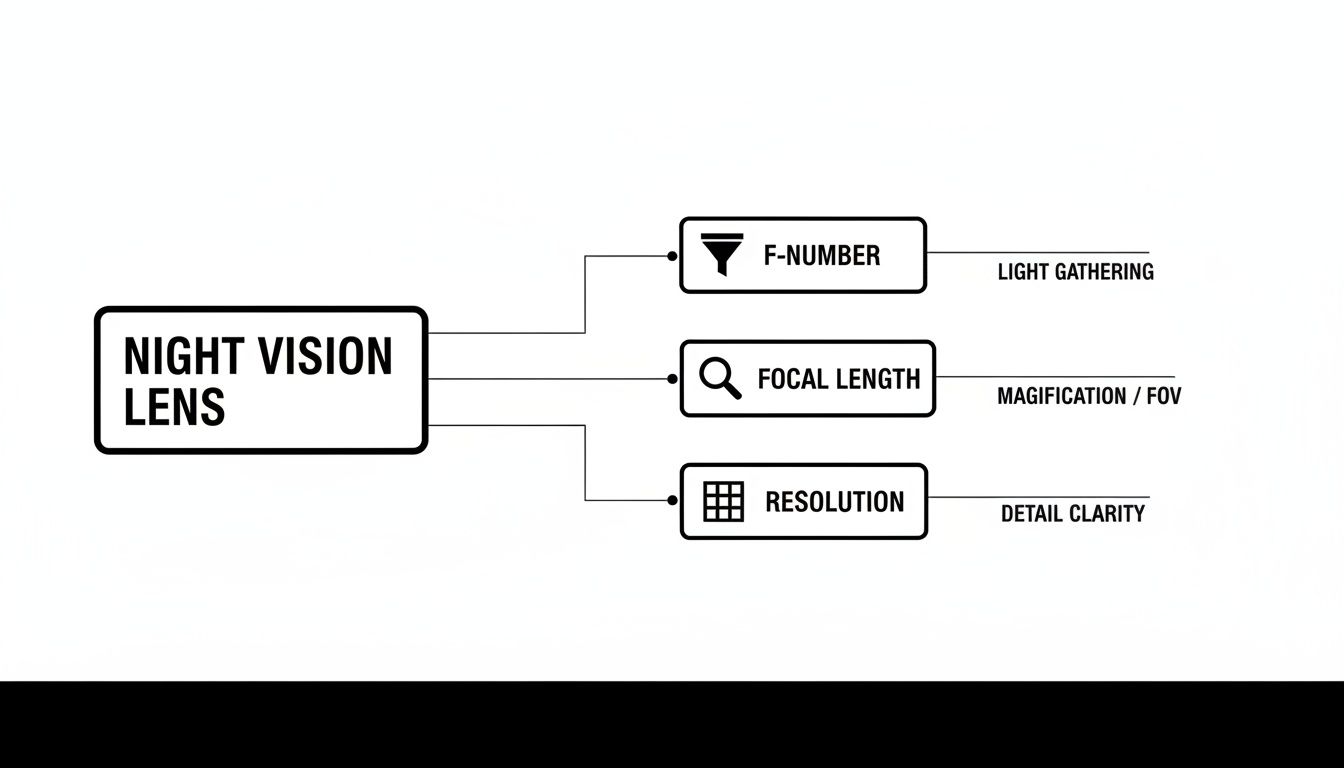
As you can see, each specification controls a vital piece of the performance puzzle, from how much light the lens can gather to how much detail it can ultimately resolve. Pinpointing the right lens type for your device is always the first and most important step.
How to Select the Right Lens for Your Specific Mission
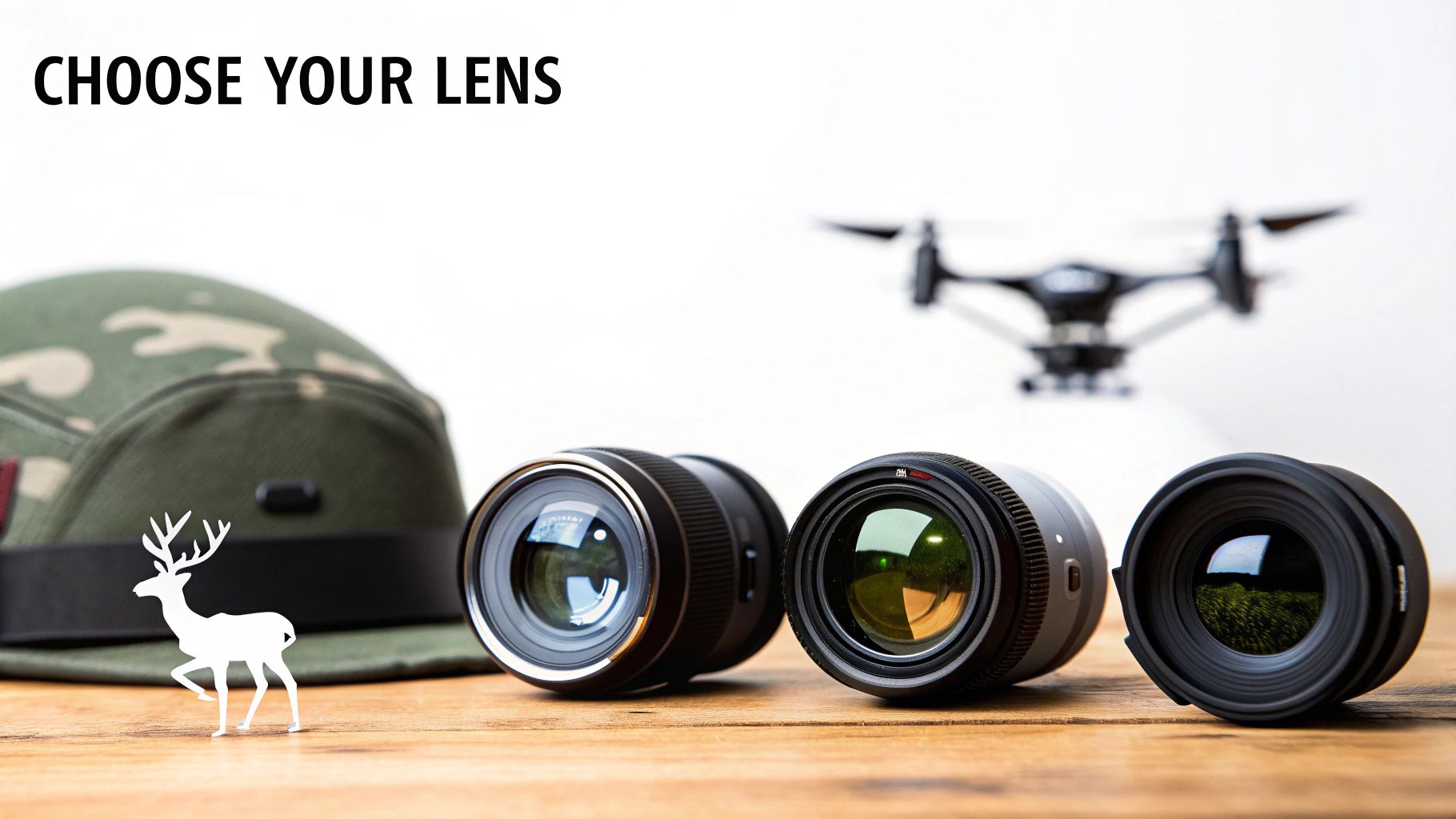
Knowing the specs is a good start, but the real test is how a lens performs on the ground. When it comes to choosing the right lens for night vision, there’s no single "best" option. It’s all about matching the tool to the task.
Think of it like a mechanic’s toolkit—you wouldn’t use a socket wrench for a job that needs a screwdriver. In the same way, the perfect lens for a cop clearing a building is totally wrong for a hunter glassing a distant field. By looking at a few common scenarios, we can cut through the complexity and make a clear, mission-driven choice.
Tactical and Law Enforcement Operations
In a tactical environment, situational awareness isn't just a buzzword; it's a lifeline. The goal is to see and process your immediate surroundings with speed and clarity. That makes a wide Field of View (FOV) non-negotiable. It’s what keeps you from getting tunnel vision, letting you scan a room or an alley without constantly whipping your head around.
This is why a standard 1x magnification lens is almost always the right call for any helmet-mounted system. It gives you a natural, true-to-life perspective, which makes moving through a space intuitive and keeps you from getting disoriented.
Here’s what really matters for tactical users:
- Wide Field of View: A 40-degree FOV is the baseline. Anything less can create dangerous blind spots.
- Durability and Ruggedization: Your gear will get bumped, dropped, and shaken. The lens housing has to be tough enough to handle it.
- Low F-Number: An f-stop of f/1.2 or lower is critical. It sucks in every available photon in dark interiors, giving you a brighter, more usable image when it counts.
- Weight: Every ounce on your helmet adds up. A lightweight lens reduces neck strain and fatigue over long nights.
For professionals in these roles, the objective lens is a critical piece of life-saving equipment. Trading a wide FOV for more magnification on a primary helmet-mounted device is a mistake that can have serious consequences.
Wildlife Observation and Hunting
When you’re out in the field spotting wildlife or hunting, the script flips completely. The challenge isn't navigating a tight space; it's getting a positive ID on a target from far away. Here, magnification is king.
This is where a lens for night vision with a higher focal length—think 3x or 5x models—really comes into its own. It lets you get a good look at an animal from a safe distance, making sure it’s the right species and size before you make a move. This kind of magnification is absolutely essential for ethical hunting and detailed observation.
The demand for better long-range performance is a big reason why this market is growing. In fact, security and surveillance applications drove 26.9% of revenue in 2022, and the wildlife spotting segment is set to expand even more. This trend underscores the need for optics that are both powerful and compact. You can dig into these night vision device market dynamics on GrandViewResearch.com.
For this kind of work, your checklist looks different:
- High Magnification: You'll want 3x, 5x, or even higher to get the reach you need for long-range identification.
- Low F-Number: A low f-stop is still vital. Woods and open fields at night don’t offer much ambient light, so you need a lens that can make the most of it.
- High Resolution: A high lp/mm rating means you can see fine details, like the points on a deer's antlers, from hundreds of yards out.
Astrophotography and Stargazing
Night vision astrophotography is a fascinating niche that pushes gear to its absolute limits. The name of the game is capturing the faintest possible light from across the universe. This means you need a lens that puts light transmission and pure resolution above everything else.
For this pursuit, enthusiasts often adapt C-mount compatible night vision units to telescopes or use specialized, super-fast camera lenses. The goal is simple: get the lowest F-Number you can find to gather more light, cut down on exposure times, and pull in dim nebulae and galaxies.
Here’s what to look for when pointing your gear at the heavens:
- Lowest Possible F-Number: Hunt for lenses with f-stops of f/1.0 or even f/0.95. Every photon is precious.
- Exceptional Resolution: The lens needs an incredibly high lp/mm rating to render stars as sharp pinpoints, not fuzzy blobs.
- Minimal Distortion: You want a clean image from edge to edge, with little to no chromatic aberration or other optical flaws.
Drone and UAV Operations
When you mount night vision on a drone, one factor trumps all others: weight. Every single gram matters. A heavier payload means shorter flight times and less agile maneuvering, period.
Operators have to find the lightest lens that can still get the job done. This usually means a trade-off between the size of the lens (which affects light-gathering) and its weight. For general aerial observation, a compact and lightweight 1x lens is often the best choice, giving a wide overview of the ground below without weighing the aircraft down.
Navigating Lens Mounting and Compatibility
Picking out a new lens based on its impressive optical specs is only the first step. That phenomenal piece of glass won't do you any good if you can't actually attach it to your night vision device. This is where the practical, hands-on side of things—mounting systems and physical compatibility—really comes into focus. Getting this part wrong can be a costly, frustrating mistake.
Think of it like buying new wheels for your car. It doesn't matter how great the tires are if the lug nut pattern doesn't match your vehicle. In the world of night vision, the most common "bolt pattern" is the C-Mount, and knowing about it opens up a whole universe of options.
The C-Mount: A Universal Standard
The C-Mount is a standardized screw-in lens mount you'll find on a massive number of devices, most famously on the PVS-14 monocular. This standard essentially creates a universal language between lenses and devices, letting you swap glass from different manufacturers without ever worrying if they’ll physically fit.
This interchangeability is a game-changer. It gives you the freedom to:
- Upgrade Your Glass: Start with a standard-issue lens and later step up to a high-performance objective with a lower f-stop or sharper resolution.
- Adapt on the Fly: Quickly switch from a 1x lens for walking around to a 3x or 5x telephoto lens for spotting things far off in the distance.
- Find Replacements Easily: If you scratch or damage a lens, the market is full of C-Mount compatible options to get you back in the game.
This kind of modularity is a huge reason why systems built around the C-Mount are so incredibly popular. You’re not stuck in one company's ecosystem; you're free to customize your setup however you see fit.
Proprietary Mounts and Being "Locked In"
On the other end of the spectrum, many dedicated night vision scopes and binoculars use proprietary mounts. These are custom-designed by the manufacturer, meaning they won't work with any other brand. While this often ensures the lens is perfectly matched to the device's sensor, it also kills any flexibility. You're stuck with the lens that came with it, for better or worse.
Before you commit to a system with a proprietary lens, you absolutely have to understand this limitation. If your needs change down the road, your only choice is to buy a whole new device, not just a new lens.
It's More Than Just the Threads
Beyond the mount itself, a few other factors determine if a lens is truly the right fit, especially when you're talking about helmet-mounted setups where every ounce and inch matters.
Weight and Balance
A front-heavy helmet is a one-way ticket to neck strain. The weight of your objective lens is a huge part of your helmet's overall balance. A heavy, chunky lens can constantly pull your goggles downward, making them uncomfortable for long missions and harder to keep steady. To really get this right, check out our guide on choosing the best night vision mount and see how the mount itself plays a critical role in system stability.
Infinity Focus Stop
An infinity focus stop is a small feature with a massive impact. It’s a physical hard stop on the lens's focus ring that keeps you from twisting past true infinity focus. In total darkness, this is your best friend. You can just twist the lens until it stops, and you know instantly that distant objects will be perfectly sharp—no fumbling or guessing required. It’s a simple little thing that makes a world of difference when you need a clear picture, right now.
Protecting Your Investment with Proper Lens Care
Your night vision lens is a finely tuned piece of optical engineering. Keeping it in prime condition isn't just about cleanliness; it's about guaranteeing a clear, reliable image every time you power it on. A little bit of routine care goes a long way in protecting your investment and ensuring your gear is always mission-ready.
Think of it this way: the biggest enemy of any high-quality optic is the gunk that builds up on its surface. Fingerprints, dust, and smudges don't just look bad—they actively degrade performance by scattering light, creating flare, and cutting down on what little light you have to work with. The first rule of lens care? Fight the urge to wipe it on your t-shirt.
A Safe and Effective Cleaning Process
When it's time to clean, always start with the gentlest method first. A simple air blower or a soft-bristled lens brush is perfect for whisking away loose dust and debris without ever touching the glass. This simple step prevents you from grinding tiny particles into the lens coatings, which can cause microscopic scratches over time.
For more stubborn spots like fingerprints or oil, your best friend is a dedicated lens pen. Use its brush end first to clear away any loose particles. Then, use the carbon-tipped polishing end in a slow, circular motion, starting from the center and working your way out. If you need a liquid cleaner, put a single drop on a fresh microfiber cloth—never spray it directly on the lens—and then gently wipe.
A word of caution: Never use household cleaners like Windex or rubbing alcohol. These harsh chemicals will strip the delicate anti-reflective coatings right off your lens, permanently crippling its light-gathering ability and ruining your night vision.
Smart Storage for Long-Term Health
How you store your gear between uses is just as critical as how you clean it. Moisture is a silent killer for optics, potentially leading to fungus growth inside the lens assembly—a problem that's often impossible to fix without sending it in for a professional teardown.
- Use a Hard Case: A padded, waterproof hard case is your best defense against bumps, drops, and the elements.
- Fight Humidity: Always toss a desiccant pack (like silica gel) into your case to absorb any ambient moisture. This is non-negotiable if you live in a humid environment.
- Attach Lens Caps: It sounds simple, but keeping the front objective and rear eyepiece caps on is the easiest way to prevent accidental scratches and keep dust off the glass.
For a much deeper dive into the specifics of upkeep, our guide on the maintenance and care for a PVS-14 monocular has plenty of tips that translate well to other systems.
It's also worth noting how complex modern lenses are becoming. For example, industry reports show that thermal imaging lenses now account for 40.10% of the market, thanks to new designs like ultra-thin metasurfaces that pack powerful infrared detection into smaller, lighter units. Technology is always moving forward, but the fundamentals of good care remain the same. Stick to these simple habits, and your optics will serve you well for years to come.
Common Questions About Night Vision Lenses
Stepping into the world of night vision optics always brings up a few key questions. Let's tackle some of the most common ones I hear from people trying to get their setup dialed in perfectly.
Can I Just Slap a Regular Camera Lens on My Night Vision Device?
That’s a definite no-go. While you might find some night vision devices that share a common C-mount thread with cameras, a standard camera lens is built for the visible light spectrum, not the near-infrared light that your image intensifier tube thrives on. The coatings and, more importantly, the internal iris will choke off the precious little light available, severely crippling your device's performance.
When it comes to thermal, it's not just a bad idea—it's impossible. Regular glass is completely opaque to the long-wave infrared energy that thermal sensors detect. For thermal, a specialized germanium lens isn't just an upgrade; it's non-negotiable.
What's the Real Difference Between a 1x Lens and a 3x Magnifier?
This one is crucial for understanding how you’ll actually use your gear. The 1x lens is the main objective lens screwed onto the front of your night vision monocular or goggle. It gives you a true, unmagnified field of view that mirrors what your own eyes see. This is absolutely essential for moving around, driving, or simply maintaining your awareness of what’s happening around you.
A 3x magnifier, on the other hand, is a totally separate piece of kit. You mount it behind your device, between the night vision and your eye. It takes the image your device is already producing and simply makes it bigger. This is great for spotting details at a distance, but it comes at the cost of a seriously reduced field of view.
Think of it like this: your 1x lens is for walking around and taking in the whole scene. The 3x magnifier is what you flip into place when you stop and need to get a closer look at something specific way out there.
How Much Should I Expect to Pay for a Good Night Vision Lens?
The price tag on night vision lenses can vary wildly, and it really comes down to the specific type and its performance capabilities.
- Standard Surplus Lenses: You can often find a standard-issue PVS-14 objective lens for a few hundred dollars. They get the job done.
- High-Performance Lenses: If you're looking for an upgrade, aftermarket lenses with better glass and faster f-stops can run anywhere from $800 to over $2,000.
- Thermal Lenses: These are in a different league entirely. The high cost of germanium means thermal lenses often start at several thousand dollars and go up from there.
At Superior Tactical LLC, we use our decade of hands-on experience to help you find the perfect lens for your mission and budget, all backed by a 10-year warranty on our Gen 3 systems. Check out our hand-picked selection of night vision and thermal optics today at https://superiortac.com.
