A Complete Guide to How Night Vision Cameras Work
Night vision cameras are incredible pieces of technology. They take a world that’s pitch-black to our eyes and make it as clear as day. By either amplifying tiny amounts of light or by seeing invisible heat signatures, these cameras open up a world that's normally hidden after the sun goes down.
They’re invaluable for everything from home security and watching wildlife to serious tactical operations. Essentially, they give us a superpower: the ability to see far beyond the natural limits of human vision.
Seeing in the Dark: What Night Vision Really Is
Ever wonder how your security camera gets such a clear shot of your backyard on a moonless night? It’s not magic. It’s a remarkable technology that peels back the curtain of darkness.
For a homeowner, it’s the peace of mind of knowing what made that strange noise at 2 AM. For a nature lover, it’s a secret window into the hidden lives of nocturnal animals, all without disturbing them in their natural habitat.
The fundamental problem night vision solves is simple: our eyes just don't work well in the dark. These cameras get around this limitation in one of two main ways.
-
Light Amplification: This technique is often called image intensification. It works by gathering tiny, almost imperceptible amounts of ambient light—like starlight or the faint glow from a distant city—and multiplying it thousands of times over.
-
Heat Detection: This is what we call thermal imaging. Instead of looking for light, it detects the invisible infrared energy, or heat, that every object gives off. It then creates a visual "heat map" of the scene.
You’ve probably seen the classic green-hued image from night vision devices. That green tint is actually on purpose. The human eye is incredibly sensitive to shades of green, more so than any other color, which makes it easier to pick out details and reduces eye strain during long periods of observation.
The demand for this technology is absolutely exploding. The global night vision surveillance camera market is forecast to jump from USD 190.08 billion in 2025 to a staggering USD 1.57 trillion by 2035.
This massive growth shows just how vital these cameras have become for keeping people and property safe. In this guide, we'll dive into the science, the different types, and what to look for, so you can feel confident choosing the right camera for what you need. You can explore more market insights about night vision technology to see just how fast its role is expanding.
How a Camera Can See Without Light
It almost feels like magic, doesn't it? The way a night vision camera can take a scene cloaked in total darkness and make it as clear as day. But this isn't science fiction; it’s a brilliant application of two very different scientific principles.
One method works by grabbing the tiniest bits of light and cranking up the volume, so to speak. The other method doesn't care about light at all—it sees the invisible world of heat. Getting a handle on these two technologies is the key to understanding just how incredible these devices really are.
Amplifying Faint Light
The classic night vision you’ve probably seen in movies uses a technology called image intensification (I²). The best way to picture it is as a super-powered light amplifier. It’s built on a simple truth: even on what we’d call a pitch-black night, there’s almost always some light bouncing around from the stars, the moon, or even a city glowing miles away.
An image intensification device sucks in these microscopic particles of light, called photons, through its objective lens. Inside, a component called a photocathode turns those photons into electrons. Then, the real magic happens: a micro-channel plate multiplies those electrons, often by tens of thousands, and shoots them onto a phosphor screen. That screen lights up where the electrons hit, converting them back into a visible image you can see.
This whole process is why you get that iconic green-hued image. Our eyes just happen to be most sensitive to shades of green, which means we can pick out more detail and it's easier on our eyes over long periods of observation.
The big thing to remember here is that image intensifiers can't see in absolute darkness. They need a little bit of ambient light to work with. That makes them fantastic for scanning a field under a starry sky, but pretty useless inside a sealed, windowless basement.
Seeing Invisible Heat Signatures
The other side of the coin is thermal imaging, and it plays by a completely different set of rules. Instead of amplifying light, a thermal camera sees heat. Every single thing, from a person to a tree to a rock, gives off a certain amount of thermal energy as infrared radiation. Our eyes can't see it, but a thermal camera can.
Think of it as a device that paints a picture using temperature instead of light. A special lens focuses this infrared energy onto a sensor that measures tiny temperature differences across the scene. The camera then processes that data and displays it as an image, called a thermogram.
What you get is essentially a "heat map" of your surroundings.
-
Warmer Objects: Things like people, animals, and recently-driven cars give off more heat, so they show up as bright objects (usually white, yellow, or red).
-
Cooler Objects: The background environment—trees, buildings, the ground—is typically cooler and appears darker (often black, blue, or purple).
This gives thermal a massive advantage: it works perfectly in zero-light conditions because it doesn't need any light to function. It’s also a master of detection. A person trying to hide in bushes or behind smoke might be invisible to an image intensifier, but their heat signature will stick out like a sore thumb on a thermal display. While I² tech is better for identifying who or what you're looking at, thermal is second to none for just finding it.
Comparing Different Night Vision Technologies
Once you get a handle on the basic science behind night vision, the real work begins: figuring out which type of gear is right for you. It's a common misconception that all night vision is the same. The truth is, choosing the right system is a balancing act between your specific needs, the environment you'll be in, and of course, your budget. From classic image intensifiers used by the military to the latest in digital and thermal systems, each one has its own unique set of pros and cons.
The market for this kind of tech is booming, driven by everything from heightened security needs to incredible leaps in technology. We're talking about a global market projected to jump from USD 8.57 billion in 2025 to a massive USD 12.91 billion by 2030. That growth isn't just coming from defense contracts; it's also fueled by the miniaturization of cameras for drones and the expansion of smart city infrastructure.
This simple chart illustrates the two fundamental paths all night vision technology follows: either amplifying existing light or detecting heat.
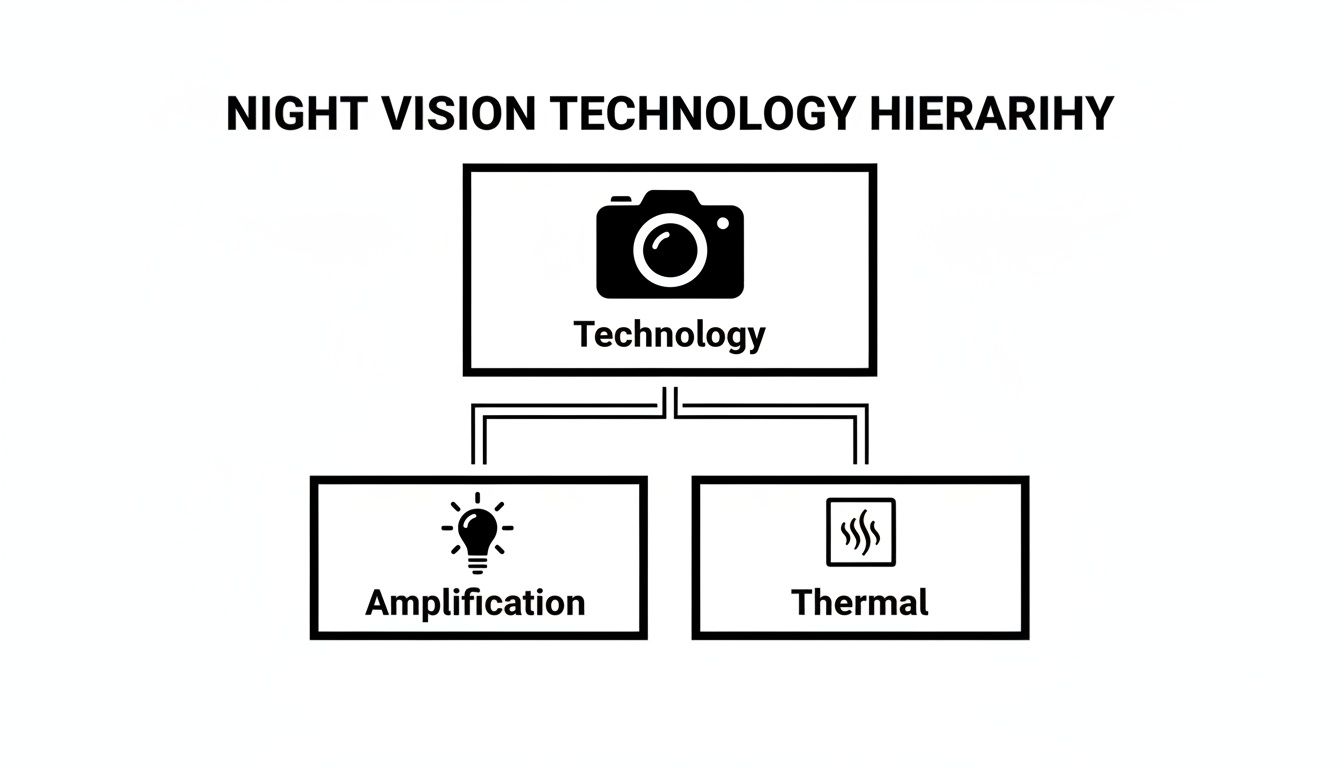
As you can see, these two methods are worlds apart. One makes the visible world brighter, while the other reveals an entirely invisible landscape of heat.
The Evolution of Image Intensification
When people talk about traditional night vision, they're usually referring to image intensification (I²). This technology is often broken down into "generations," with each one marking a significant improvement in performance and durability. Think of it like the evolution of gaming consoles—every new generation delivered a major upgrade in graphics, speed, and overall experience.
-
Generation 1 (Gen 1): This is the entry-level, old-school tech. Gen 1 devices are the most affordable, but they come with trade-offs like noticeable image distortion around the edges (a "fish-eye" effect) and a much shorter operational life.
-
Generation 2 (Gen 2): The big leap forward here was the introduction of the micro-channel plate, which massively boosted image brightness and resolution. The result is a far cleaner and less distorted picture, making it suitable for more serious uses.
-
Generation 3 (Gen 3): This is the current gold standard for most military and law enforcement units. Gen 3 offers incredible low-light performance, sharp clarity, and a long lifespan, often good for over 10,000 hours of use.
While the early generations were purely analog, many modern systems now incorporate digital sensors. Digital night vision brings a few key advantages to the table: it's more rugged, it can easily record video and photos, and it won't be damaged by sudden exposure to bright light—a huge weakness of older analog tubes.
Thermal Imaging vs. Image Intensification
This is probably the most important distinction to understand in the night vision world. Both technologies let you see in the dark, but they work in completely different ways, which makes them suited for very different jobs.
Key Takeaway: Image intensification amplifies light so you can identify a target with clear detail. Thermal imaging detects heat signatures, allowing you to detect a target, even in complete darkness or concealment.
Here’s a practical example: an I² device is perfect for identifying a person's face or reading the numbers on a license plate in low light because it builds an image from reflected light. The downside? It's rendered useless by smoke, thick fog, or even heavy camouflage.
A thermal camera, on the other hand, couldn’t care less about light. It sees heat. This means it can easily spot a person hiding in dense woods or see right through a smokescreen because their body heat pops against the cooler background. Its limitation is detail—since it only renders a heat map, you won’t be able to make out fine features or read text. You can explore this topic further in our in-depth look at thermal, digital, and analog night vision.
To make it even clearer, let's put them side-by-side. This table breaks down their core differences so you can see which technology lines up with what you need to do.
Night Vision Technology Comparison Thermal vs Image Intensification
| Feature | Thermal Imaging | Image Intensification (I²) |
|---|---|---|
| Operating Principle | Detects heat signatures (infrared) | Amplifies ambient light |
| Light Requirement | None; works in absolute darkness | Requires some ambient light |
| Best For | Detection, spotting hidden targets | Identification, recognizing details |
| Performance in Fog/Smoke | Excellent; sees through obscurants | Poor; blinded by obscurants |
| Image Output | Heat map (monochrome or color) | Detailed, typically green-hued image |
| Primary Use Cases | Search and rescue, surveillance | Navigation, facial recognition |
So, what’s the bottom line? Your choice really boils down to your main objective. If your priority is knowing that something is out there, thermal is your best bet. If you need to know exactly what that something is, image intensification is the only way to go.
Getting to Grips with the Specs That Actually Matter
When you start shopping for a night vision camera, the spec sheet can feel like you're trying to read a foreign language. It's just a wall of jargon and numbers. But here’s the good news: you don't need an engineering degree to figure it out. The trick is to cut through the marketing fluff and focus on the handful of metrics that directly impact what you'll see on the screen.
Nailing this down is the difference between buying a camera that works for you and one that’s a constant source of frustration. Let's break down the numbers that truly make a difference.
Resolution: How Clear is the Picture?
Resolution is usually the first thing people look at. It's a simple measure of the detail the camera's sensor can pick up, typically expressed in pixels—like 640×480 for a thermal camera or 1080p (1920×1080) for a digital one. More pixels generally mean a sharper, clearer image, which is vital if you need to identify specifics like faces or license plates.
But resolution isn't the whole story. A high-resolution sensor is only as good as the parts it's paired with. If the lens is cheap or the image processor is weak, you'll still get a grainy, fuzzy picture. Think of it like playing a scratchy, low-quality MP3 through a high-end sound system—the best speakers in the world can't fix a bad recording.
Detection Range: How Far Can It Really See?
This number tells you the maximum distance at which a camera can detect something. The catch is that "detection" is a very slippery term, and manufacturers have their own definitions. To really understand a camera's capability, you need to look for the DRI ratings:
-
Detection: This is the absolute maximum range where the camera’s sensor can tell something is there. On a thermal camera, it might just be a warm blob. You won't know what it is, just that it's present.
-
Recognition: At this range, you can start to tell what kind of object you're looking at. You can distinguish between a person and a deer, for instance.
-
Identification: This is the closest and most important range. It’s where you can identify specific details, like confirming the identity of a person.
So, a camera might boast a 1,500-meter detection range for a vehicle, but the range at which you can identify a person might only be 100 meters. Always dig for these more detailed ratings to get a realistic sense of what the camera can do.
Don't fall into the common trap of thinking the "detection range" on the box is the distance for clear identification. In the real world, your effective identification range is often just 10-20% of that maximum detection number.
Field of View: How Wide is Your Vision?
Field of View, or FoV, tells you how wide of an area the camera can see at once. It's measured in degrees. A wide FoV (say, 40°) is like using a wide-angle lens on a traditional camera. It’s perfect for getting the big picture—monitoring a backyard, a field, or a parking lot. You get fantastic situational awareness, but you lose out on detail at a distance.
On the other hand, a narrow FoV (maybe 10°) acts more like a telephoto lens. This is what you want for zeroing in on a specific, distant spot, like the end of a long driveway or a gate. You'll get incredible detail in that tight corridor, but you’ll have a major blind spot on either side. It's a direct trade-off: do you want to see a lot of area with less detail, or a small area with more detail?
IR Illuminators: The Stealth Flashlight
For any digital or image-intensified night vision camera, the infrared (IR) illuminator is absolutely essential. Think of it as a built-in flashlight that emits light in the infrared spectrum. It's completely invisible to our eyes, but to the camera's sensor, it lights up the night. This is the magic that lets these devices see in what appears to be total darkness.
The power and range of the illuminator are specs you can't ignore. A camera with a weak 30-foot IR range might be okay for watching your front porch, but it's completely useless for keeping an eye on a large property. You need to make sure the illuminator’s effective range matches or exceeds the distance you want to see clearly. Otherwise, the camera is just staring into a darkness it can't penetrate.
Real-World Uses for Night Vision Cameras
The science behind night vision is fascinating, but it's in the real world where this technology truly proves its worth. From keeping an eye on your home after dark to enabling life-saving rescue missions, these cameras have become essential tools in countless situations. They give us the power to see when our own eyes fall short, bringing clarity and safety to the darkness.
Let's dive into a few of the most impactful ways this tech is used every day. Its versatility goes far beyond the spy movies and video games you might be familiar with.
Securing Homes and Businesses
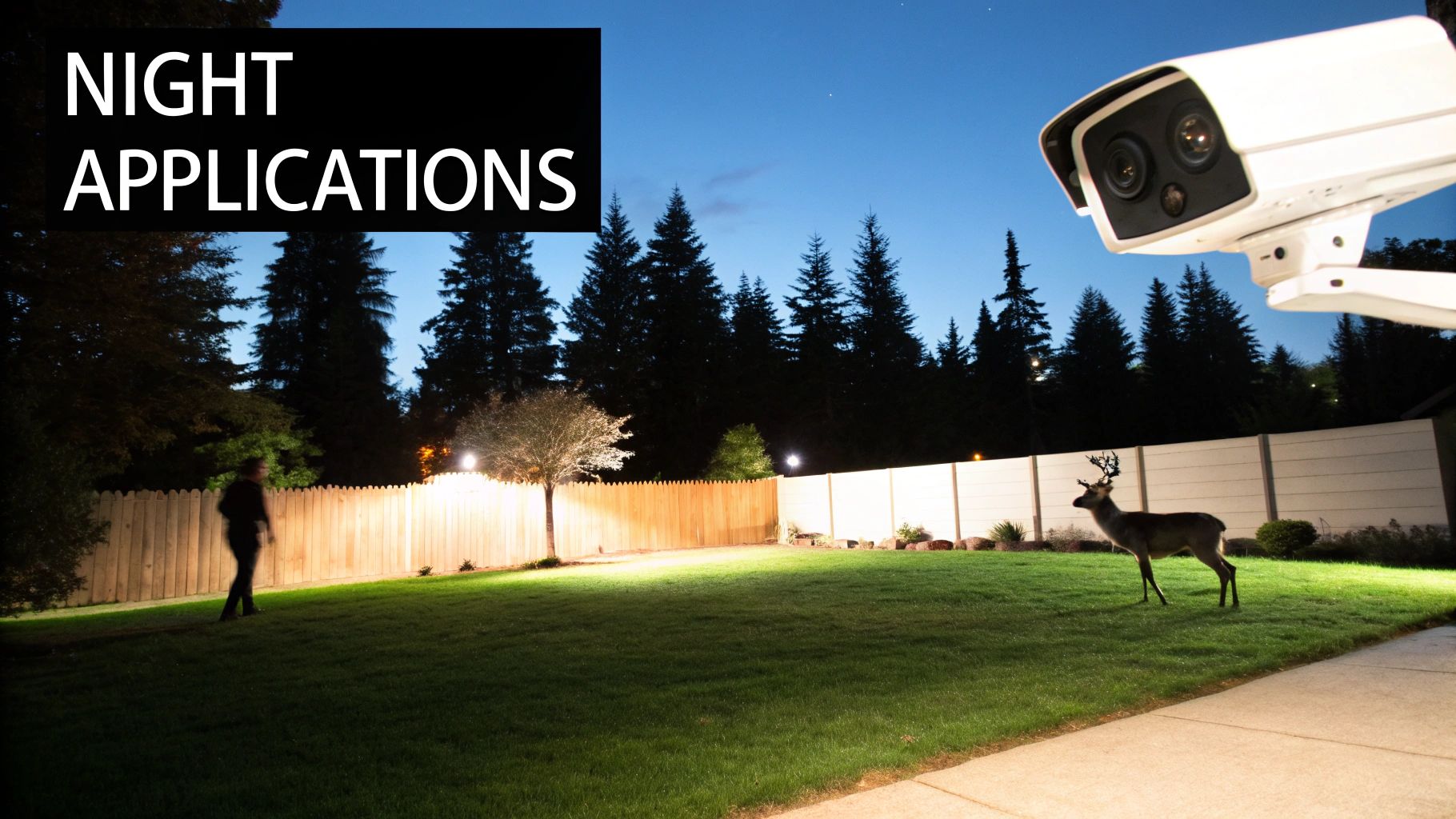
For home security, night vision isn't just an upgrade; it's a complete game-changer. We all remember the old motion-activated floodlights that would blast on for every stray cat or gust of wind. Modern night vision cameras are smarter.
Many now come with AI-powered object detection that can tell the difference between people, animals, and cars. This means you get alerts that actually matter, giving you genuine peace of mind. For a business owner, this technology is the ultimate after-hours security guard, capturing clear evidence if a break-in ever occurs.
Observing Wildlife Undisturbed
For wildlife lovers and professional researchers, night vision is the key to observing animals without disrupting their world. A bright flashlight or car headlight will send most nocturnal creatures running, ruining any chance to see their natural behavior.
This is where thermal cameras really excel. Since they see heat instead of light, they're completely passive and don't emit a single photon. This allows for truly silent, invisible observation, offering a rare window into the secret lives of animals after the sun goes down.
Crucial Insight: This technology's value is undeniable when you look at the numbers. Night vision cameras command a massive 34% of the entire night vision device market. Security and surveillance applications alone accounted for 26.9% of all revenue in 2022, a figure driven heavily by their indispensable role in military and security operations. You can delve into more details about night vision device trends to see the full market picture.
Aiding Law Enforcement and Rescue Operations
When the stakes are high, the ability to see in the dark can literally mean the difference between life and death. Law enforcement and search and rescue (SAR) teams depend on night vision for a huge range of critical tasks.
-
Search and Rescue: A drone equipped with a thermal camera can scan miles of rugged terrain at night, spotting a missing hiker’s body heat in minutes—a search that might have taken a ground team days.
-
Suspect Apprehension: Officers can track a fleeing suspect through a dark alley or dense woods without giving away their position with a flashlight beam.
-
Situational Awareness: During nighttime raids or standoffs, night vision gives teams a massive tactical advantage, letting them assess threats and navigate complex environments safely.
These examples are just the tip of the iceberg. To learn more, check out our guide on the primary applications of night vision technology.
Enhancing Automotive and Marine Safety
Night vision’s reach extends into transportation, where it acts as a critical co-pilot in low-visibility conditions.
Some advanced vehicles now feature thermal cameras that can spot pedestrians, cyclists, or deer on a pitch-black road long before they’re caught in the headlights. The system alerts the driver, buying them precious seconds to react. Out on the water, mariners use night vision to navigate safely on moonless nights, spotting other boats, buoys, or floating debris that would otherwise be completely invisible.
How to Choose the Right Night Vision Camera
Alright, you've got the tech basics and the key specs down. Now it's time for the fun part: picking the right camera. This isn't about grabbing the most expensive model off the shelf. It’s about matching the right tool to the job you actually need it for.
Let's boil everything we've covered down to a simple, practical checklist to help you make a smart buy.
The whole process kicks off with one fundamental question: what am I really trying to accomplish? Answering this honestly is the most critical step you'll take. Do you need to be able to positively identify a face on your front porch? Or do you just need a reliable way to know when something—be it a person or a deer—crosses a fence line on a remote part of your land? Those are two very different jobs requiring very different gear.
Define Your Objective First
Before you even glance at a product page, get crystal clear on your mission. This simple act will instantly filter out dozens of unsuitable options, saving you from either overspending on features you'll never use or, even worse, underspending on a camera that can't do what you need.
Think about which of these common goals fits your situation:
-
Identification: If you need to see clear facial features, make out the numbers on a license plate, or pick out specific details, your best bet is an image intensification tube or a high-resolution digital night vision camera. These systems are designed to capture reflected light and turn it into a recognizable picture.
-
Detection: If your primary goal is just to spot a heat signature in total darkness, cut through fog, or see through thick brush, nothing beats a thermal camera. It makes living things pop out from their surroundings, making it almost impossible to hide. Just remember, it won't give you identifying details.
A classic mistake is buying a camera for detection when you really need identification. A thermal camera can tell you someone is in your backyard from 300 yards out, but it can’t tell you who it is. Nail down your main objective from the get-go.
Assess Your Environment and Budget
Next up, take a good, hard look at where you'll be using this camera. The amount of available ambient light is a huge deal. A typical suburban backyard with streetlights and house lights provides more than enough light for a good digital camera with an IR illuminator to do its job well.
But a rural property with zero light pollution? That's a whole different ballgame. In those pitch-black conditions, an image intensifier can struggle without a powerful illuminator. This is where a thermal camera really shines, since it doesn't need any light to work.
Finally, you have to land on a realistic budget. Night vision gear has a massive price range, from a couple hundred bucks to well over ten thousand. Setting a clear budget helps you zero in on the best performance you can get for your money. For a more detailed look at the costs involved, check out our guide on budgeting for night vision gear. Investing smart means getting a camera that not only meets your needs today but will also be a reliable piece of kit for years to come.
Common Questions About Night Vision Cameras
Even after diving into the tech, a few questions always seem to come up. Let's run through some of the most common ones I hear to clear up any confusion you might still have about night vision cameras. Getting these answers straight will give you a much better real-world feel for how this technology actually performs.
Can These Cameras See in Complete Darkness?
This is a classic "it depends" situation, and the answer hinges entirely on which type of camera we're talking about. It's probably the single biggest point of confusion for newcomers.
A thermal camera can absolutely see in pitch-black, total darkness. No question. Since it's reading heat signatures instead of reflected light, it doesn't need a single photon to paint a picture. This makes thermal unbeatable for spotting a warm body in a windowless room or out in the backcountry on a moonless, cloudy night.
Your image intensifier cameras (the analog tubes and digital versions) are a different story. They need some ambient light to work with—even just a sliver. They operate by taking tiny amounts of light from stars, the moon, or even distant city glow and amplifying it thousands of times. If there's truly zero light to multiply, they can't see a thing.
Why Are Night Vision Images Usually Green?
That iconic green glow isn't just for Hollywood. It's a smart, practical choice rooted in how our eyes are built.
The human eye is most sensitive to the color green and can pick out more shades of it than any other color on the spectrum. By displaying the intensified image in green, our brains can process more detail, see better contrast, and get a better sense of depth than with a simple black-and-white image. It also happens to cause less eye fatigue, which is a huge deal if you're a soldier, hunter, or wildlife biologist staring through a scope for hours on end.
That classic green phosphor view makes spotting details much easier and more comfortable over the long haul. While many newer digital and thermal devices let you switch between different color palettes, the original "green screen" is still the standard for a very good reason.
How Far Can a Night Vision Camera See?
This is probably the number one question I get, but there's no single, simple answer. A camera's real-world range is a mix of its core technology, the quality of its lens, and the environment you're in.
For example, the digital night vision security cameras you might put up around your house typically have a solid identification range of 50 to 200 feet. Their performance is mostly limited by how powerful their built-in IR illuminators are.
Step up to professional-grade gear, though, and it's a whole new ballgame. A high-end Gen 3 image intensifier or a top-tier thermal scope can detect a person-sized heat signature from over a mile away. When you're shopping, always look for the "Detection, Recognition, and Identification" (DRI) specs—that's the true measure of what a device can do at distance.
Are Night Vision Cameras Legal to Own?
For almost everyone in the United States, the answer is yes—owning and using night vision is perfectly legal for civilian activities. Whether you're using it for home security, hunting, boating, or just watching animals in your backyard, you can buy most consumer-grade gear without needing any special permits.
Where you might run into some red tape is with the most advanced, military-spec systems. The export of certain high-performance Gen 3 image intensifier tubes, for instance, is tightly regulated by the U.S. government. But unless you're trying to buy bleeding-edge, restricted equipment, you won't have any legal issues for typical recreational or security use. It never hurts to double-check your local state laws, just to be safe.
Ready to see what you've been missing in the dark? The team at Superior Tactical LLC has over a decade of experience outfitting professionals and enthusiasts with the best night vision and thermal optics on the market. Explore our curated collection and get expert advice to find the perfect gear for your mission at https://superortac.com.
