Night Vision for Law Enforcement: A Modern Guide to Advanced Optics
Night vision isn't a luxury for law enforcement anymore. It's become as essential as body armor or a radio, a core tool for modern policing that gives officers a powerful tactical edge. This technology effectively flips a switch, turning a dangerously dark environment into a clear, manageable operational area.
When we empower officers to own the night, we’re doing more than just handing them a piece of gear. We’re boosting their safety, sharpening their situational awareness, and driving better mission outcomes.
Why Night Vision is a Must-Have, Not a Nice-to-Have
When the sun goes down, the world changes for a cop on patrol. Darkness is a criminal's best friend, creating uncertainty and spiking the risk for any officer responding to a call. Night vision technology is the direct countermeasure to that threat.
It’s not just about seeing in the dark. It’s about controlling the dark. An officer with a good set of NODs (Night Observation Devices) or a thermal imager can spot a threat, identify a suspect, or navigate a treacherous path without ever giving away their position with a flashlight beam. That single capability can completely change the outcome of a high-stakes encounter.
The Tactical Edge in the Real World
Think about the calls your officers run every single night. Night vision becomes a game-changer in countless situations:
-
Covert Surveillance: Watching a drug house or a suspect's location from a distance is infinitely more effective when you can see everything without being seen yourself.
-
Building Searches: Clearing a dark warehouse or a creepy, abandoned house is one of the most dangerous jobs in policing. Night vision lets an officer scan a room and spot a threat tucked away in a dark corner before they even step through the door.
-
Tracking Fugitives: Chasing a suspect through an open field, a dense patch of woods, or a maze of unlit back alleys is far safer and more likely to succeed when the officer can see clearly.
-
Officer Safety on Traffic Stops: Walking up to a car on a dark road is one of the most unpredictable things an officer does. Night vision allows them to scan the inside of the vehicle and see what the occupants are doing before they're standing at the driver's window.
This isn't just a niche tool anymore; it’s a mainstream necessity. The global market for law enforcement night vision hit USD 4.28 billion in 2024, a clear sign that agencies see it as an essential investment. It's a direct response to the real-world threats officers face. You can dive deeper into market trends and the technology's growth with this report from DataIntelo.
At its core, night vision strips away the criminal's biggest advantage: the cover of darkness. It gives our people the confidence, precision, and safety they need to dominate nighttime operations.
Ultimately, putting this technology in the hands of your officers is about bringing them home safe. It's about reducing risk and making them more effective at their job. When you give them the ability to see and act decisively in the dark, you're not just buying hardware—you're investing in successful outcomes and, most importantly, in your people.
Decoding the Core Technologies: Image Intensifiers and Thermal Imaging
To get the right gear into your officers' hands, you first need to understand that not all "night vision" is created equal. The two technologies that form the backbone of nighttime operations—Image Intensification (I²) and Thermal Imaging—work in completely different ways. Getting this distinction right is the most critical first step in making a smart purchase.
Think of an Image Intensifier, or I² tube, as a massive light amplifier. It scoops up the faintest traces of ambient light—from the moon, stars, or even distant city glow—and boosts it by tens of thousands of times. This process creates that familiar green or white phosphor image, giving an officer a clear, detailed picture of their surroundings. It's sharp enough to identify faces, read license plates, and spot specific threats.
Thermal imaging, on the other hand, doesn’t see light at all. It sees heat. Every person, running car engine, and recently discarded piece of evidence gives off a thermal signature. A thermal device picks up on these tiny temperature differences and paints a picture from them, usually showing hotter objects as bright white, black, or vivid colors against a cooler background.
Image Intensification: Seeing the Visible World, Amplified
Image Intensification (I²) gives officers a genuine superpower in low-light environments. It works by gathering the few available photons, converting them into a cascade of electrons, and then using those electrons to illuminate a phosphor screen. That’s why I² devices need some light to work. In a sealed room with zero light, you won't see a thing without an infrared (IR) illuminator to provide a light source.
The undeniable strength of I² is its ability to produce a detailed, intuitive image that looks much like what you'd see during the day. This makes it the undisputed champion for any task that requires positive identification.
-
Positive Identification: Absolutely essential for confirming if a subject is holding a weapon or verifying they are the person you're looking for.
-
Navigation: Provides the clarity needed for officers to move through difficult terrain or even drive a vehicle without headlights.
-
Evidence Gathering: Lets you clearly observe a subject's actions, locate discarded items, and take in crucial environmental details.
Because it relies on reflected light, an I² device can also see through glass. That's a huge tactical plus when you're trying to assess a threat inside a vehicle or a building before making entry.
Thermal Imaging: Seeing the Invisible World of Heat
Thermal imaging lives in a world of heat, not light. At its heart, it's a detection tool. It shines where I² devices fall short, especially when there's no light to amplify or when a target is using camouflage or concealment. A suspect buried in thick brush or hiding in a pitch-black alley will glow like a beacon through a thermal imager.
But thermal's greatest strength is also a key limitation for many law enforcement jobs. It shows you heat signatures, not the fine details needed for identification. You can tell that someone is hiding behind a bush, but you probably won't be able to tell who it is.
Thermal imaging tells you something is there, cutting through concealment and visual clutter. Image Intensification tells you what or who it is.
The infographic below breaks down how night vision, whether thermal or I², fundamentally improves an officer's ability to do their job safely and effectively.
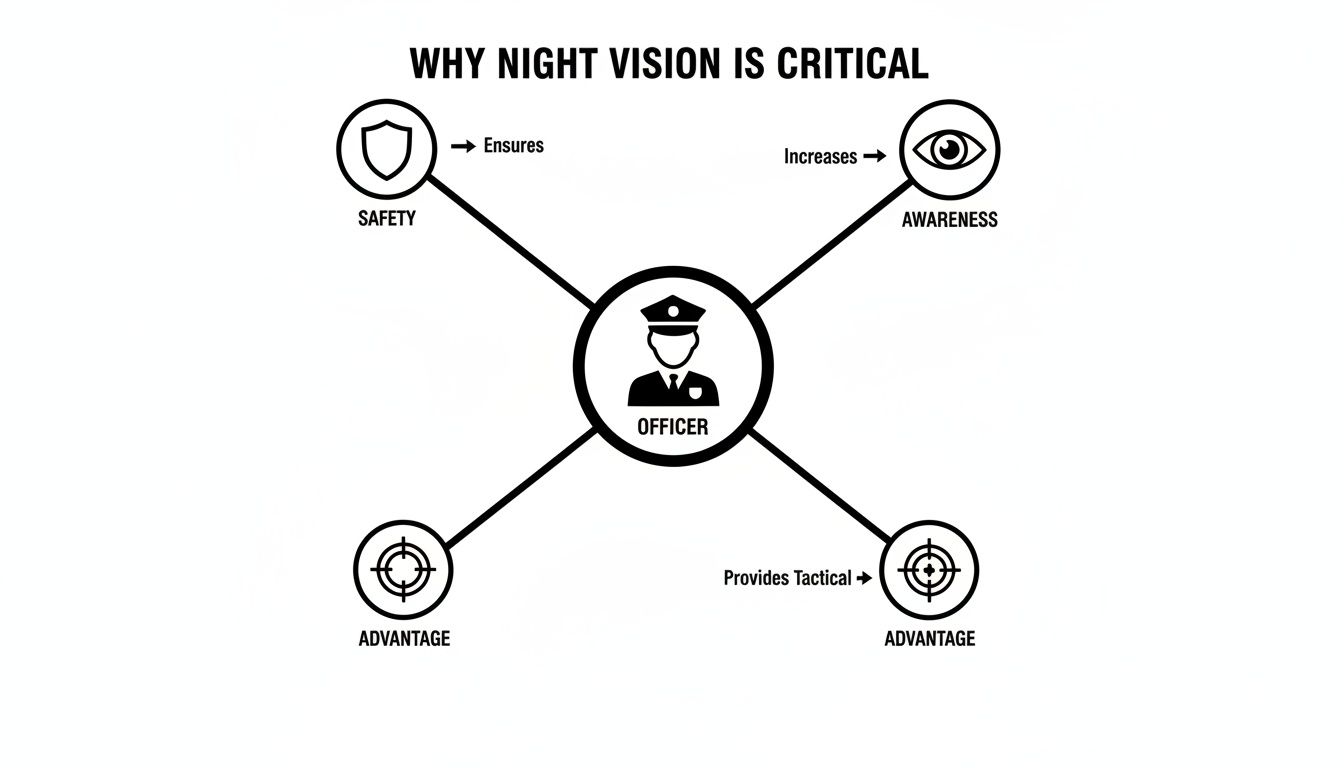
The takeaway is clear: the goal is always to enhance officer safety, expand situational awareness, and create a decisive advantage when it matters most.
Here's a quick cheat sheet to help you compare the two technologies head-to-head.
Image Intensifier (I2) vs. Thermal Imaging At a Glance
| Attribute | Image Intensifier (I2) | Thermal Imaging |
|---|---|---|
| How It Works | Amplifies existing ambient light | Detects differences in heat energy |
| Primary Use | Identification & Navigation | Detection & Tracking |
| Needs Light? | Yes, a small amount is required | No, works in complete darkness |
| Sees Through Glass? | Yes | No |
| Sees Through Smoke/Fog? | No, light is blocked | Yes, heat penetrates obscurants |
| Image Detail | High detail, similar to human vision | Lower detail, shows heat shapes |
| Best For… | Positive ID, driving, evidence | Finding hidden suspects, surveillance |
Understanding how these technologies handle common barriers is mission-critical. A thermal imager can punch right through smoke, fog, and dense foliage, but it’s stopped cold by a simple pane of glass. For a deeper dive into the science, you can see night vision technology explained here.
Knowing whether to grab the I² or the thermal when looking into a smoky building versus a car window can make all the difference. While fused systems that combine both are the ultimate solution, most agencies must choose their primary tool based on their most common operational needs.
Understanding the Evolution of Night Vision Generations
When gearing up your agency with night vision, the first question is always the same: "Which 'gen' do we actually need?" It's a critical question. Think of it like the jump from an old tube TV to a modern 4K screen—each generation represents a massive leap in what your officers can see and do in the dark.
The term "generation" is just shorthand for the level of image intensifier (I²) tube technology inside the device. This tube is the heart and soul of the system. The better the tube, the better an officer can see. While the tech has come a long way, any serious procurement conversation today starts with the most advanced options. You can get the whole story on the full evolution of night vision technology in our historical deep-dive.
A Quick Look at Gen 1 and Gen 2
Generation 1 (Gen 1) is the most basic form of night vision you'll find. It’s affordable, but it’s completely dependent on a built-in infrared (IR) illuminator to be useful. The image is often distorted and fuzzy. For any professional law enforcement work, Gen 1 is a non-starter; it just doesn't have the clarity or reliability for tactical situations.
Generation 2 (Gen 2) was a big step up. These devices introduced a microchannel plate (MCP), which really cranked up the light amplification. The result is a much brighter and clearer picture. While Gen 2 can be a workable solution for certain non-critical roles, it's been left behind by modern professional standards.
Generation 3: The Professional Standard
For any night vision for law enforcement applications, Generation 3 (Gen 3) is the line in the sand. This is where the technology gets serious. The introduction of a gallium arsenide photocathode made these tubes incredibly sensitive to even the tiniest amounts of ambient light.
For your officers in the field, this translates to real-world advantages:
-
Superior Low-Light Performance: Gen 3 can function in near-total darkness, often without needing an IR illuminator—a huge plus for staying covert.
-
Exceptional Clarity and Range: The image is sharp and clean, making positive target identification possible at much greater distances.
-
Longer Tube Life: A quality Gen 3 tube is built to last, typically rated for 10,000+ hours of operation. That’s a solid, long-term investment.
Let’s be clear: for any serious tactical work—from patrol and surveillance to high-risk SWAT operations—Gen 3 is the absolute minimum requirement. Its ability to paint a clear picture in the dark is a game-changing tactical advantage.
Beyond Gen 3: Unfilmed Tubes and What FOM Means
Things can get a little murky when you hear terms like "Gen 3 Unfilmed" or even "Gen 4." First off, "Gen 4" is largely a marketing term, not an official military designation. What people are usually talking about are high-performance, filmless Gen 3 tubes.
An "unfilmed" or "filmless" tube simply removes a protective ion barrier film from the microchannel plate. Doing this boosts the signal-to-noise ratio, giving you an even crisper image with less of that background "sparkle" or "scintillation," especially when it's really dark out.
This brings us to another key metric: Figure of Merit (FOM). FOM is a simple calculation: the tube's resolution (line pairs per millimeter) multiplied by its signal-to-noise ratio. Forget the math—all you need to know is that a higher FOM means a cleaner, sharper, and more detailed image. While any Gen 3 unit is a force multiplier, a high-FOM device will let your team see farther and identify threats with more certainty.
The demand for this level of performance is exploding. In 2024, law enforcement agencies drove the global night vision market, pushing for better surveillance tools to handle low-light threats. As the technology gets better and more accessible, departments of all sizes are gaining the ability to own the night. You can read the full report on the night vision device market to see where the industry is headed.
Selecting the Right Device for Your Mission Profile
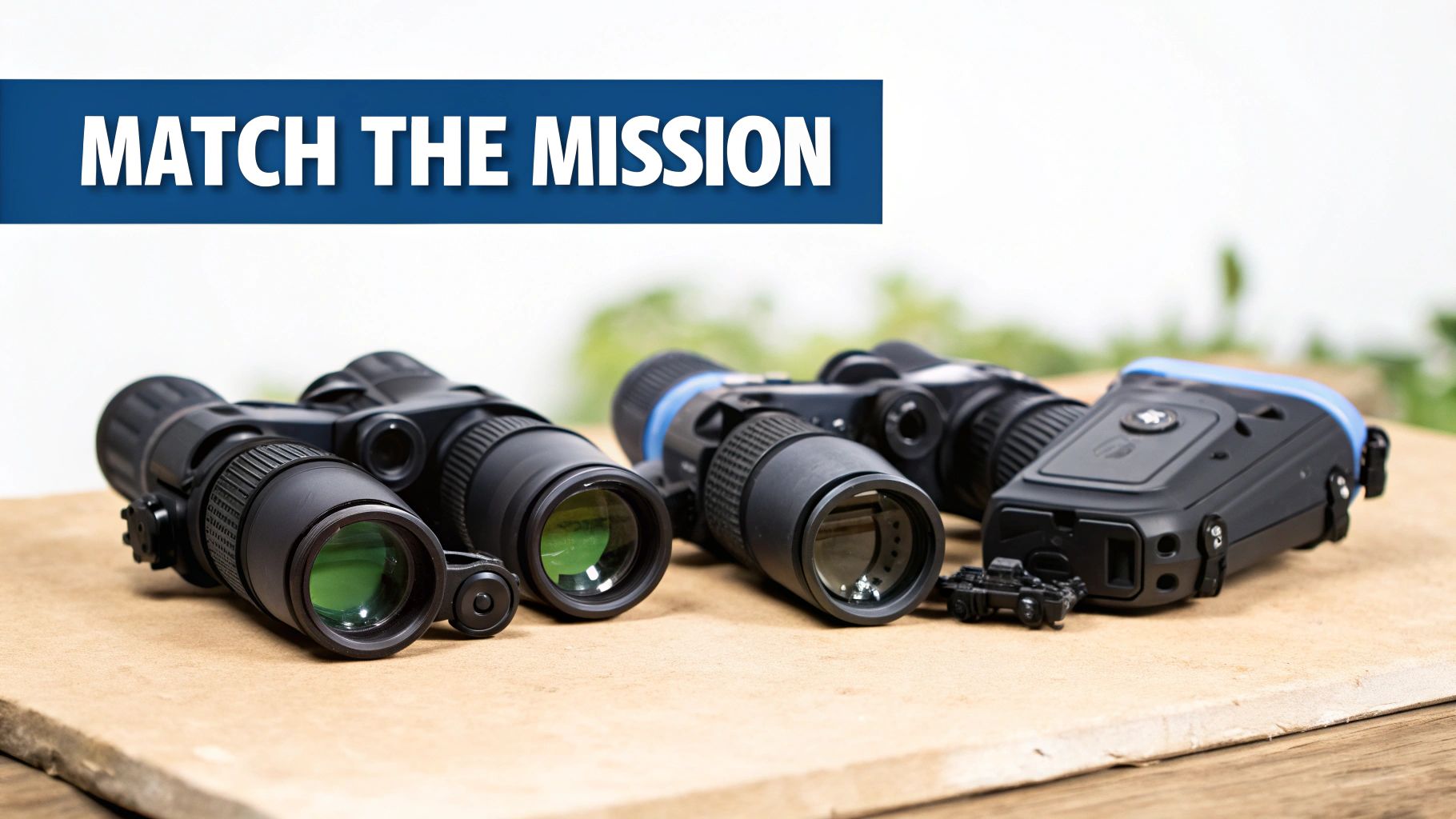
Picking the right night vision for your team isn't about grabbing the most expensive piece of kit off the shelf. It’s about matching the tool to the job. That high-speed, dual-tube goggle system is a game-changer for a SWAT team, but it's probably overkill for a patrol officer who just needs to see what’s happening in a dark alley. Technology only becomes a true force multiplier when its design and function perfectly align with the mission.
The device an officer carries at night fundamentally defines what they can and can't do. Every form factor—from a simple monocular to a dedicated weapon sight—comes with its own set of tactical trade-offs. You have to weigh situational awareness, weight, hands-free use, and of course, cost, to make sure every officer gets the right hardware for their role.
Night Vision Monoculars: The Versatile Workhorse
For most law enforcement applications, the night vision monocular is the undisputed champ of adaptability. A unit like the venerable PVS-14 covers one eye, which leaves the other eye free to maintain its natural adaptation to the dark. This setup is a massive tactical advantage, as it prevents the dreaded "tunnel vision" and lets an officer instantly switch between the NVG view and their naked eye.
This flexibility is why monoculars are so popular. They can be:
-
Helmet-Mounted: This provides hands-free capability, essential for driving, navigating, or handling a weapon.
-
Hand-Held: It doubles as a compact spotting scope for quick scans from a patrol car or on foot.
-
Weapon-Mounted: You can mount it behind a red dot sight for a simple, effective passive aiming setup.
Their light weight and small size make them perfect for patrol officers who need a serious capability boost without being weighed down. A good monocular gives you 80% of the capability of a dual-tube system for a fraction of the cost.
Dual-Tube Goggles for Unmatched Awareness
When you absolutely cannot compromise on situational awareness and depth perception, dual-tube goggles are the only way to go. By feeding a clear image to both eyes, these systems feel much more natural, drastically cutting down on eye strain during long operations. But the real magic is the true stereoscopic vision they provide.
That depth perception is critical for high-stakes tasks:
-
Driving: Navigating a vehicle in total blackout is far more intuitive and safer.
-
Clearing Structures: Moving through a building cluttered with furniture and debris becomes smoother and faster.
-
High-Threat Operations: For SWAT teams making a dynamic entry, the added awareness and reduced disorientation can mean the difference between success and failure.
Yes, they're heavier and more expensive. But the tactical edge that dual-tube systems give to dedicated tactical units in high-risk scenarios is undeniable. They are the gold standard for a reason.
The choice between a monocular and dual-tubes really boils down to a core trade-off. A monocular prioritizes versatility and preserves your natural night vision in one eye. Goggles go all-in on depth perception and operator immersion for the most demanding jobs.
Dedicated and Clip-On Weapon Sights
For putting rounds on target in the dark, nothing beats a dedicated night vision weapon sight. These optics are purpose-built to handle the recoil and abuse of being mounted on a firearm, providing a crisp reticle and rock-solid construction. They are the go-to tool for designated marksmen or overwatch positions where precision is everything.
The downside? A dedicated sight pretty much commits that rifle to nighttime-only duty. A more flexible solution is the clip-on night vision device (CNVD). A CNVD mounts in front of your existing daytime scope, instantly converting it for night use without messing with your zero. This is a huge benefit, as it allows an officer to use their familiar optic and reticle, day or night.
If you're looking for a deeper dive into the options, you can learn how to choose the right night vision device for your needs in our complete guide.
At the end of the day, the best night vision for law enforcement is simply the one that best supports the officer's job. A patrol officer gets tremendous value from a monocular, a SWAT operator needs the immersion of dual tubes, and a marksman depends on the precision of a dedicated sight. Making the right choice is the first and most important step toward owning the night.
Integrating Night Vision Into Your Operational Loadout
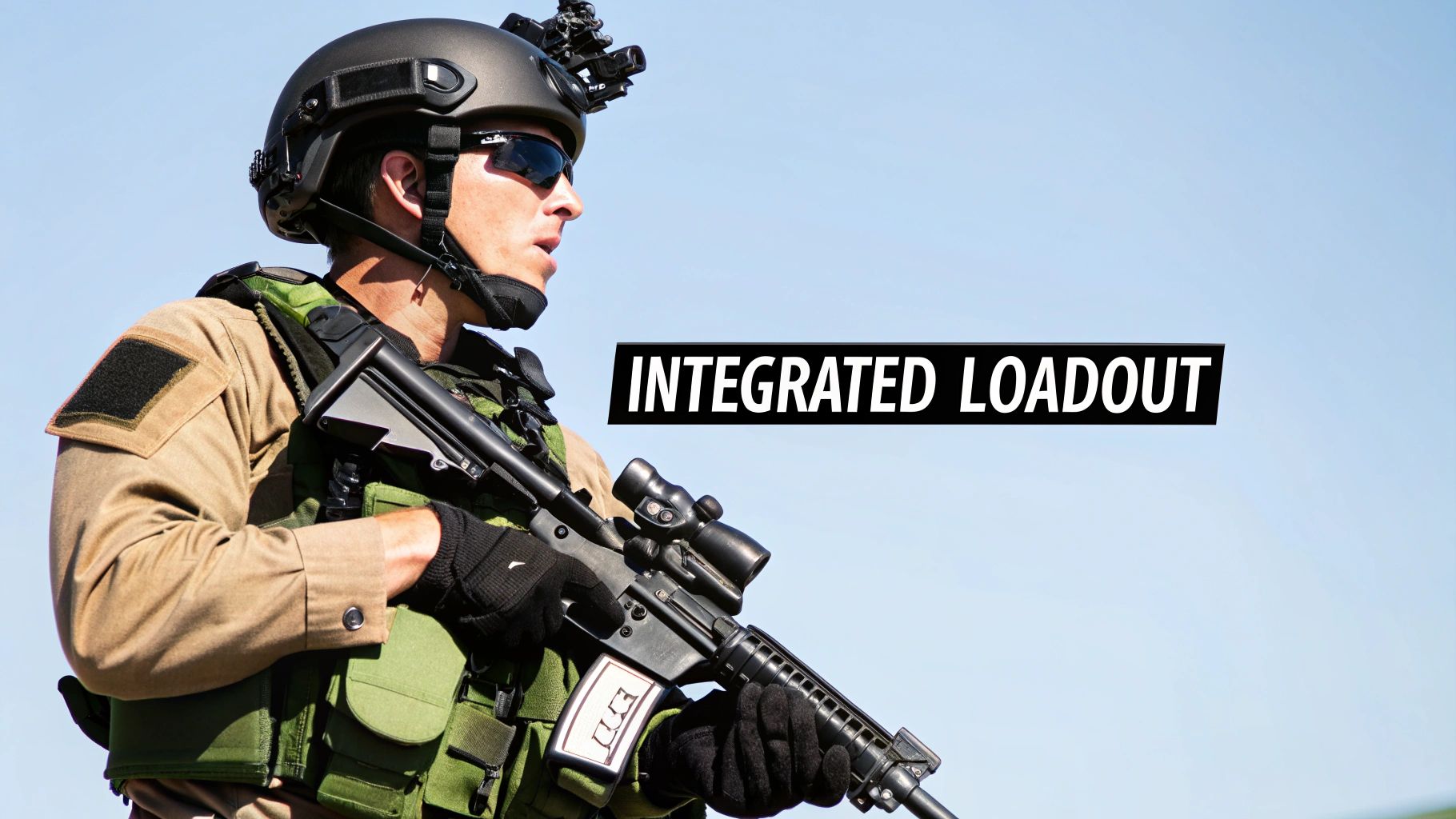
A top-tier night vision device is useless if it’s not properly integrated into an officer's kit. You can't just buy a high-end monocular, slap it on a helmet, and call it a day. It has to become a seamless, balanced part of your entire operational system. Get it wrong, and even the best NODs will cause fatigue, limit your movement, and quickly become more of a liability than an asset.
The real goal here is to make the technology feel like a natural extension of your body, not some clunky afterthought you have to fight with. That means thinking carefully about your helmet setup, how it works with your weapon system, and the crucial link between the two. A well-integrated loadout is what allows an officer to move, communicate, and handle threats without being distracted by their own gear.
Building a Balanced Helmet System
Everything starts with the helmet. It’s the foundation for any hands-free night vision setup. Modern ballistic helmets are built to be platforms, ready for shrouds, mounts, and all sorts of accessories. The absolute key, though, is balance. If you don't get the balance right, you're setting your officers up for significant neck strain and fatigue, which can become a major issue on a long call-out.
Think about it: an unbalanced helmet is constantly trying to pull forward, forcing you to use your neck muscles to fight gravity. That’s not just uncomfortable; it’s a constant, nagging distraction. The solution is a counterweight system. These are pouches that attach to the back of the helmet, filled with dedicated weights—or even useful things like battery packs—to perfectly offset the weight of the NOD hanging off the front.
Here are the core parts you need for a solid helmet rig:
-
Helmet Shroud: This is the mounting point on the front of the helmet where the NVG mount locks in.
-
NVG Mount: The articulating arm that connects your device to the shroud and lets you flip it up out of the way or down over your eye.
-
Counterweight: A pouch on the back of the helmet to balance the entire setup and save your neck.
-
Retention System: Bungees or lanyards that act as a safety net to keep your very expensive device from hitting the ground if it gets knocked off the mount.
When you have it right, the helmet should feel stable and almost weightless on your head. It shouldn't dive forward when the NOD is down, and it shouldn't rock back when it's flipped up. That balance is non-negotiable for anyone who needs to wear this gear for hours.
Integrating with Your Weapon System
Of course, night vision for law enforcement isn't just about seeing; it's about being able to effectively engage threats. This means your NOD has to work in perfect concert with your primary weapon. While you can mount a PVS-14 behind a red dot sight for "passive aiming," the professional standard for fast and intuitive targeting is an infrared (IR) laser.
An IR aiming laser mounts to your rifle's rail and projects a beam that's completely invisible to the naked eye. But through your night vision device, it shows up as a crisp, bright aiming dot. This is a game-changer. It lets an officer get rounds on target from awkward positions without needing a perfect cheek weld, much like using a visible laser in daylight.
This setup gives you a powerful, integrated system:
-
IR Laser: Gives you a precise aiming point that only you can see through your NOD.
-
IR Illuminator: This is your stealth flashlight. It floods an area with infrared light, dramatically boosting what you can see and how far you can identify a potential threat. Most quality laser units have a powerful illuminator built-in.
-
Pressure Switches: These let an officer activate the laser or illuminator with a quick tap, all without shifting their grip on the weapon.
When you combine a helmet-mounted NOD with a weapon-mounted IR laser, you get the best of both worlds. An officer can scan their environment heads-up, completely independent of where their rifle is pointed. Once a threat is spotted, they can bring the weapon up, and their aiming point is instantly on target. It’s a fluid and ruthlessly efficient system that maximizes both situational awareness and lethality.
9. A Strategic Approach to Procurement and Lifecycle Management
When it comes to buying night vision for law enforcement, looking at the initial price tag is a rookie mistake. A truly strategic purchase is about the total cost of ownership. You have to think about what it will cost to keep that gear running for its entire service life.
If you ignore the long game—support, repairs, and compliance—a "good deal" can quickly morph into an expensive operational headache. It’s the hidden costs that always get you.
Making a smart, sustainable investment means looking at the whole picture. How good is the manufacturer's warranty? Is their customer support team actually responsive? What’s the real-world process for getting a unit fixed or upgraded? Remember, a device that's sitting in a repair shop for months is just an expensive paperweight; it's not protecting anyone.
Planning for the Long Haul
The life of a night vision device starts way before it’s handed to an officer and ends long after its first mission. Getting the procurement phase right is everything if you want gear that lasts and performs when it counts.
It’s no different than buying a new fleet of patrol cars. You wouldn't just compare the sticker prices. You’d dig into the fuel efficiency, the scheduled maintenance costs, and how easy it is to get spare parts. The exact same logic applies to this kind of high-tech optical equipment.
The real value of a night vision system isn't just its performance on day one, but its consistent, dependable readiness year after year. That reliability is built on a foundation of smart procurement decisions that prioritize durability, support, and total lifecycle costs.
Your Agency Procurement Checklist
To make sure you're making a solid investment, your procurement team needs a go-to set of questions for any vendor. This isn't about getting swayed by slick marketing; it's about getting to the facts that matter for real-world police work.
We've put together a checklist to help your agency cut through the noise and focus on what’s truly important when evaluating night vision devices. These are the questions you need to ask before you sign a purchase order.
Law Enforcement Night Vision Procurement Checklist
| Consideration Category | Key Questions to Ask Vendor | Why It Matters |
|---|---|---|
| Warranty & Support | What, exactly, does the warranty cover and for how long? Do you offer a 10-year warranty? How do we access technical support for field issues? | A long warranty shows the manufacturer stands behind their product. Quick, accessible support means less downtime for your officers. |
| Repair & Maintenance | Where are repairs done? Is it in-house or outsourced? What’s the average turnaround time for common repairs? | An in-house service center typically means faster repairs, getting critical gear back in service where it belongs. |
| Durability Ratings | What is the device’s IP (Ingress Protection) rating? Is it at least IP67? Has it been tested against mil-spec drop standards? | An IP67 or IP68 rating means the unit is sealed against dust and can handle being submerged in water—a must for all-weather operations. |
| Power Source | What kind of batteries does it use? How long is the operational runtime on a single set? Are the batteries common types (AA or CR123A)? | Using common batteries makes logistics a breeze. You don't want officers struggling to find a proprietary battery type in the middle of a callout. |
| Legal & Compliance | Can you provide documentation showing full compliance with International Traffic in Arms Regulations (ITAR)? | ITAR compliance is non-negotiable. It governs the sale of this technology and protects your agency from serious legal and operational risks. |
By getting clear answers to these questions up front, you can build a complete picture of what you're signing up for. This proactive approach doesn't just protect your budget; it ensures your officers have gear they can trust when the lights go out and the stakes are highest.
Common Questions About Law Enforcement Night Vision
When an agency starts looking to buy or upgrade its night vision gear, the same few questions always pop up. Getting straight answers is the first step toward making a smart purchase that serves your officers well. Let’s break down some of the most common things we hear from team leaders and procurement officers.
What Is the Real Difference Between White and Green Phosphor?
The color you see through a night vision device—that classic green or a crisp black-and-white—is determined by the phosphor screen in the tube.
For decades, green was the only game in town. It was chosen for a simple reason: the human eye is incredibly sensitive to shades of green, which makes it easier to stare through a tube for hours without getting a headache. It's a proven, reliable standard.
White phosphor is the newer option, offering a black-and-white image that many operators feel is more natural and provides better contrast. This can make it easier to spot details, judge distances, and separate a potential threat from a cluttered background. While green phosphor still gets the job done, white is quickly becoming the go-to for agencies that can afford the higher price tag. Ultimately, it often comes down to budget and what your operators prefer.
How Important Is Figure of Merit (FOM) in a Device?
Figure of Merit (FOM) is arguably the single most important spec you'll see on a modern image intensifier tube. It's a simple calculation: the tube's resolution multiplied by its signal-to-noise ratio.
Think of it this way: a higher FOM gives you a cleaner, sharper picture, especially when you're working in near-total darkness. For a patrol officer, a standard-issue FOM might be perfectly fine for spotting a prowler in a backyard. But for a SWAT team clearing a dark warehouse, that extra clarity from a high-FOM tube is non-negotiable.
A higher FOM score gives an officer the ability to see farther and with greater detail, providing crucial extra seconds to assess a threat and make a sound tactical decision.
A high FOM means better detection ranges and more positive identifications. It’s a direct investment in operational effectiveness and officer safety.
Can Night Vision See Through Glass, Smoke, or Fog?
This is a huge tactical question, and the answer is a hard "it depends" on what kind of device you're using.
-
Image Intensifiers (I²): These light-amplifying devices can see right through a car window, no problem. But throw up a wall of thick smoke or dense fog, and they're blind. If light can't get through, neither can your I² device.
-
Thermal Imagers: Thermal works on heat, not light, so it's the exact opposite. It cannot see through glass, which acts like a mirror to thermal radiation. But it cuts through smoke, fog, and even thick brush like they aren't even there, easily spotting a heat signature on the other side.
Knowing this distinction is everything. You'd use an I² monocular to see what a suspect is doing inside a car, but you'd switch to a thermal sight to find someone hiding in a smoke-filled room.
At Superior Tactical LLC, we specialize in getting the right night vision and thermal gear into the hands of law enforcement agencies. Our team has been there, and we can help you cut through the noise to find the best solution for your mission. Check out our curated selection of professional-grade equipment at our official website.
