Your Complete Guide to 2nd Gen Night Vision Technology
If you've ever found yourself squinting through an old night vision unit, you know the frustration. The jump to 2nd-generation night vision isn’t just an incremental step up; it’s like going from a blurry, black-and-white tube television to a high-definition flat screen. It's a foundational shift that delivers a genuinely usable image, bridging the gap between clunky Gen 1 toys and the super-high-cost of Gen 3.
What Makes 2nd-Gen Night Vision a Game Changer
Think of Gen 1 like trying to find your way through a pitch-black forest with a weak penlight. You need that active infrared (IR) illuminator just to see, but that beam is a dead giveaway to anyone else out there with night vision. It’s a massive tactical disadvantage.
Gen 2 devices, on the other hand, operate passively. They work more like an owl's eye, gathering the faint, existing ambient light from the moon or stars and multiplying it to create a clear picture.
The secret sauce behind this leap in performance is the Microchannel Plate (MCP). This is the heart of a Gen 2 tube. Picture a wafer-thin glass disc, riddled with millions of microscopic tubes. When the few photons of available light enter the device, they're first converted into electrons.
The Power of Amplification
Those electrons are then funneled into the MCP. As they ricochet down the tiny channels, they knock loose thousands more electrons in a cascading chain reaction. This process is the "gain" you hear about—it's what cranks up a barely visible scene into a bright, usable image for navigation or target identification.
This technology, first introduced in the 1970s, was a revolution. It allowed for light amplification of up to 20,000 times and got rid of the weird fisheye distortion that plagued Gen 1. You can learn more about the history of night vision technology and the MCP's development.
The ability to see clearly without projecting an IR beam is Gen 2's single greatest advantage. It lets you operate in the dark while remaining completely unseen.
This is exactly why Gen 2 technology has remained so relevant. It delivers serious, reliable performance without the budget-breaking price tag of Gen 3, hitting a perfect sweet spot for a wide range of users.
- Law Enforcement: It provides the clarity needed for effective surveillance and observation without compromising an officer's position.
- Hunters: It allows for positive target identification at responsible ranges, ensuring a safe and ethical shot.
- Security Professionals: It offers dependable perimeter monitoring when the lights go out.
How Light Becomes a Usable Image
At the heart of any 2nd-gen night vision device is the image intensifier tube, a slick piece of engineering that turns what looks like total darkness into a clear, visible scene. It pulls this off by amplifying the tiniest bits of ambient light by thousands of times. Picture it as a high-speed relay race for photons.
It all starts with faint, barely-there light from the moon, stars, or even distant city glow. These light particles, known as photons, pass through the objective lens and hit a special surface at the front of the tube called a photocathode. Its one crucial job is to convert every photon that strikes it into an electron.
Unleashing the Electron Cascade
A small stream of electrons isn't nearly enough to build a picture, though. This is where the magic really happens, thanks to the star of the Gen 2 show: the Microchannel Plate (MCP). This is an incredibly thin glass wafer, just fractions of a millimeter thick, riddled with millions of microscopic, angled tubes.
When the electrons from the photocathode enter these channels, a high voltage zaps across the plate. This energy sends the electrons ricocheting down the channel walls like pinballs. Every time an electron hits a wall, it knocks loose a bunch of new electrons, creating an avalanche. A single electron going in can trigger thousands to come pouring out the other side. This is the "gain" that makes the image so bright. For a more detailed breakdown of the science, check out our full guide on how night vision works.
The Microchannel Plate is the single biggest upgrade that separates Gen 2 from its predecessors. This 'electron multiplier' provides the massive light amplification that makes passive operation possible, often without needing a giveaway IR illuminator.
The flowchart below maps out this entire process, showing how faint light gets transformed into the crisp image you see through the eyepiece.
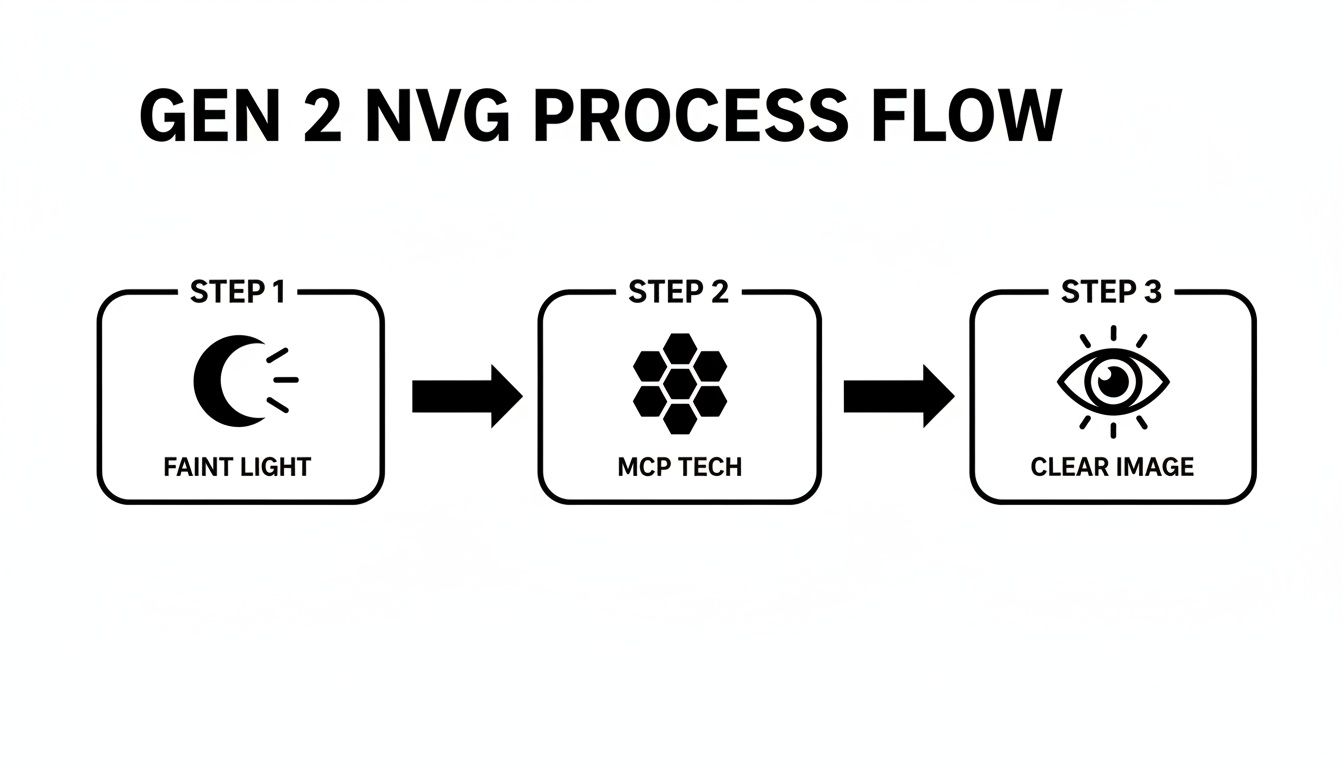
As you can see, the MCP is the engine at the center of it all, turning a weak signal into a powerful, usable image.
Creating the Final Image
So what happens to this massive cloud of amplified electrons? They fly out of the MCP, cross a tiny gap, and slam into a phosphor screen. When these supercharged electrons hit the screen, they make the phosphors glow, working a lot like an old-school CRT television.
This glowing screen is what produces that classic green image we all associate with night vision. The pattern and brightness of the lit-up phosphors perfectly match the original scene, only now it's up to 20,000 times brighter. You look through the eyepiece lens and see this bright, detailed picture, effectively turning the night into day.
Gen 2 vs. Other Generations: A Practical Comparison
Choosing the right night vision isn't about memorizing spec sheets. It’s about understanding the real-world trade-offs and what you can actually see and do when the lights go out. This is where 2nd-generation night vision truly finds its sweet spot.
When you put a Gen 2 unit up against its predecessor, the difference is night and day—literally. Generation 1 devices are almost entirely dependent on active illumination. They need a built-in infrared (IR) illuminator to see in anything less than a full moon, which is like waving a flashlight that only other night vision users can see. Gen 2's ability to operate passively, thanks to its Microchannel Plate, is its single greatest advantage over Gen 1. It lets you see without being seen.
Performance Against Gen 1
The visual quality is a massive leap forward as well. Gen 1 devices are notorious for a few key problems:
- Heavy image distortion, especially that "fisheye" effect you see around the edges of the picture.
- Low resolution and gain, which translates to a fuzzy, grainy image that lacks detail.
- A very limited effective range, often making it tough to identify anything beyond 75-100 yards.
A decent Gen 2 unit cleans all of this up. You get a crisp, flat image with enough clarity to reliably identify targets out to 150-200 yards in decent starlight. It's not just a minor upgrade; it’s a complete game-changer for tactical and practical use.
Weighing Gen 2 Against Gen 3
The discussion gets more interesting when we compare Gen 2 to Gen 3. This is where your budget and specific needs really start to matter. Generation 3 technology uses a more efficient Gallium Arsenide (GaAs) photocathode, giving it the edge in the darkest conditions. The result is a brighter, cleaner image with a better Signal-to-Noise Ratio (SNR), meaning you see less of that sparkling static.
But that top-tier performance comes with a serious price tag, often costing double or even triple what you'd pay for a comparable Gen 2 device. For a huge number of users, that extra cost just isn't justified by the performance gain. A solid Gen 2 unit delivers the vast majority of Gen 3's capability, providing a perfectly usable and clear image in most situations where any ambient light exists.
To help visualize these differences, here's a quick breakdown of how the generations stack up on key performance metrics.
Night Vision Generation Performance Comparison
| Specification | Generation 1 | Generation 2 | Generation 3 |
|---|---|---|---|
| Photocathode | S-20 Multialkali | S-25 Bialkali | Gallium Arsenide (GaAs) |
| Light Gain | ~1,000x | 20,000x – 70,000x | 50,000x – 100,000x+ |
| Resolution | Low (~30 lp/mm) | Good (54-72 lp/mm) | Excellent (64-72+ lp/mm) |
| Tube Lifespan | ~1,500 hours | ~10,000 hours | ~10,000+ hours |
| Low-Light Ability | Poor (Needs IR) | Good (Passive) | Excellent (Passive) |
| Cost | Low | Moderate | High |
This table clearly shows the massive leap from Gen 1 to Gen 2, and the more incremental (though still significant) improvements offered by Gen 3. You can dive deeper into the specifics in our complete guide covering all night vision generations.
Think of it this way: Gen 1 is a basic tool that works, but with some major compromises. Gen 3 is the specialized, high-end gear for no-fail missions where cost is no object. Gen 2 is the professional-grade workhorse that reliably handles almost anything you can throw at it, delivering outstanding performance for the price.
For law enforcement, serious hunting, or home security, 2nd-gen night vision hits that perfect balance. It gives you the critical tactical advantage of passive operation and clear imaging without the premium price of the absolute latest tech, making it the smartest choice for a wide range of dedicated users.
Where Gen 2 Optics Shine in the Real World
Specs on a page are one thing, but how a night vision device performs when you actually need it is what truly matters. This is exactly where 2nd-generation night vision comes into its own, hitting a sweet spot between serious capability and real-world affordability. For a lot of users, it’s the perfect choice when you need professional-grade performance without the top-tier price tag of Gen 3.
Law Enforcement and Tactical Use
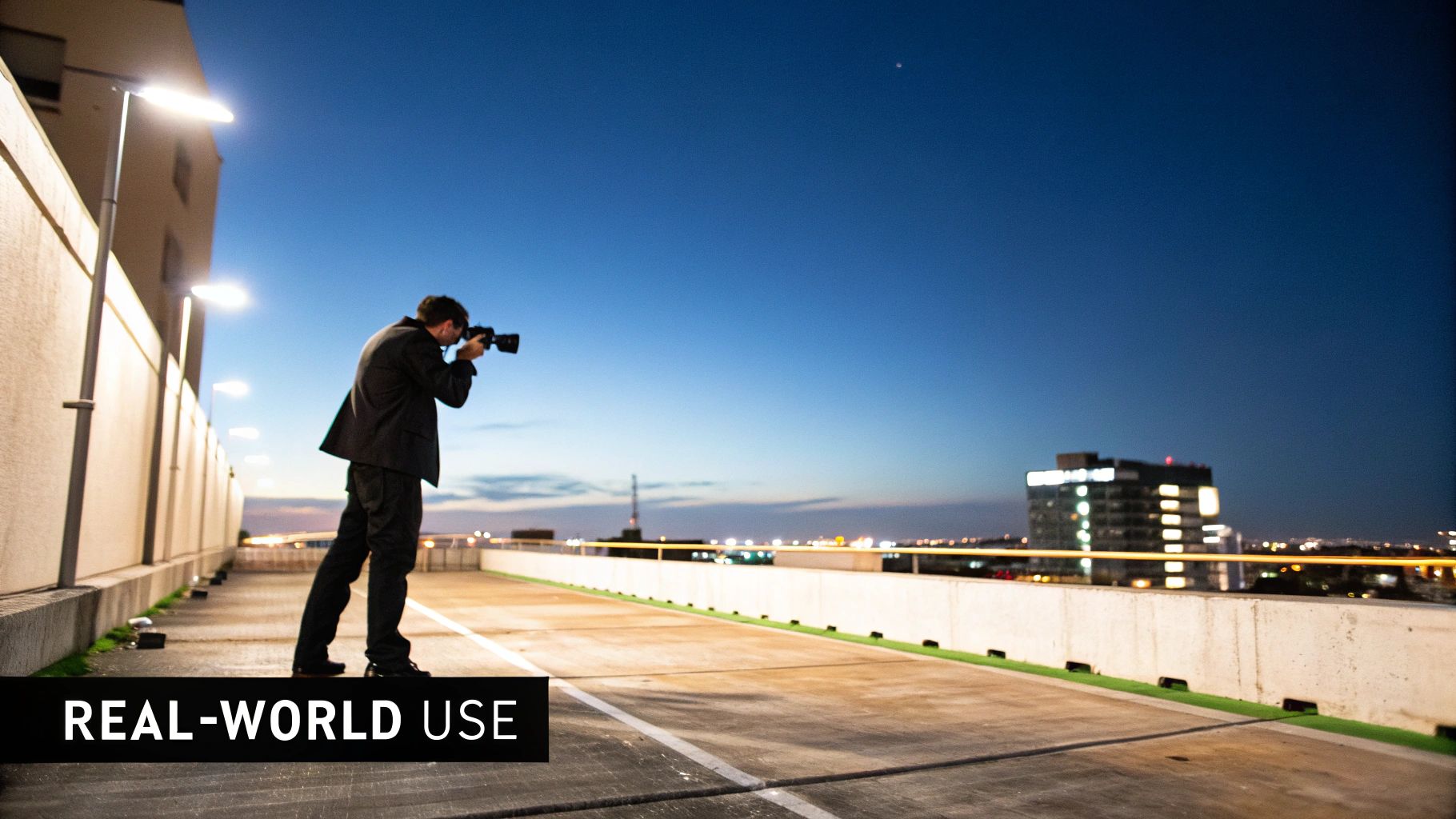
For police and security teams, Gen 2 provides a huge tactical advantage. Because it works passively, it's ideal for covert surveillance in urban areas where giving away your position is not an option. Officers can watch a location or follow a suspect using only the faint ambient light from streetlamps and buildings, getting a clean, usable image without having to flip on an IR illuminator that screams "I'm over here."
The roots of this technology are deeply military. It was the introduction of Gen 2 optics during the Vietnam War era that gave U.S. forces a game-changing advantage at night. These units finally got rid of the need for the active IR illuminators that plagued Gen 1 devices, offered light amplification around 20,000x, and effectively doubled or tripled their operational range. This battle-tested tech eventually found its way into law enforcement, where it’s still a trusted tool today. You can learn more about the historical development of night vision to see how far it's come.
Hunting and Perimeter Security
When you're out hunting predators or hogs at night, positive target identification is everything. Gen 2 optics give you the sharp resolution needed to clearly distinguish an animal from the background at ethical shooting distances, often out to 200 yards with decent moonlight. This level of clarity is critical for a safe, humane hunt and helps prevent the kind of tragic mistakes that can happen with lesser optics.
For anyone wanting to secure their property, a helmet-mounted Gen 2 monocular is a powerful tool. It lets you move hands-free to check on a strange noise, look over livestock, or patrol a fence line, all with crystal-clear vision that doesn't compromise your awareness of what's around you.
This adaptability makes 2nd gen night vision a true workhorse. It delivers in situations where you simply can't afford to fail, offering some key operational benefits:
- Covert Observation: The power to see without being seen is a cornerstone of any tactical operation.
- Positive Target ID: Hunters can be absolutely sure of their target, which is fundamental to safe and ethical practices.
- Hands-Free Navigation: Mounting a unit on a helmet frees up your hands, letting you move quickly and quietly in total darkness.
Whether you're in a patrol car or a deer stand, the practical, field-proven uses for Gen 2 technology make it one of the most versatile and valuable tools for anyone who owns the night.
Building Your Ideal Gen 2 Night Vision Setup
Getting your hands on a powerful 2nd gen night vision device is just the first step. To truly own the night, you need to think bigger and build a complete system around it. The right accessories and mounting solution will make that optic feel like a natural extension of your body.
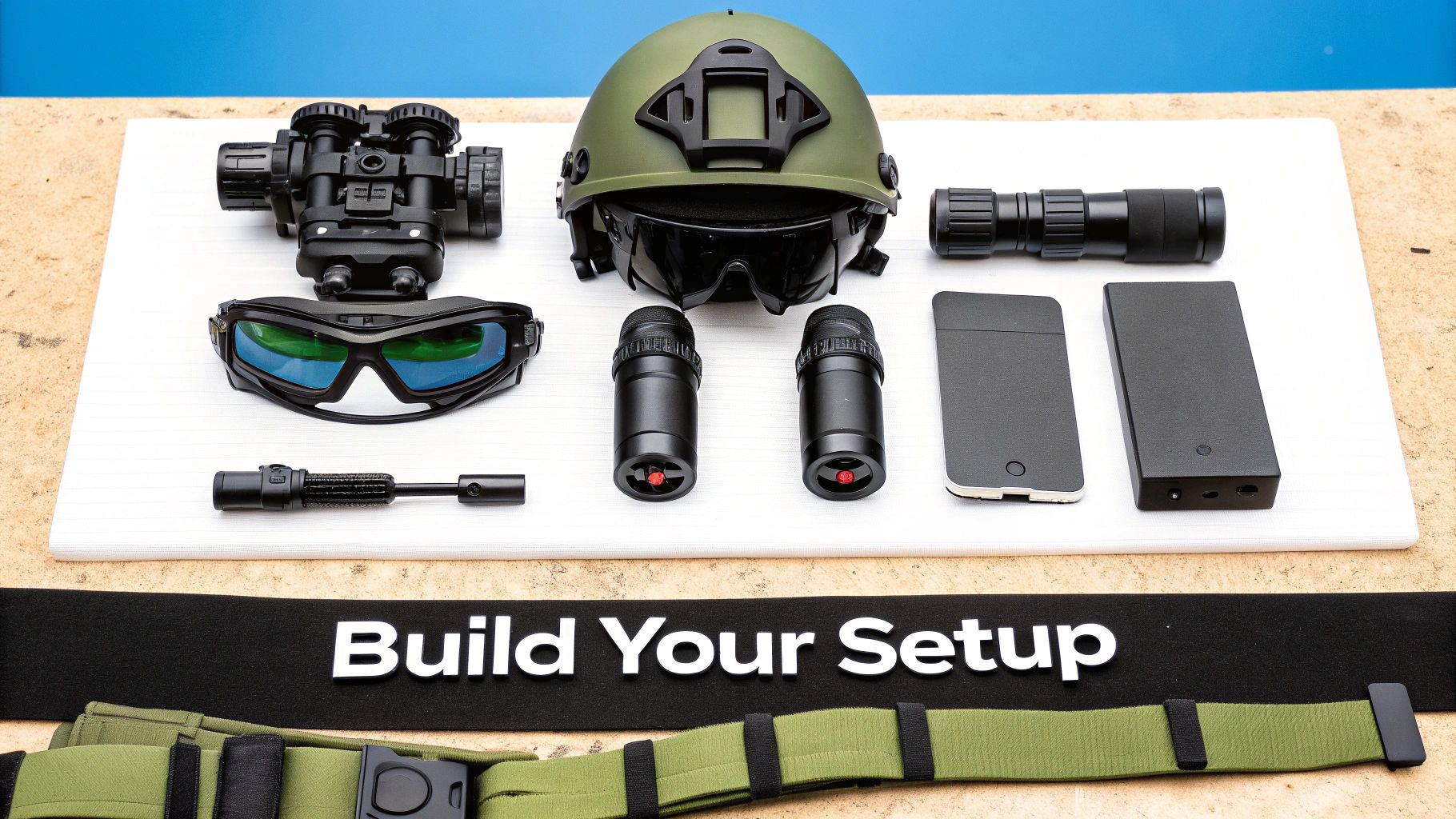
Your first big decision is how you're going to mount it. How you plan to use your NVD—whether for navigating, observing, or aiming—is going to point you toward the right setup. For hands-free operation, nothing beats a helmet-mounted monocular or goggle. It lets you move, drive, and work on other tasks without being tied down, which is why it’s the go-to for anyone on the move.
The other main route is a weapon mount. This turns your firearm into a dedicated night-fighting tool. It’s a simpler, often more budget-friendly approach that works great for static roles, like hunting from a blind or holding a defensive position.
Essential Accessories for Peak Performance
With mounting figured out, it's the accessories that will take your setup from good to great. They protect your investment, push the device's performance, and help you adapt to changing conditions. For any serious user, some of these aren't just nice-to-haves; they're mandatory.
Here are a few key pieces of kit to look at:
- Supplemental IR Illuminator: Gen 2 is impressive on its own, but nothing can see in total darkness. A good IR illuminator is like a stealth flashlight that only you can see. It cuts through deep shadows and lights up pitch-black interiors without giving away your position. Our guide on the best infrared illuminator for night vision can help you pick the right one.
- Sacrificial Lens: This is a cheap, clear lens cover that threads onto the front of your optic. Think of it as a screen protector for your expensive night vision. It takes the scratches, dirt, and dings so your primary lens doesn't have to. Don't go into the field without one.
- Demist Shield: Ever had your glasses fog up on a cold day? The same thing happens to your eyepiece lens in humid or cold weather. A demist shield creates a small pocket of air that stops condensation in its tracks, ensuring your view stays crystal clear.
Building a complete system is about creating synergy between your gear. Your mount, illuminator, and protective accessories should work together to make your night vision device more effective, durable, and intuitive to use.
When you carefully select these components, you end up with a cohesive, mission-ready kit tailored to what you do. This deliberate approach is what turns a piece of equipment into a true capability, ensuring your 2nd gen night vision setup is ready for whatever the night throws at you.
Common Questions About 2nd Gen Night Vision
Diving into the world of night vision is going to kick up a few questions. That's a good thing. Getting clear, honest answers is the only way to make a smart purchase and know exactly what your gear can—and can’t—do. We get these questions all the time, so let's cut through the noise and get right to it.
Is Gen 2 Good Enough for Hunting and Tactical Use?
Let's be direct: absolutely. For a massive range of serious applications, 2nd generation night vision isn't just "good enough"—it's an outstandingly effective tool. It represents a quantum leap in performance over Gen 1, giving you the real-world capability you need when the lights go out.
For hunters after predators or hogs, Gen 2 provides the clarity to positively identify your target. Under decent starlight or moonlight, you’re looking at reliable target ID out to 150 to 200 yards. That’s well within ethical engagement distances, ensuring you can make a safe, humane shot every time.
In the tactical world, Gen 2's greatest strength is its passive operation. Law enforcement and security teams can run surveillance without broadcasting an IR signature that screams "I'm over here!" to anyone else with night vision. While Gen 3 is undeniably the king in near-total darkness, Gen 2 provides a crisp, usable image in the vast majority of low-light scenarios, making it a reliable and incredibly cost-efficient workhorse.
Think of it this way: Gen 2 gives you a huge slice of Gen 3's core capability for a fraction of the price. For many operators, it's the sweet spot—professional-grade performance that gets the job done without destroying your budget.
What Is the Lifespan of a Gen 2 Image Intensifier Tube?
Modern, well-made 2nd gen night vision tubes are built for the long haul. You can typically expect an operational lifespan between 2,500 and 5,000 hours, with some of the higher-spec tubes pushing toward 10,000 hours. That's a massive upgrade from Gen 1 tubes, which often tap out around 1,000-1,500 hours.
For the average user, even 5,000 hours is an enormous amount of time—it translates to years of consistent use. Just remember, how you treat your gear directly impacts how long it lasts. The number one killer of image intensifier tubes is exposure to bright light. Practicing good light discipline is the key to protecting your investment and getting every last hour of performance out of it.
Can I Use Gen 2 Night Vision During the Day?
No. Never. Do not power on a 2nd gen night vision device in daylight without a proper filter. An image intensifier tube is designed to amplify tiny amounts of light tens of thousands of times. Hitting it with the full force of daylight is like pointing a firehose into a thimble—it causes immediate and permanent damage.
This damage often shows up as "burn-in," leaving dark spots or blemishes permanently scorched onto the phosphor screen. To keep that from happening, make these rules second nature:
- Keep the Cap On: The main lens cap (the "day cap") should always be on when the device is stored or not in active use.
- Use a Day Cap for Testing: For a quick function check in a lit room, you need a day cap. This is a special lens cover with a tiny pinhole that only lets a minuscule, safe amount of light in. It’s just enough to see the green glow and confirm it’s working without frying the tube.
- Mind Your Surroundings: Even at night, be constantly aware of bright light sources. Car headlights, streetlights, and sudden security lights can all be hazardous. A quick glance across a bright light is usually okay, but staring at it can cause temporary or even permanent damage.
What Are the Legal Restrictions on Owning Gen 2 Night Vision?
For civilians inside the United States, the rules are pretty straightforward. There are generally no federal restrictions on buying, owning, or using 2nd gen night vision. As a U.S. citizen, you are legally able to purchase and use this technology for legitimate purposes like hunting, security, or just exploring the dark.
Exporting this technology, however, is a whole different ballgame. Night vision devices are considered defense articles and are strictly controlled by the U.S. Department of State under the International Traffic in Arms Regulations (ITAR).
Under ITAR, it is illegal to ship, carry, or otherwise transfer night vision devices outside of the U.S. without a specific government export license.
This is non-negotiable. While you're free to use your gear within the U.S., you can't take it on an international trip or sell it to a non-U.S. person without navigating a complex legal process. It’s always smart to check your specific state and local laws too, though they rarely add restrictions beyond the federal guidelines.
At Superior Tactical LLC, we believe an informed operator is an effective one. We’re here to cut through the confusion and help you build the right low-light setup for your needs. Explore our curated selection of night vision and tactical gear to find equipment you can trust when it matters most.
Ready to own the night? Shop our complete collection of night vision optics and accessories at Superior Tactical today!
