What a 100 Lumen Flashlight Can Really Do in 2026
A 100 lumen flashlight is all about finding that sweet spot between usable light and fantastic battery life. This isn't the kind of light that will turn night into day, but that’s not its job. Instead, it delivers a focused, highly practical beam for most close- and mid-range situations without scorching your retinas or killing your night vision.
What 100 Lumens Looks Like in the Real World
It's easy to get fixated on lumen numbers, but what does 100 lumens actually mean when you’re out in the field? Think of it this way: it’s like taking the light from an old 60-watt incandescent bulb and concentrating all of it into a focused beam right where you need it, instead of letting it scatter across a room. This is the perfect amount of light for a huge range of everyday tasks.
A 100 lumen flashlight gives you more than just illumination; it delivers solid situational awareness without the downsides of a super-bright beam, like blinding glare off a wet surface or tunnel vision in tight spaces.
This moderate output is often a deliberate tactical choice. I’ve seen law enforcement officers use a light like this for administrative work—writing a ticket or checking an ID—without disrupting their partner’s night-adapted vision. For hunters and outdoor folks, it’s exactly what you need to get to your stand before dawn or manage gear around the campsite. We cover more on this topic in our comprehensive guide on finding the best flashlight for camping.
To give you a quick visual reference, here’s a breakdown of what you can expect from a 100-lumen light in various scenarios.
100 Lumen Flashlight Performance at a Glance
| Use Case | Effective Illumination Distance | Ideal Environment |
|---|---|---|
| Indoor Room Search | 20-30 feet | Small rooms, closets, basements |
| Outdoor Path Navigation | 50-75 feet | Maintained trails, sidewalks, backyards |
| Campsite Tasks | 10-15 feet | Setting up a tent, cooking, gear prep |
| Vehicle Inspection | 5-10 feet | Engine bay, interior, undercarriage |
As you can see, a 100-lumen output is more than capable for most of the things you'll run into on a daily basis. It excels in close quarters where a more powerful beam would be overkill.
The Balance of Power and Longevity
Here’s where a 100-lumen light truly shines: efficiency. While those high-lumen monsters chew through batteries in a hurry, a 100-lumen model just sips power. This often translates to many hours of solid, unwavering runtime from a single set of batteries or one charge, making it a tool you can count on when endurance matters more than raw power.
This blend of practical brightness and marathon-like battery performance is precisely why the 100 lumen flashlight is a staple in any well-thought-out Everyday Carry (EDC) setup or emergency kit. It gives you reliable light for:
- Navigational Tasks: Lighting up a dark path or finding your way around during a power outage.
- Close-Quarters Work: Reading a map, fixing a piece of gear, or digging through your pack.
- General Utility: From walking the dog late at night to checking on a strange noise in the yard.
Beyond Lumens: Understanding Beam Throw and Spill
It’s easy to get fixated on the lumen number printed on the box, but that figure only tells part of the story. Think of it as the raw horsepower of an engine—impressive, but useless without good transmission and steering. The real magic of a flashlight lies in its optics, the reflector and lens that take that raw light and shape it into a useful beam.
A great way to picture this is with a garden hose. The lumen count is the total amount of water coming out. But it's the nozzle that determines whether you get a tight, powerful jet stream or a wide, gentle spray. A flashlight’s beam works the exact same way.
Throw: The Distant Jet Stream
Throw is all about distance. This is the tight, focused center of the beam—what we call the hotspot—that punches through the darkness to light up faraway objects. To achieve this, a flashlight uses a deep, smooth reflector that acts like a satellite dish, gathering all the light from the LED and projecting it forward in a concentrated column.
This kind of beam is your best friend when you need to see what's way out there. For a hunter scanning a distant tree line or a security guard checking the perimeter fence, a light with a strong throw is non-negotiable. Even with a modest 100 lumens, a well-designed thrower puts that light exactly where you need it.
Spill: The Close-Quarters Flood
Spill, on the other hand, is the softer, less-intense light that surrounds that central hotspot. This is what illuminates your immediate area and peripheral vision. Lights designed for good spill often use a shallow reflector or one with a textured surface, sometimes called an "orange peel" finish, to scatter the light and create a broad, even flood.
This is exactly what you want for up-close tasks. When you're working under the hood of a car, rummaging through a tent, or clearing a small room, good spill is crucial. It eliminates that disorienting "tunnel vision" effect, giving you a clear sense of your surroundings without having to constantly whip the light around.
This diagram helps visualize how brightness, function, and battery life all intersect in a well-balanced 100-lumen light.
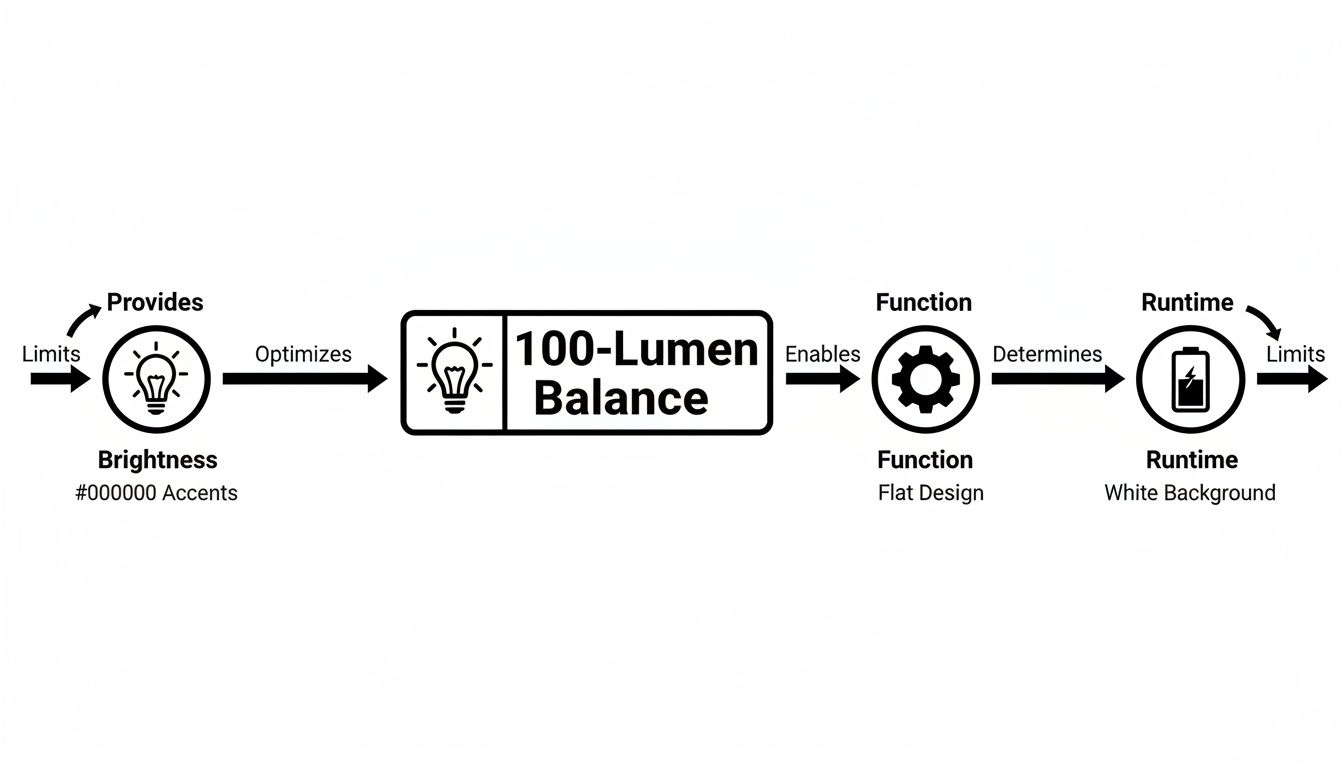
The takeaway here is that 100 lumens often hits a sweet spot, providing plenty of usable light for most jobs while really stretching out that battery life.
A well-engineered 100-lumen light with a superior beam pattern can easily outperform a poorly designed 300-lumen light that just throws out an unfocused "light grenade." It’s not just about how much light you have, but how effectively you can control it.
It's amazing to think how far we've come. Back in 1922, there were about 10 million flashlight users in the U.S., using bulbs that, thanks to tungsten filaments introduced in 1904, produced a dim 10-20 lumens. Today, a quality 100-lumen flashlight from a brand like Nitecore at Superior Tactical can cast a focused beam over 100-150 meters. That's more than enough power for a hunter to scan a field or for tactical use. If you're interested in the journey to get here, the history of flashlights is a fascinating read.
Choosing Your Power Source for Maximum Runtime
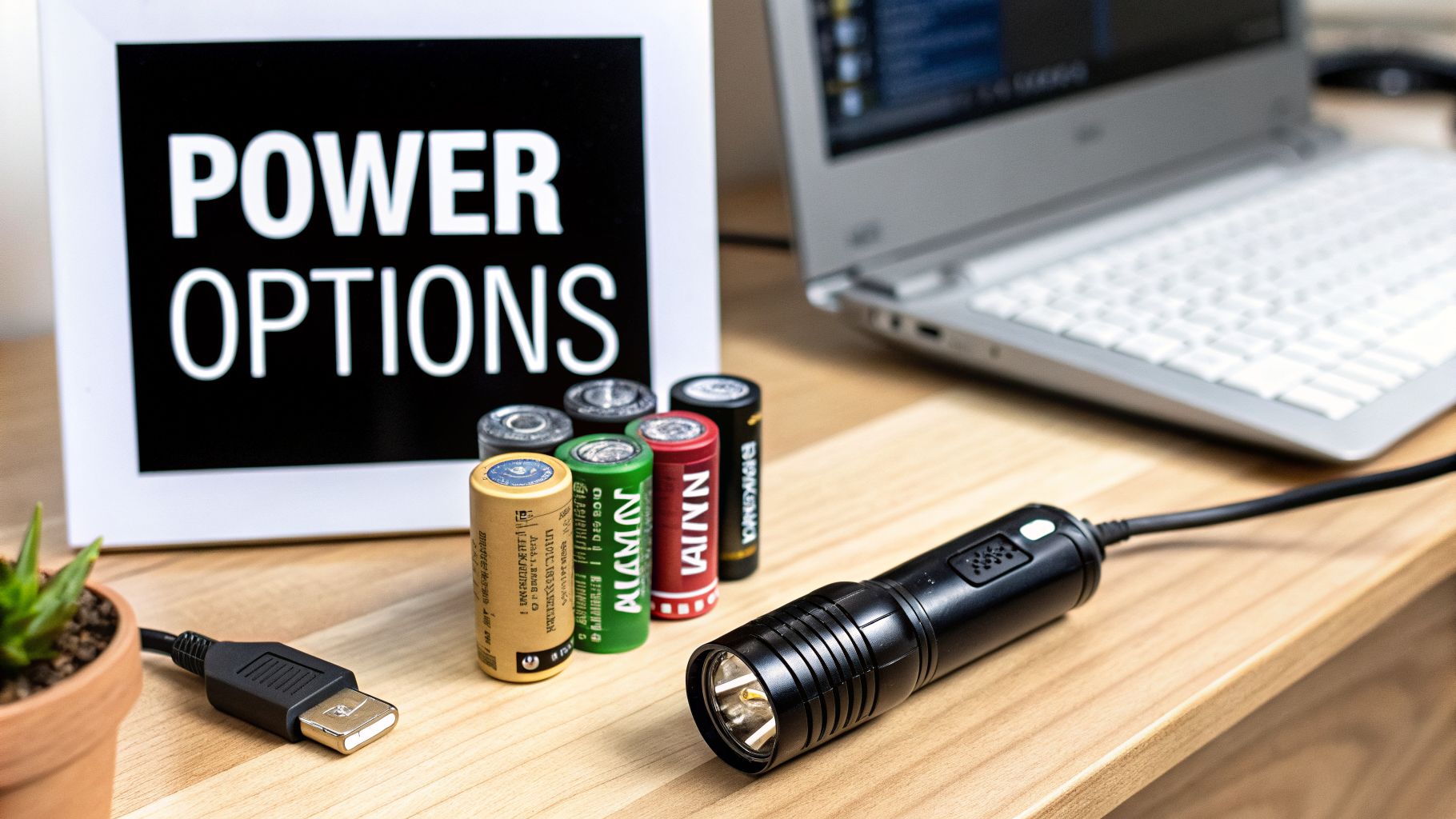
Even the best flashlight in the world is just a fancy paperweight without the right batteries. The power source you pick is every bit as important as the light itself, because it's what dictates your runtime, reliability, and overall convenience in the field.
The big advantage of a 100-lumen flashlight is how it sips, not gulps, power. This incredible efficiency is why it's not unusual to see these lights run continuously for 10 to 20 hours—sometimes even longer. That kind of endurance makes them a reliable partner for long jobs where stopping to swap batteries just isn't an option.
Common Battery Types Compared
Your choice really boils down to balancing cost, convenience, and performance under pressure. Each battery type has its place.
Disposable Alkalines (AA/AAA): These are the kings of convenience. You can find them at nearly any gas station or grocery store on the planet, which makes them a fantastic backup. Just know their limits: they struggle in the cold and can leak if you store them inside your light for years.
Lithium Primaries (CR123A): A top pick for professionals, and for good reason. CR123A batteries boast a shelf life of up to 10 years, work like a charm in freezing temperatures, and deliver consistent voltage so your light stays bright. This reliability makes them perfect for gear stored in a go-bag or truck console.
Rechargeable Li-ions (18650/14500): These are the workhorses for anyone who uses their light often. The initial cost is higher, but since you can recharge them hundreds of times, they quickly become the most economical choice. They also pack an impressive amount of power for their size.
For a lot of us, a "dual-fuel" light is the smartest way to go. Having a light that runs on a rechargeable Li-ion for daily tasks but can also take a disposable CR123A in a pinch gives you the flexibility to handle anything.
The Rise of USB-C Charging
Modern flashlights have made keeping your gear powered up incredibly simple. Many of the best models now come with built-in USB-C charging ports. This means you can top off your battery directly from a power bank, your laptop, or an adapter in your car, no separate charger required.
That level of convenience is a total game-changer for anyone on the move. The LED revolution, which really took off around 2001, has given us tools that are both powerful and unbelievably small. For our customers at Superior Tactical, Nitecore makes 100-lumen lights that weigh less than 100 grams—perfect for security pros or backcountry adventurers. These lights blend modern features like USB-C charging with the ability to use CR123A batteries, a world away from the flickering rechargeable lights of the past.
It's amazing to see how far technology has come in just a couple of decades. For a deeper dive into battery specifics, particularly for high-performance brands, check out our guide on batteries for Surefire flashlights.
It’s easy to get caught up in the "lumen wars," where brighter always seems better. But when you're actually out in the field, you quickly learn that specs on paper don't tell the whole story. The truth is, that 100-lumen flashlight you might have overlooked is often the smartest tool for the job.
Think of it as finesse over brute force. A monster beam with 1,000+ lumens is great for lighting up a whole field, but in tight spaces, it's a liability. That intense light bounces off walls, windows, and close-up objects, creating blinding glare. You end up with tunnel vision, and your natural night-adapted vision is completely shot. A 100-lumen light, on the other hand, gives you a soft, usable field of view that lets your eyes do their job.
For Law Enforcement and Security Professionals
For anyone on patrol, a reliable 100-lumen light is a go-to for countless daily tasks. It’s the perfect amount of light for administrative and investigative work where you need to see clearly up close without sacrificing your situational awareness.
- Writing Citations and Reports: It lights up your notepad or vehicle console perfectly, without causing the eye strain a brighter light would.
- Searching Vehicle Interiors: You can easily check under seats or in a glove box. The beam is plenty strong without creating harsh, disorienting reflections off the glass.
- Backup and Partner Safety: Using a 100-lumen light for a small task means you aren't blasting your partner’s retinas, which is a huge deal for maintaining team security.
The real goal isn't always to be the brightest. It’s about using the right amount of light for the job. A 100-lumen light lets an officer read an ID or check a bag while keeping their peripheral vision intact and ready to respond.
This isn’t just an opinion; it's backed by years of professional feedback. A 2015 survey showed that 65% of tactical professionals actually preferred lights in the 100-300 lumen range for their most common low-light tasks. They valued the mix of useful visibility and stealth. This became a key standard after the FBI determined that 100 lumens was the minimum needed to properly identify a subject at 25 yards, a huge step in the evolution of tactical lighting.
For Hunters and Outdoor Enthusiasts
Out in the woods, being subtle is everything. That’s where the 100-lumen flashlight truly shines—by not shining too brightly. It gives you just enough light to get things done without announcing your presence to every creature in the county.
Its controlled hotspot and moderate spill are perfect for:
- Navigating to a Treestand: You can easily follow a trail in the pre-dawn darkness without sending a beacon of light through the forest.
- Field Dressing Game: It provides plenty of clear light for precise work after a successful hunt, all without overwhelming your eyes.
- Campsite Management: Setting up a tent, cooking a meal, or digging through your gear is simple. The light is bright enough for tasks within a 10-15 foot circle but soft enough that it won't disturb others in camp.
For hikers, preppers, or anyone who keeps an Everyday Carry (EDC) kit, this light is a cornerstone. It's what you want for navigating a power outage, finding something in your pack, or signaling for help without worrying about the battery dying in an hour. When you're miles from the nearest power source, that incredible runtime is its most valuable feature.
Built to Last: What Makes a Flashlight Truly Mission-Ready?
When your flashlight is a critical piece of gear, failure isn't an option. For law enforcement on a tough beat, a hunter tracking game at dusk, or an adventurer deep in the backcountry, your equipment has to work, every single time. That’s why you can't compromise on durability, even with a straightforward 100 lumen flashlight.
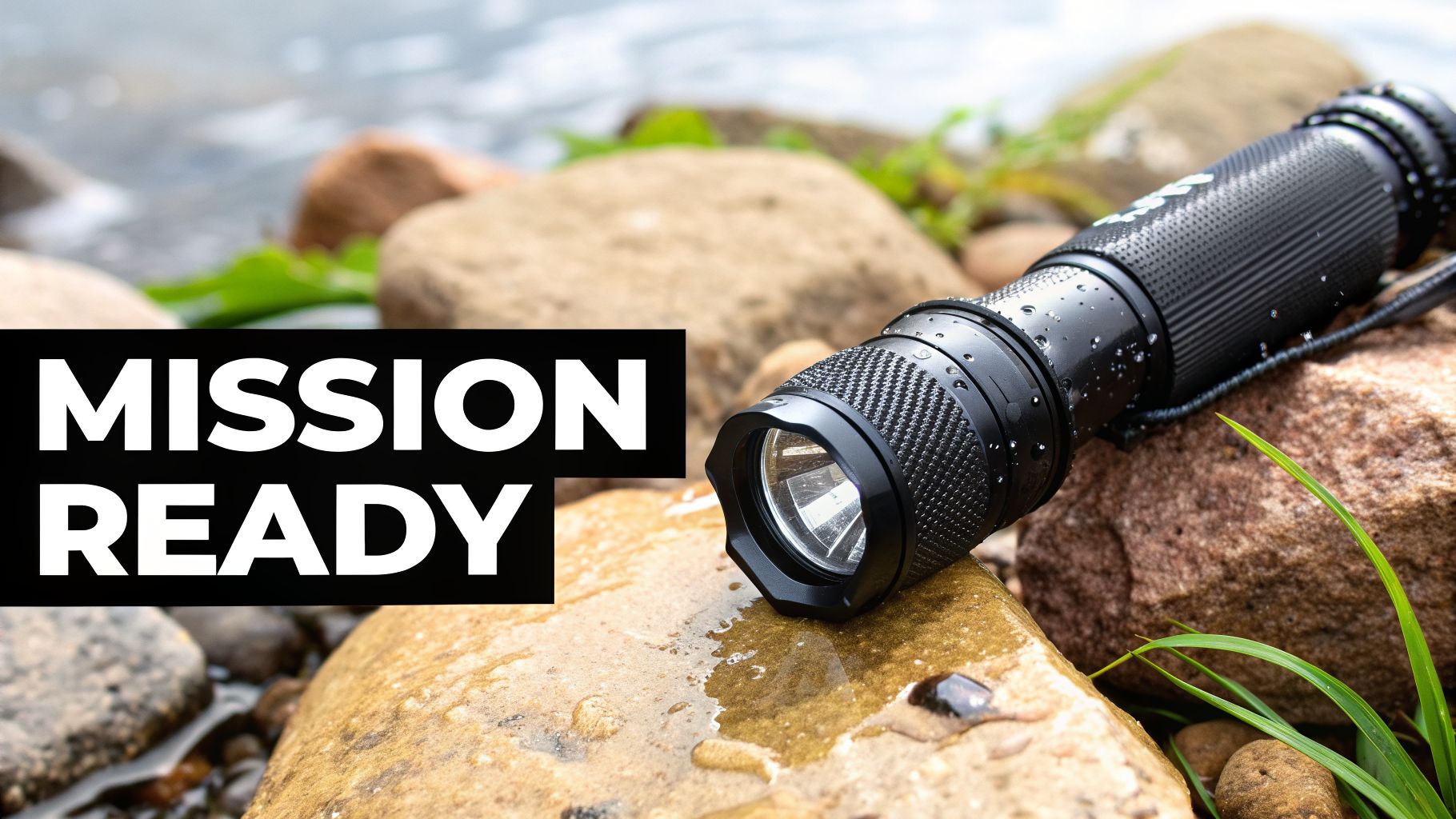
So, how do you know if a flashlight can handle the rough stuff? It all starts with its Ingress Protection (IP) rating. This simple two-digit code is an industry standard that tells you exactly how sealed the light is against dust and water.
- IPX7: This is a very common and reliable rating. It means your flashlight can survive being submerged in up to one meter of water for 30 minutes. So, dropping it in a puddle or getting caught in a downpour is nothing to worry about.
- IP68: This is the top tier for rugged electronics. The "6" confirms it's completely sealed against dust and grit, while the "8" signifies it can handle being continuously underwater, often deeper than one meter.
Of course, a good light needs to be tough on the outside, too. The best tactical flashlights are machined from anodized aluminum, a material known for its incredible resistance to scratches, impacts, and corrosion. An impact resistance rating, often given in meters, will also tell you how far it can fall onto a hard surface without breaking.
Simple Care for Long-Term Reliability
A tough build gets you halfway there, but keeping your gear in top shape is the other half of the equation. Even the most rugged flashlight needs a little attention to ensure it's ready to go when you are.
A flashlight is a tool, and like any good tool, it needs care. Spending two minutes on maintenance can be the very thing that keeps you from being left in the dark at a critical moment.
Keeping your light mission-ready is easy. Just follow these simple steps every so often:
- Check and Lube the O-Rings: Those little rubber rings are what create the waterproof seal. Wipe them clean of any dirt or grit and apply a tiny bit of silicone grease. This keeps them from drying out, cracking, and failing.
- Clean the Battery Contacts: Pop the tailcap off and check the metal contacts for any grime or corrosion. This is especially important if you've ever had a battery leak. A pencil eraser or a cotton swab with a dab of rubbing alcohol will clean them right up.
- Store It Smart: If you won't be using the flashlight for a while, take the batteries out. This simple step prevents surprise damage from a slow battery leak or the light getting turned on by accident in your pack.
This same mindset of proactive care applies to all of your professional equipment. If you want to dig deeper into what separates real-deal gear from the knockoffs, you can learn how to spot genuine tactical flashlights when buying online in our complete guide.
Common Questions About 100 Lumen Flashlights
Alright, we've covered the technical specs, but what does 100 lumens really mean when you're out in the field? This is where the rubber meets the road. Let's get straight into the practical questions that always come up when people are deciding if this is the right light for them.
Is 100 Lumens Enough for Self Defense?
When it comes to self-defense, think of a 100-lumen flashlight as a tool for situational awareness, not confrontation. Its real power is in helping you spot trouble before it starts.
Could it disorient someone? Sure, any bright light shined in the eyes can be jarring. But to truly blind an attacker and create that critical window to escape, you’re looking for a light in the 500-1000 lumen range. The 100-lumen beam excels at something different: it lets you check out a dark alley or a suspicious noise without the massive, high-intensity beam that screams, "I'm right here!" It's about seeing a threat without announcing your exact location.
Will 100 Lumens Damage My Night Vision Goggles?
This is a huge deal for anyone running night vision devices (NVDs). The good news is that a 100-lumen flashlight is much safer for your expensive gear. A direct, close-range blast might cause a temporary "bloom" or washout in your NVDs, but it's highly unlikely to cause the permanent tube damage you risk with a 1000+ lumen light.
In fact, this lower output is exactly why many operators keep one on hand for administrative tasks. It’s just enough light to read a map, check your gear, or fix a problem without completely destroying your night-adapted vision or frying your tubes. It allows for a much quicker and safer return to passive observation.
How Does a 100 Lumen Light Compare to My Phone?
Your phone’s flashlight is handy for finding keys you dropped, but that's about where its usefulness ends. A typical phone LED puts out maybe 40-50 lumens in a wide, undefined flood. It's all spill and no throw.
A dedicated 100-lumen flashlight is in a completely different league:
- Engineered Beam: It uses a specially designed reflector and lens. This creates a functional beam with a focused hotspot to see things at a distance and just enough spill to see what’s around your feet.
- Superior Durability: Most are built from aircraft-grade aluminum and are rated for water and impact resistance. Try dropping your smartphone on a rock and see what happens.
- Dedicated Power: It runs on its own batteries. You won’t drain your only line of communication just because you need to see in the dark.
Your phone is a jack-of-all-trades, but a dedicated flashlight is a master of one. When you need reliable, effective light in a tough situation, there is simply no substitute for a tool built for the job.
What Is Better: a 100 Lumen or a 500 Lumen Light?
The "better" light is the one that best fits the job you need it to do. It’s not about which is more powerful, but which is more practical for your specific mission.
A 100-lumen flashlight is the undisputed champion of runtime and sustained use. If you’re navigating a trail for hours, working on an engine, or setting up a campsite in the dark, its incredible endurance is exactly what you need. It provides plenty of usable light for a very long time without you having to worry about carrying a pocketful of spare batteries.
On the other hand, a 500-lumen light is more of a specialty tool. It's built for moments when you need a powerful burst of light to identify something far away or overwhelm a potential threat. For a versatile, reliable everyday carry (EDC) light that gives you a perfect balance of useful brightness and outstanding endurance, the 100-lumen model is often the smarter, more dependable choice.
At Superior Tactical LLC, we focus on providing gear that delivers mission-ready performance, from high-end optics to versatile lighting tools. Explore our curated selection of tactical flashlights and find the perfect balance of power and endurance for your needs at https://superiortac.com.
